Prelims: Coral Reefs, IUCN Red List of Ecosystems, Coral Bleaching, Ocean Acidification, Marine Biodiversity, INCOIS, Global Coral Reef Monitoring Network (GCRMN), International Coral Reef Initiative (ICRI).
Mains: GS Paper III: Environment and Ecology, Climate Change, Biodiversity Conservation, Environmental Governance, Coastal Ecosystems and Sustainable Development. |
Why in news?
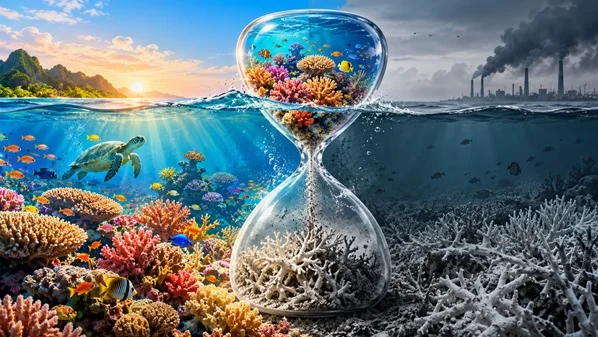
On 22 October 2026, the International Union for Conservation of Nature (IUCN) released a global assessment warning that virtually all assessed shallow-water coral reef ecosystems face a high risk of collapse over the coming decades.
Key Facts
|
Particular
|
Details
|
|
Assessment organisation
|
International Union for Conservation of Nature (IUCN)
|
|
Release date
|
22 October 2026
|
|
Assessment framework
|
IUCN Red List of Ecosystems
|
|
Ecosystems assessed
|
Shallow-water coral reef ecosystems
|
|
Geographic coverage
|
127 tropical and subtropical marine ecoregions
|
|
Reef area covered
|
Approximately 188,362 km²
|
|
Critically Endangered under projected climate impacts
|
96% of assessed ecosystems
|
|
Classification based on observed historical changes alone
|
24% of assessed ecosystems
|
|
Major threat
|
Climate change-induced heat stress
|
|
Climate scenario cited
|
Approximately 2.7°C warming by the end of the century under the assessment’s middle-of-the-road scenario
|
|
Major concern
|
Loss of coral reef structure, biodiversity and ecological functions
|
What are Coral Reefs?
- Underwater ecosystems built primarily by colonies of tiny marine animals called coral polyps.
- Many reef-building corals live in a symbiotic relationship with microscopic algae, commonly known as zooxanthellae.
- The algae provide much of the energy required by corals through photosynthesis, while the corals provide shelter and access to nutrients.
- Over time, corals deposit calcium carbonate, forming complex reef structures that provide habitats for fish, crustaceans, molluscs and numerous other marine organisms.
- Coral reefs are often called the “rainforests of the sea” because of their high biodiversity.
Why are Coral Reefs at risk of collapse by 2075?
- Rising Ocean Temperatures
- Corals survive within a suitable range of environmental conditions.
- Prolonged unusually high sea temperatures can disrupt their relationship with symbiotic algae.
- Corals may expel these algae, causing them to lose colour and turn white. This process is called coral bleaching.
- Severe or repeated bleaching can cause coral mortality and reduce the ability of reefs to recover.
- Ocean Acidification
- Oceans absorb a substantial amount of atmospheric carbon dioxide.
- When carbon dioxide dissolves in seawater, it changes ocean chemistry and lowers pH.
- This process reduces the availability of carbonate ions needed by many marine organisms to build calcium carbonate structures.
- Pollution and Declining Water Quality
- Untreated sewage, agricultural runoff, industrial discharges, plastics and sediment can damage coral reefs.
- Excess nutrients may encourage algal growth, while sediment can cover coral surfaces and interfere with feeding and growth.
- Poor water quality can weaken reefs and make recovery after bleaching more difficult.
- Overfishing and Destructive Fishing
- Overfishing can disturb reef food webs and reduce the populations of species that help maintain ecological balance.
- The removal of herbivorous fish may allow algae to spread across reef surfaces.
- Destructive fishing practices can directly damage coral structures and reduce biodiversity.
- Coastal Development and Tourism Pressure
- Dredging, construction, anchoring and poorly managed coastal development can physically damage reefs.
- Inadequate wastewater management and sediment runoff can increase environmental stress.
What does Ecosystem collapse mean?
- Occurs when an ecosystem loses the defining characteristics that allow it to function in its existing form.
- In coral reefs, this may involve widespread loss of reef-building corals, degradation of reef structures and changes in the communities dependent on them.
- As hard corals decline, algae, rubble and other organisms may increasingly dominate the habitat.
- Fish and invertebrates that depend on complex coral structures may lose food, shelter and breeding grounds.
Major Coral Reef Systems at Risk
- Great Barrier Reef, Australia: The world’s largest coral reef system and a major centre of marine biodiversity.
- Coral Triangle: A highly bio diverse marine region spanning parts of Southeast Asia and the western Pacific.
- Mesoamerican Barrier Reef System: A major reef system along parts of the Caribbean coast of Central America.
- Red Sea coral reefs: Important reef habitats supporting diverse marine life.
Impact on India’s Coral Reefs
- India has four principal coral reef regions Gulf of Mannar, Gulf of Kachchh, Lakshadweep Islands and Andaman and Nicobar Islands.
- These reefs support marine biodiversity, fisheries, tourism and coastal livelihoods.
Government Initiatives for Coral Reef Conservation in India
- Wildlife (Protection) Act, 1972
- The Ministry of Environment, Forest and Climate Change stated in a February 2026 parliamentary reply that coral species are listed under Schedule I of the Wildlife (Protection) Act, 1972.
- Coastal Regulation Zone Notification, 2019
- Issued under the Environment (Protection) Act, 1986.
- Includes provisions for the conservation and management of ecologically sensitive coastal areas, including coral reefs.
- Regulates activities that may damage fragile coastal ecosystems.
- National Coastal Mission
- Part of the National Coastal Management Programme.
- Coral reef development, management and restoration are among its identified activities.
- A project titled “Development of Corals and its Management” was sanctioned for implementation in Lakshadweep and the Andaman and Nicobar Islands by the National Centre for Sustainable Coastal Management (NCSCM), in collaboration with the Zoological Survey of India (ZSI), according to the Ministry’s February 2026 parliamentary reply.
- Coral Bleaching Alert System
- The Indian National Centre for Ocean Information Services (INCOIS), under the Ministry of Earth Sciences, provides coral bleaching alert services.
- It uses satellite data, buoys and oceanographic models to monitor sea-surface temperatures, marine heat waves and related ocean conditions.
- Coral Reef Monitoring and Restoration
- The Ministry of Earth Sciences has identified work by NCSCM, the Space Applications Centre of ISRO, the National Centre for Coastal Research and the Zoological Survey of India in this area.
- These activities help researchers assess reef health and identify conservation priorities.
Global Initiatives for Coral Reef Conservation
- International Coral Reef Initiative (ICRI)
- Promotes the conservation and sustainable use of coral reefs and related ecosystems.
- Encourages governments and other stakeholders to coordinate conservation action.
- Global Coral Reef Monitoring Network (GCRMN)
- Coordinates coral reef monitoring and publishes global assessments of reef status and trends.
- Provides evidence on changes in coral cover, bleaching and environmental pressures.
- IUCN Red List of Ecosystems
- Assesses the risk of ecosystem collapse rather than focusing only on individual species.
- The October 2026 assessment combines historical observations, current conditions and future climate projections to evaluate coral reef risks.
- Paris Agreement
- Provides an international framework for limiting global warming through national climate commitments and collective action.
- Reducing greenhouse gas emissions is essential to limiting Future Ocean warming and the associated risks to coral reefs.
Significance of Coral Reefs
- Marine biodiversity: Provide habitat, feeding grounds and breeding areas for a wide range of marine species.
- Coastal protection: Reef structures dissipate wave energy and can reduce coastal erosion and storm-wave impacts.
- Food security: Support fisheries and provide food and livelihoods to coastal communities.
- Economic importance: Support tourism, recreation, fishing and associated employment.
Challenges in Coral Reef Conservation
- Global climate change: Local conservation cannot fully offset prolonged ocean warming driven by global greenhouse gas emissions
- Limits of restoration: Coral nurseries and transplantation need time, funding and favourable environmental conditions.
- Coastal development: Infrastructure, shipping, tourism and fishing may damage reefs if poorly managed.
- Pollution: Sewage, agricultural runoff, plastics and sediment weaken coral ecosystems.
- Repeated bleaching: Frequent heat stress can leave insufficient time for reefs to recover between bleaching events.
Prelims MCQ
Q. Consider the following statements about coral reefs:
- Coral bleaching always kills corals.
- Ocean acidification affects coral skeleton formation.
- Lakshadweep has coral reefs.
Which are correct?
(a) 1 only
(b) 2 and 3 only
(c) 1 and 3 only
(d) 1, 2 and 3
Mains Practice Question
Q. How does climate change threaten coral reefs? Suggest.
|
FAQs
What did the IUCN report warn?
96% of assessed coral reef ecosystems face a Critically Endangered risk under projected climate impacts.
What is coral bleaching?
The loss of symbiotic algae that causes corals to turn white.
Which are India’s major coral reef regions?
Gulf of Mannar, Gulf of Kachchh, Lakshadweep, and Andaman and Nicobar Islands.
What is the main threat to coral reefs?
Climate change, particularly rising ocean temperatures.
Can bleached corals recover?
If conditions improve; repeated bleaching can prevent recovery.
|