Why in News?
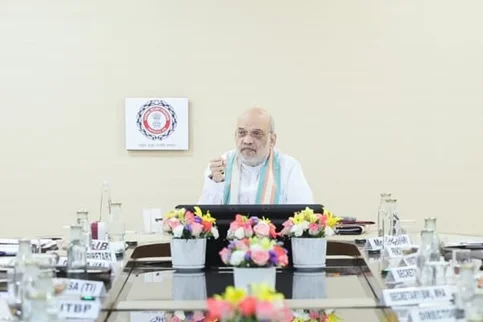
Union Home Minister Amit Shah has outlined a long-term roadmap for strengthening India’s internal security up to 2047, linking national security with the goal of Viksit Bharat 2047.
What Is Amit Shah’s 2047 Security Blueprint?
- Amit Shah’s 2047 security vision focuses on identifying and neutralising security threats before they turn into major crises.
- The strategy can be understood through five major pillars:
- Early threat detection
- Stronger border security
- Counter-terrorism and narcotics control
- Technology-driven intelligence
- Centre-state coordination
- The broader objective is to create a secure internal environment for India's economic and social development.
Why Is Internal Security Important for Viksit Bharat 2047?
- A developed India requires a stable and secure environment for investment, infrastructure, employment and economic growth.
- According to Shah, security agencies should not focus only on today's threats. They should assess the country's security environment 15–20 years ahead and prepare accordingly.
- Past challenges such as narcotics trafficking, Naxalism and unrest in the Northeast, he argued, could have been addressed more effectively through earlier anticipation and intervention.
India’s Major Internal Security Priorities
1. Stronger Border Security
- Border management is a major component of the 2047 security vision.
- Shah said the Centre had consulted states sharing India's land borders and developed a four-pillar border security framework.
- The objective is to strengthen coordination and tackle challenges such as:
- Illegal infiltration
- Cross-border crime
- Smuggling
- Narcotics trafficking
- Terror-related activities
2. Counter-Terrorism
- The government is focusing on dismantling terrorist networks rather than simply responding after an attack.
- Shah highlighted coordinated action against the Popular Front of India (PFI) following its ban as an example of cooperation between the Centre and states.
- He also called for the PRAHAR strategy to become part of regular security operations.
- The broader approach is:
- Identify → Track → Disrupt → Dismantle
3. Fight Against Narcotics
- Narcotics trafficking is being treated as an important internal security challenge.
- Shah called upon states to implement the Narcotics Control Vision Document 2026–2029 at the ground level.
- Its approach is based on:
- Detect → Disrupt → Destroy
- This means identifying drug networks, disrupting their supply chains and dismantling the wider trafficking ecosystem.
How Will AI Strengthen India’s Internal Security?
- Technology is becoming increasingly important for modern policing and intelligence gathering.
- Shah highlighted the integration of:
- CCTNS – Crime and Criminal Tracking Network & Systems
- ICJS – Interoperable Criminal Justice System
- NATGRID – National Intelligence Grid
- NAFIS – National Automated Fingerprint Identification System
- The integration of these systems can help agencies connect information from different sources.
- AI can help security agencies in:
- Analysing large datasets
- Identifying suspicious patterns
- Connecting information from multiple cases
- Supporting intelligence analysis
- Detecting potential threats
- The objective is to move towards data-driven and predictive policing.
Criminal Justice Reform: What Is the Government Target?
- Shah said the government is working towards the full implementation of the three new criminal laws within the next year.
- The stated objectives include:
- Faster investigation
- Faster trials
- Better use of technology
- Criminal cases reaching the Supreme Court level within three years
- A 25% increase in conviction rates
- These figures represent government targets, rather than guaranteed outcomes.
What Is the Role of Multi-Agency Centre?
- The Multi-Agency Centre (MAC) has been upgraded to strengthen intelligence sharing between different agencies.
- The idea is simple:
- More information sharing → Better analysis → Faster intelligence → Earlier action
- This can help agencies develop a broader picture of threats and coordinate their responses.
Action Against Economic Offenders and Fugitives
- Another important part of the security strategy is bringing economic offenders and fugitives back to India.
- According to Shah, around 274 fugitives were extradited or deported between 2019 and 2026.
- The government has emphasised stronger cooperation between Indian agencies and foreign governments to bring offenders hiding abroad within the reach of Indian law.
What Are India’s Emerging Security Threats?
- India's security challenges are no longer limited to conventional terrorism or border threats.
Future challenges may include:
|
Emerging Threat
|
Possible Impact
|
|
Cyber threats
|
Attacks on digital infrastructure
|
|
Online misinformation
|
Social disruption
|
|
Radicalisation
|
Internal security concerns
|
|
Narcotics trafficking
|
Organised crime and social harm
|
|
Energy insecurity
|
Economic vulnerability
|
|
Supply-chain disruption
|
Economic and strategic risks
|
|
Global instability
|
Geopolitical uncertainty
|
|
Illegal infiltration
|
Border and security concerns
|
- This changing threat environment makes continuous intelligence gathering and early intervention increasingly important.
Why Is Centre-State Coordination Important?
- In India, internal security requires cooperation between the Central Government, state governments, police forces, intelligence agencies and Central Armed Police Forces.
- Issues such as terrorism, organised crime, narcotics trafficking and infiltration often cross state and national boundaries.
- Therefore, effective information sharing and joint operations are essential for a coordinated security response.
What Is the Way Forward for India’s Internal Security?
- India needs to gradually move from a reactive model to a preventive and predictive security model.
- Key priorities should include:
- Early identification of threats
- Modern border surveillance
- Better Centre-state coordination
- AI and data-driven policing
- Integrated intelligence systems
- Stronger counter-terrorism operations
- Effective narcotics control
- Faster criminal justice delivery
- International cooperation against fugitives
- Preparedness for cyber and geopolitical threats
Amit Shah’s 2047 Security Vision in One Line
- The core idea is simple: identify threats early, use technology and intelligence to understand them, and take action before they become major security challenges.
Prelims Question
Q. With reference to India’s internal security, consider the following as emerging challenges:
- Cyber threats
- Narcotics trafficking
- Radicalisation
- Supply-chain disruptions
- Online misinformation
Which of the above are considered emerging internal security challenges?
-
1, 2 and 3 only
-
2, 3, 4 and 5 only
-
1, 2, 3, 4 and 5
-
1 and 5 only
Mains Question
Q. Analyse the role of intelligence sharing, technology and Centre-State coordination in strengthening India’s internal security.
|
FAQs
What is Amit Shah’s 2047 security blueprint?
It is a long-term approach to strengthen India's internal security by anticipating future threats and improving border management, counter-terrorism, narcotics control, intelligence sharing and technology-based policing.
What is the main objective of the 2047 security strategy?
The objective is to create a secure internal environment that supports India's economic development and the goal of Viksit Bharat 2047.
What is the Detect, Disrupt and Destroy strategy?
It is an approach to combating narcotics trafficking that focuses on identifying drug networks, disrupting their operations and dismantling them.
How will AI help India’s security agencies?
AI can help analyse large amounts of data, identify patterns and support intelligence agencies in detecting potential threats.
|






 Contact Us
  New Batch : 9555124124/ 7428085757
  Tech Support : 9555124124/ 7428085757