Prelims: (Art & Culture + CA)
Mains: (GS 1 – Indian Culture, Ancient History, Archaeology) |
Why in News ?
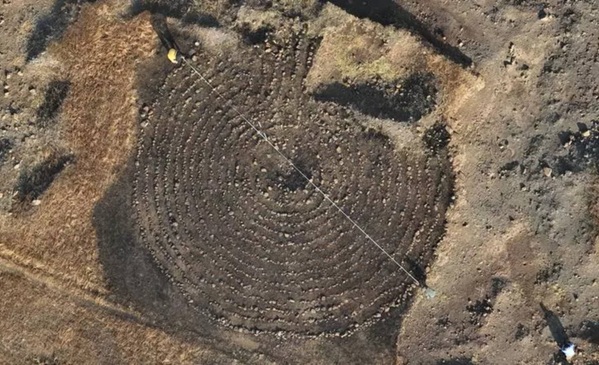
Archaeologists have discovered a large circular stone labyrinth in the Boramani grasslands of Solapur district, Maharashtra, identified as the largest circular stone labyrinth ever recorded in India.
The discovery has generated significant interest due to its unique design, exceptional scale, and its possible links to Indo-Roman trade networks during the Satavahana period.
Background & Context
India’s archaeological landscape continues to reveal evidence of cross-cultural interactions, particularly during the early historic period (circa 1st century BCE to 3rd century CE).
The Satavahana dynasty, which ruled large parts of the Deccan, played a pivotal role in facilitating maritime and overland trade with the Roman world, reflected in coinage, ports, and material culture.
Labyrinth motifs—though rare in India—are globally significant symbols, often associated with ritual movement, cosmology, and symbolic journeys, making the Solapur discovery archaeologically and culturally significant.
India’s Largest Circular Stone Labyrinth: Key Features
- Located in the Boramani grasslands, Solapur, Maharashtra
- Constructed using small, carefully arranged stone blocks
- Comprises multiple concentric circular rings
- Rings guide movement inward towards a tightly coiled spiral at the centre
- The layout reflects:
- High geometric precision
- Strong symbolic intent
Archaeological Significance
- Soil accumulation between stone rings indicates the structure has remained undisturbed for several centuries
- Represents a rare physical labyrinth structure, unlike common rock carvings
- The number of circular circuits exceeds all previously known circular labyrinths in India
- Earlier largest circular labyrinth in India had 11 circuits; the Solapur example surpasses this
Cultural and Symbolic Influences
Indo-Roman Linkages
- Design similarities with classical Mediterranean labyrinths
- Comparable motifs found on Roman-era coins and mosaics
- Suggests cultural diffusion through Indo-Roman trade networks during the Satavahana period
Indigenous Symbolism
- Central spiral resembles the Chakravyūha
- Chakravyūha:
- A complex military formation described in the Mahabharata
- Symbolises layered defence and strategic entrapment
- Indicates indigenisation of foreign motifs into local symbolic frameworks
Comparison with Other Indian Labyrinths
- Largest square labyrinth in India:
- Located at Gedimedu, Tamil Nadu
- Solapur site:
- Largest circular stone labyrinth in India
- Unprecedented in terms of circular complexity and scale
Mazes vs. Labyrinths: Conceptual Difference
Though often used interchangeably, they are structurally and conceptually distinct
Mazes
- Multicursal
- Multiple paths and decision points
- Designed as puzzles
- Often bounded by walls
Labyrinths
- Unicursal (single path)
- No dead ends or wrong turns
- Path winds through concentric circuits to a central point
- Open design without walls
- Emphasises journey rather than choice
Global Historical Context of Labyrinths
- Labyrinth designs date back over 4,000 years
- Found in:
- Roman mosaics
- Caves and cliffs
- Tombs
- Medieval European churches
- Turf-cut landscapes
- The Solapur discovery adds India to the global archaeological map of large-scale labyrinth structures
FAQs
Q1. Where was India’s largest circular stone labyrinth discovered ?
In the Boramani grasslands of Solapur district, Maharashtra.
Q2. Which historical period is the labyrinth linked to ?
It is associated with the Satavahana dynasty period.
Q3. What is the Chakravyūha ?
A complex circular military formation described in the Mahabharata.
Q4. How is a labyrinth different from a maze ?
A labyrinth has a single winding path, while a maze has multiple paths and dead ends.
Q5. Why is this discovery significant ?
It represents the largest circular stone labyrinth in India and highlights Indo-Roman cultural interactions.
|







 Contact Us
  New Batch : 9555124124/ 7428085757
  Tech Support : 9555124124/ 7428085757