Why in news?
Andhra Pradesh observes its Formation Day on 1 November, commemorating the creation of the state in 1956 through the merger of Andhra State with the Telugu-speaking areas of the erstwhile Hyderabad State.
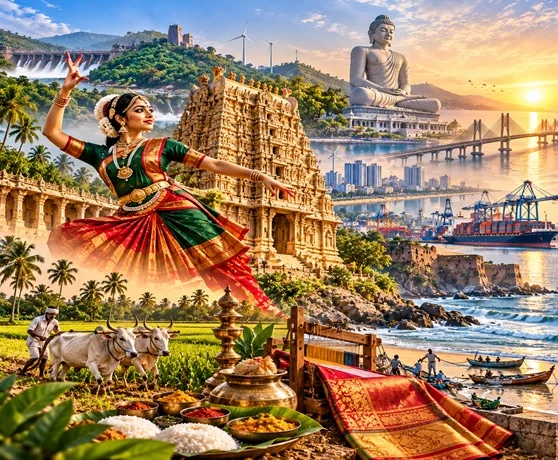
Key Facts
|
Particular
|
Details
|
|
Formation of Andhra State
|
1 October 1953
|
|
Formation of Andhra Pradesh
|
1 November 1956
|
|
Formation legislation
|
Andhra State Act,1953 & States Reorganisation Act, 1956
|
|
First Chief Minister of Andhra State
|
Tanguturi Prakasam Pantulu
|
|
First Chief Minister of Andhra Pradesh
|
Neelam Sanjiva Reddy
|
|
Capital region
|
Amaravati
|
|
Major language
|
Telugu
|
|
Classical dance
|
Kuchipudi
|
|
Major rivers
|
Godavari and Krishna
|
|
Bifurcation
|
2 June 2014
|
|
New state created
|
Telangana
|
|
Bifurcation legislation
|
Andhra Pradesh Reorganisation Act, 2014
|
Historical Background
- Telugu-speaking regions before independence
- Before independence, a significant part of the Telugu-speaking population lived in the Madras Presidency, while other Telugu-speaking areas were part of the princely Hyderabad State.
- The Telugu-speaking population increasingly demanded a separate administrative unit to protect its language, literature and cultural identity. The demand gained momentum after independence.
- Potti Sriramulu and the Andhra Movement
- One of the most important personalities associated with the movement was Potti Sriramulu.
- He was an Indian freedom fighter and social reformer who undertook a fast-unto-death demanding a separate state for Telugu-speaking people.
- His fast began on 19 October 1952. After 58 days of fasting, he died on 15 December 1952. His death triggered widespread protests and public demonstrations across Telugu-speaking regions.
- The movement created enormous political pressure on the Government of India to consider the demand for a separate Andhra State.
- Formation of Andhra State: 1 October 1953
- Following the movement, the Government of India accepted the demand for a separate Telugu-speaking state.
- The Andhra State Act, 1953, provided the legal framework for its establishment. On 1 October 1953, Andhra State was formed by separating Telugu-speaking areas from the erstwhile Madras State.
- Andhra became the first state formed on a linguistic basis after India's independence. Kurnool became its capital. Tanguturi Prakasam Pantulu became its first Chief Minister.
States Reorganisation Commission and Formation of Andhra Pradesh
- The formation of Andhra State increased demands for the reorganisation of other Indian territories on linguistic lines.
- In December 1953, the Government of India established the States Reorganisation Commission.
- It was chaired by Fazl Ali, with K.M. Panikkar and H.N. Kunzru as members.
- The commission examined linguistic, administrative, geographical, economic and national considerations.
Formation of Andhra Pradesh in 1956
- The States Reorganisation Act, 1956, provided the legal framework for reorganising India's states.
- On 1 November 1956, Andhra State was merged with the Telugu-speaking Telangana region of the erstwhile Hyderabad State. The new state was named Andhra Pradesh. Hyderabad became its capital.
- Neelam Sanjiva Reddy became the first Chief Minister of the newly formed Andhra Pradesh.
The Telangana Movement and Bifurcation of Andhra Pradesh
- The formation of Andhra Pradesh in 1956 did not end regional political aspirations.
- Over the following decades, demands for a separate Telangana state gained momentum.
- The movement was influenced by concerns relating to regional economic development, employment opportunities, political representation, irrigation and water-resource allocation, public expenditure and administrative priorities and regional identity and cultural aspirations.
The creation of Telangana in 2014
- After years of political mobilisation and negotiations, Parliament passed the Andhra Pradesh Reorganisation Act, 2014.
- The Act provided for the bifurcation of Andhra Pradesh.
- On 2 June 2014, Telangana became a separate state. It became the 29th state of India at that time.
- Following bifurcation; Andhra Pradesh continued as a separate state. Telangana became a separate state with Hyderabad as its capital.
- Hyderabad was designated as the common capital for Andhra Pradesh and Telangana for a period not exceeding ten years under the Act .
Constitutional and Legislative Framework
- Article 3 empowers Parliament to form new states and alter the area, boundaries or names of existing states.
|
Legislation
|
Year
|
Significance
|
|
Andhra State Act
|
1953
|
Established Andhra State
|
|
States Reorganisation Act
|
1956
|
Created Andhra Pradesh by merging Andhra State with Telangana region
|
|
Andhra Pradesh Reorganisation Act
|
2014
|
Provided for the creation of Telangana
|
Geographical Significance
- Andhra Pradesh is located on India's southeastern coast, along the Bay of Bengal.
- It has an extensive coastline, fertile river deltas, agricultural plains and parts of the Eastern Ghats.
|
Feature
|
Details
|
|
Location
|
Southeastern India
|
|
Capital
|
Amaravati (state's capital region)
|
|
Coastline
|
Along the Bay of Bengal
|
|
Major rivers
|
Godavari, Krishna and Penna
|
|
Mountain system
|
Eastern Ghats
|
|
Important natural region
|
Araku Valley
|
|
Major agricultural areas
|
Krishna-Godavari delta
|
Godavari and Krishna river systems
- The Godavari and Krishna rivers are central to Andhra Pradesh's agriculture and water-resource management.
- Their extensive delta regions support rice cultivation and other agricultural activities.
- The rivers also play an important role in irrigation, drinking-water supply and hydropower development.
Cultural and Historical Heritage
- Kuchipudi: Kuchipudi is one of India's recognised classical dance forms and originated in Andhra Pradesh. It combines dance, music, expressive gestures and dramatic storytelling.
- Amaravati Buddhist Heritage: Amaravati is historically associated with an important Buddhist centre. The Amaravati Stupa and its sculptural traditions represent significant developments in ancient Indian Buddhist art.
- Tirupati: The Sri Venkateswara Temple at Tirumala is among India's most prominent pilgrimage destinations.
- Lepakshi: Lepakshi is famous for its Vijayanagara-era temple architecture, murals and the celebrated hanging pillar of the Veerabhadra Temple.
- Telugu Literature: Telugu has a rich literary tradition, with important contributions from poets such as Nannaya, Tikkana and Yerrapragada, collectively associated with the Telugu Mahabharata tradition.
Economic Significance
- Agriculture: Major agricultural products include Rice,Chilli, Tobacco, Cotton, Sugarcane and Horticultural crops. The Krishna and Godavari delta regions are particularly important for agricultural production.
- Fisheries and aquaculture: Andhra Pradesh is an important centre for fisheries and aquaculture. Its long coastline, inland water resources and aquaculture infrastructure contribute to seafood production and exports.
- Ports and industrial development: Visakhapatnam is an important port city and industrial centre. The state's coastline offers significant opportunities for maritime trade, logistics, fisheries and industrial development.
Prelims MCQs
Q. Which of the following states was the first to be formed on a linguistic basis in independent India?
(a) Andhra State
(b) Kerala
(c) Karnataka
(d) Maharashtra
Mains Practice Question
Q. The formation of Andhra Pradesh in 1956 marked an important phase in India's linguistic reorganisation. Discuss.
|
FAQs
When is Andhra Pradesh Formation Day celebrated?
1 November.
When was Andhra State established?
1 October 1953.
Who was the first Chief Minister of Andhra State?
Tanguturi Prakasam Pantulu.
Who was the first Chief Minister of Andhra Pradesh after its formation in 1956?
Neelam Sanjiva Reddy.
Which state was created from Andhra Pradesh in 2014?
Telangana.
|