Prelims: Environment & Ecology | Biodiversity | Conservation | Artificial Intelligence | Protected Areas
Mains: GS Paper III – Environment & Biodiversity | Science & Technology | Conservation of Wildlife | AI Applications in Governance |
Why Is This in the News
- Maharashtra has announced India's first proposed AI-enabled bird conservation project at Thane Creek Flamingo Sanctuary (a Ramsar site).
- The sanctuary will leverage cutting-edge technologies such as AI-based surveillance, smart cameras, drones, acoustic sensors, and real-time biodiversity monitoring to improve bird conservation, habitat management, and eco-tourism.
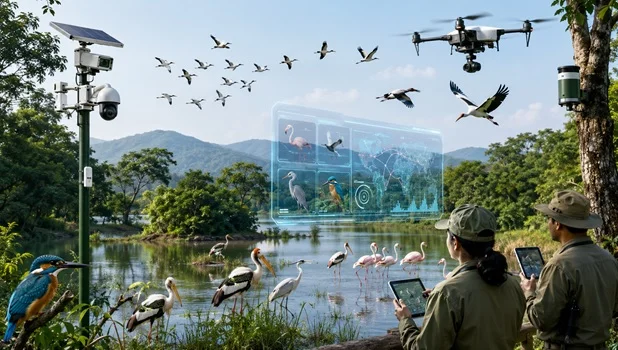
What Is an AI-Powered Bird Sanctuary?
- A regular bird sanctuary is a protected area where birds are safe from hunting and habitat destruction, and where forest officials and volunteers usually track species by manual observation and record-keeping.
- An AI-powered bird sanctuary adds digital technology to this process. Cameras, sensors, and software work together to detect birds automatically, identify their species, and record data about their numbers and movement, without needing a human observer to be present at all times.
What Technology Will Be Used
- According to the project plan, the facility will use AI-based bird tracking and identification systems covering a 1.5-kilometre radius. The system is designed to provide automated, real-time detection and identification of bird species within this zone.
- It will include centralised data management, live synchronisation of information, and digital analytics to help both researchers and visitors. The technology will also systematically record species presence and biodiversity trends over time, creating a long-term digital record of the creek's birdlife.
What Infrastructure Is Planned
-
Besides the AI systems, the project includes several visitor and conservation facilities. These include a 2.16-kilometre mangrove nature trail, multi-storey observation towers, viewing decks, a nature interpretation centre, a lecture hall, a butterfly garden, and a boat jetty, along with off-site parking so that vehicle traffic does not disturb the core habitat.
Why is this Initiative Important?
- Conservation of Migratory Birds: India hosts hundreds of migratory bird species under the Central Asian Flyway. AI helps monitor arrival timings, population trends, habitat changes, and migration routes.
- Better Biodiversity Monitoring: Traditional surveys are periodic. AI provides 24×7 monitoring, continuous data collection, greater accuracy, and faster decision-making.
- Prevention of Wildlife Crimes: AI can detect human intrusion, illegal hunting, forest fires, and habitat destruction. This allows quicker response from forest officials.
- Scientific Research: Researchers receive large datasets, species-wise distribution, behavioural changes, and climate impact analysis.
- Promoting Eco-Tourism: Visitors may benefit from smart interpretation centres, AI-guided bird identification, digital information systems, and interactive educational displays.
Importance for India
- Supports Biodiversity Conservation: India is one of the 17 megadiverse countries and hosts nearly 1,300 bird species. Technology-based conservation strengthens efforts to protect this rich avian diversity.
- Helps Achieve Sustainable Development Goals (SDGs): The project contributes to SDG 9 – Industry, Innovation & Infrastructure, SDG 13 – Climate Action, and SDG 15 – Life on Land.
Challenges
- High Initial Cost: Deployment of AI infrastructure requires significant investment.
- Data Management: Large volumes of ecological data require secure storage and analysis.
- Skilled Workforce: Experts in AI, ecology, GIS, and wildlife biology are needed.
- Cybersecurity: Protection of wildlife databases and monitoring systems is essential.
- Technology Maintenance: Sensors and cameras require regular upkeep in harsh environmental conditions.
Government Initiatives Supporting Wildlife Conservation
- Digital India Mission
- National Action Plan on Climate Change (NAPCC)
- Wildlife (Protection) Act, 1972
- National Biodiversity Action Plan
- Wetlands (Conservation and Management) Rules, 2017
- Central Asian Flyway Action Plan
- National Mission on Biodiversity and Human Well-being
Way Forward
The AI-powered bird sanctuary represents the future of conservation in India. Combining Artificial Intelligence, ecological science, and community participation can significantly improve biodiversity protection while promoting sustainable tourism and scientific research.
Prelims MCQ
Q. With reference to India's first AI-powered bird sanctuary, consider the following statements:
- It is being established in Maharashtra.
- The sanctuary will use Artificial Intelligence for monitoring bird populations and habitats.
- AI-based acoustic sensors can identify bird species using their vocal calls.
Which of the statements given above is/are correct?
(A) 1 and 2 only
(B) 2 and 3 only
(C) 1 and 3 only
(D) 1, 2 and 3
Mains Practice Question
Q. "Artificial Intelligence is emerging as a transformative tool for biodiversity conservation in India." Discuss the significance of AI-powered protected areas with reference to India's first AI-powered bird sanctuary in Maharashtra.
|
FAQs
Why the sanctuary is called AI-powered?
Because it uses Artificial Intelligence, drones, smart cameras, and sensors for wildlife monitoring and habitat management.
What is acoustic monitoring?
It is the use of sound-recording sensors to identify bird species through their vocalizations.
How does AI help bird conservation?
AI enables real-time monitoring, species identification, migration tracking, habitat assessment, and detection of illegal activities.
What is biodiversity monitoring?
It is the continuous observation and assessment of plant and animal species, their populations, and ecosystems to support conservation efforts.
How do drones help in bird conservation?
Drones provide aerial surveillance to monitor nesting sites, wetlands, habitat changes, and illegal human activities without disturbing wildlife.
|






 Contact Us
  New Batch : 9555124124/ 7428085757
  Tech Support : 9555124124/ 7428085757