Prelims: Chapar thermal power project; Dhubri district; ultra-supercritical technology; pumped storage.
Mains: GS II—development and displacement; GS III—energy infrastructure, investment, environmental pollution and sustainable development.
Keywords: Ultra-supercritical technology, Pumped storage, Commissioning, Emissions intensity, Rehabilitation |
Why in News?
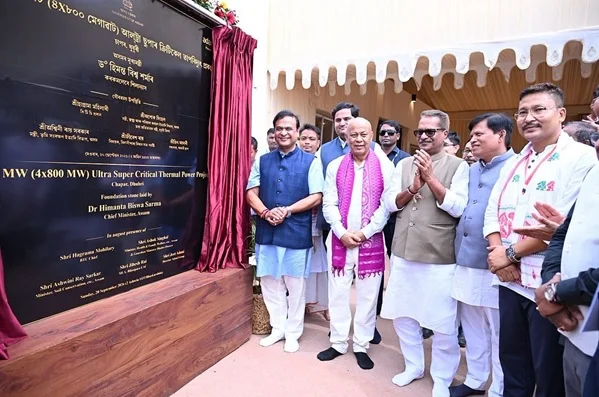
- Assam Chief Minister Himanta Biswa Sarma laid the foundation stone for Adani Power Limited’s 3,200 MW Ultra-Supercritical Thermal Power Plant at Chapar in Dhubri district.
- The ₹48,000-crore project is projected to become Northeast India’s largest power plant upon completion. Commissioning is planned in phases from December 2030.
Background
- The project emerged from investment commitments associated with the Advantage Assam Investor Summit 2.0. Adani Power received a letter of award from the Assam Power Distribution Company Limited in November 2025.
- The government initially considered Parbatjhora in adjoining Kokrajhar district. However, the former Pramod Boro-led Bodoland Territorial Council government declined to acquire private or tribal land for the project. The State subsequently selected Chapar.
- The report links the selected site to an eviction drive in July 2025, during which violence occurred. This makes rehabilitation and community participation important aspects of the project’s implementation.
Key Points
|
Parameter
|
Details
|
|
Location
|
Chapar, Dhubri district, Assam
|
|
Developer
|
Adani Power Limited
|
|
Proposed capacity
|
3,200 MW
|
|
Unit configuration
|
Four units of 800 MW each
|
|
Announced investment
|
₹48,000 crore
|
|
Technology
|
Ultra-supercritical thermal generation
|
|
Commissioning schedule
|
In phases from December 2030
|
|
Wider power investment
|
₹63,000 crore, including this thermal plant and two pumped storage projects
|
|
Pumped storage component
|
₹15,000 crore with a combined capacity of 2,700 MW
|
The thermal plant’s 3,200 MW capacity and the pumped storage projects’ 2,700 MW capacity serve different functions. Pumped storage stores energy for later use and should not be treated as an equivalent addition to primary electricity generation.
What Is Ultra-Supercritical Technology?
- Ultra-supercritical thermal plants use steam at very high temperatures and pressures to drive turbines. Higher operating efficiency allows them to consume less fuel per unit of electricity than conventional subcritical plants.
- However, higher efficiency does not eliminate carbon dioxide emissions, air pollutants, ash generation or cooling-water requirements. Environmental performance also depends on fuel quality, pollution-control equipment and operating practices.
What Is Pumped Storage?
- Pumped storage uses electricity to move water from a lower reservoir to a higher one. When electricity is needed, water flows back through turbines to generate power.
- It supports grid balancing and renewable-energy integration, although pumping and generation involve energy losses.
Significance
- Electricity reliability: The proposed plant could strengthen power availability for households, businesses and industries.
- Industrial development: More dependable electricity could support manufacturing, processing and other power-dependent economic activities.
- Employment and local enterprise: Construction and operations are expected to generate jobs and opportunities for contractors, suppliers and service providers. Actual local benefits will depend on recruitment and procurement practices.
- State economy: The Assam government anticipates wider economic activity and additional SGST revenues.
- Regional infrastructure: The investment could expand the Northeast’s electricity infrastructure, provided transmission and distribution capacity develop alongside generation.
Relevance for India
- The project illustrates India’s challenge of meeting growing electricity demand while managing the environmental costs of coal-based generation.
- It also shows why generation capacity, energy storage and grid infrastructure must be planned together. Thermal generation can provide controllable power, while pumped storage can shift electricity availability across hours and support variable renewable sources.
- For regional development, the key question is how far large investments translate into reliable electricity, affordable supply and lasting opportunities for local communities.
Challenges
1. Displacement and Rehabilitation
The supplied report states that the site involved clearance of alleged encroachments from more than 3,500 bighas, approximately 1,157 acres, affecting around 2,500 families, mostly described as migrant Muslims. Some families reportedly received ₹50,000 each.
These are reported figures; they do not establish that every affected household received compensation or adequate rehabilitation. Housing, livelihoods, access to services and grievance resolution require attention.
2. Environmental Impacts
Coal-based generation creates concerns over greenhouse-gas emissions, air quality, ash disposal and water use. Technology upgrades can reduce emissions intensity but do not remove these impacts.
3. Fuel and Transport Requirements
A plant of this scale requires dependable fuel supply and transport infrastructure. Disruptions or higher fuel and logistics costs could affect generation costs.
4. Delivery and Grid Readiness
The commissioning schedule depends on construction progress, equipment delivery, approvals and supporting infrastructure. Transmission capacity must be ready to carry the electricity generated.
5. Affordability
The stated objective of affordable power is an expected outcome, not an established tariff result. Actual costs will depend on financing, fuel, plant utilisation and power-purchase arrangements.
Way Forward
- Provide transparent information on affected households, compensation and rehabilitation outcomes.
- Combine financial assistance with housing support, livelihood restoration and accessible grievance mechanisms.
- Monitor emissions, water use and ash management, with public disclosure of environmental performance.
- Coordinate plant construction with fuel logistics and transmission development.
- Promote local skills training and transparent opportunities for local suppliers.
- Assess long-term electricity demand, tariffs and the role of renewable energy and storage.
Prelims MCQs
Q. Consider the following statements about ultra-supercritical thermal power technology:
- It uses steam at high temperatures and pressures to improve efficiency.
- It eliminates carbon dioxide emissions from coal combustion.
- It can reduce fuel consumption per unit of electricity compared with conventional subcritical technology.
Which of the statements given above are correct?
(a) 1 and 2 only
(b) 2 and 3 only
(c) 1 and 3 only
(d) 1, 2 and 3
Mains Practice Question
“Large energy projects must balance electricity security with environmental sustainability and social justice.” Discuss with reference to Assam’s proposed Chapar thermal power project. (250 words)
|
FAQs
1. What is the Chapar thermal power project?
It is Adani Power Limited’s proposed 3,200 MW ultra-supercritical thermal power plant at Chapar in Assam’s Dhubri district.
2. What is its estimated investment and unit configuration?
The announced investment is ₹48,000 crore, and the plant will comprise four units of 800 MW each.
3. When is the project expected to begin operations?
Commissioning is planned in phases from December 2030. This does not mean that all four units will necessarily begin operating together.
4. Why is ultra-supercritical technology significant?
It improves thermal efficiency and can reduce fuel consumption per unit of electricity compared with conventional subcritical technology. It does not make coal-based power emission-free.
5. What are the main concerns surrounding the project?
Key concerns include rehabilitation of displaced families, pollution, water use, ash management, fuel logistics, timely completion and electricity affordability.
|






 Contact Us
  New Batch : 9555124124/ 7428085757
  Tech Support : 9555124124/ 7428085757