Prelims: AssamSAT, Earth Observation Satellites, LEO, IN-SPACe, ISRO, ASSAC, Private Space Sector
Mains: GS Paper II: E-Governance and Government Policies
GS Paper III: Science & Technology, Space Technology, Disaster Management, Agriculture, Internal Security |
Why in News?
Assam is moving ahead with AssamSAT, its proposed dedicated Earth-observation satellite system, with the process of selecting a private-sector implementation partner reaching an advanced stage.
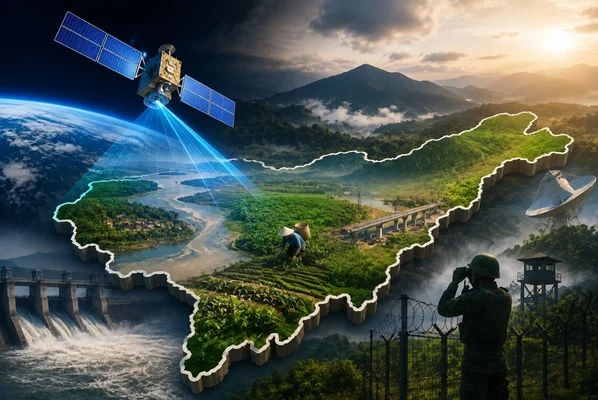
What is AssamSAT?
- AssamSAT is Assam's proposed dedicated satellite programme aimed at ensuring a continuous and reliable flow of Earth-observation data for the state's governance and development needs. The project was originally announced in the Assam Budget 2025–26.
- The Budget proposed AssamSAT in collaboration with IN-SPACe, under the Department of Space, Government of India, for applications including agriculture, disaster management, infrastructure development, border management and security and police operations.
- The government also proposed involving students from Assam's colleges in building experimental satellites with support from IN-SPACe/ISRO.
Who is Implementing AssamSAT?
- The procurement process is being handled by the Assam State Space Application Centre (ASSAC) which functions under Assam's Department of Science, Technology and Climate Change.
- The official Expression of Interest (EOI) for the establishment of AssamSAT was published on 16 March 2026. The final bid-submission deadline shown on the official procurement page was 28 May 2026.
Why Does Assam Need Its Own Satellite System?
- Flood Management: Assam is highly vulnerable to recurring floods, particularly in the Brahmaputra and Barak river systems. Satellite observations can help authorities monitor:
Flood Extent → River Changes → Inundated Villages → Damaged Infrastructure → Agricultural Loss
- Disaster Management: Apart from floods, Assam faces riverbank erosion, landslides, severe storms, earthquake risk and forest fires and other environmental hazards. Earth-observation data can support early assessment, emergency response and post-disaster damage mapping.
- Agriculture: Agriculture remains crucial to Assam's economy and rural livelihoods. Satellite data can potentially support crop-area mapping, crop-health monitoring, flood damage assessment, soil-moisture analysis, irrigation planning and agricultural forecasting.
- Infrastructure Development: Earth-observation imagery can assist governments in monitoring large infrastructure projects. Potential applications include:
Roads + Bridges + Urban Expansion + Rail Connectivity + Land-Use Changes + Public Infrastructure
Repeated satellite observations can also help authorities compare actual progress with approved project plans.
- Border and Security Management: Assam has international borders with Bangladesh and Bhutan and is strategically important to India's Northeast. The Assam Budget specifically mentioned security, border management and police operations as proposed areas where AssamSAT data could be used.
- Environmental Monitoring: Assam is ecologically sensitive and contains forests, wetlands, river systems and biodiversity-rich areas. Satellite imagery can assist with forest-cover monitoring, wetland mapping, river morphology, encroachment detection, land-use changes and environmental degradation.
Why Not Simply Use Existing Satellite Data?
India already has extensive Earth-observation capabilities through ISRO satellites. However, Assam's stated objective is to ensure a continuous and reliable flow of data specifically for critical state-level socio-economic projects.
What is the DBLOTT Model?
An important feature reported for AssamSAT is the DBLOTT model:
- D: Design
- B: Build
- L: Launch
- O: Operate
- T: Train
- T: Transfer
Under this model, the selected private-sector partner would undertake the major technical responsibilities required to establish the satellite system. It would also train Assam government personnel and eventually transfer operational capability to the state.
Why is DBLOTT Important?
The model aims to create:
Satellite System + Human Resources + Technical Knowledge + Operational Capability
Therefore, AssamSAT can potentially contribute to technology transfer and institutional capacity building within the state.
Which Companies Are in the Race?
- According to the available procurement reporting, 13 bidders participated in the AssamSAT process. The reported bidders include major established defence/space companies as well as Indian NewSpace startups.
- Among the reported names are:
- Agnikul Cosmos Private Limited
- Ananth Technologies Pvt. Ltd.
- Azista Industries Pvt. Ltd.
- Bharat Electronics Limited (BEL)
- Bharat Space Private Limited
- Data Patterns (India) Limited
- Dhruva Space Private Limited
- GalaxEye Space Solutions Pvt. Ltd.
- Garuda Aerospace Private Limited
- SatLeo Labs Pvt. Ltd.
- SpacePixxel Technologies Private Limited
- Tata Advanced Systems Limited
- XDLINX Space Labs Private Limited
What is IN-SPACe?
- IN-SPACe stands for Indian National Space Promotion and Authorisation Centre. It is an autonomous agency under the Department of Space. It acts as an interface between the government and Non-Government Entities (NGEs) participating in India's space sector.
- For AssamSAT, the original Assam Budget announcement specifically envisaged collaboration with IN-SPACe.
AssamSAT and India's Space-Sector Reforms
- AssamSAT should be viewed within the larger transformation of India's space ecosystem. Earlier, India's space activities were overwhelmingly centred on government agencies, particularly ISRO.
- Recent reforms have opened the sector to private companies in areas such as:
Satellite Manufacturing → Launch Services → Earth Observation → Space Data → Ground Systems → Space Applications
- AssamSAT illustrates another dimension of this transition: State Government + Central Space Institutions + Private Space Companies
Role of India's Private Space Sector
- The diversity of companies participating in the AssamSAT procurement is significant. It indicates that India's space ecosystem is expanding beyond traditional large defence and aerospace companies to include specialised NewSpace startups.
- The project could therefore provide an important test case for whether private-sector capabilities can deliver a complete satellite programme for a state government.
Student Participation and Capacity Building
- The state proposed working with IN-SPACe/ISRO to involve college students in building experimental satellites. This could promote STEM education, satellite engineering skills, space entrepreneurship, research culture, innovation and skilled human resources in Northeast India.
Significance of AssamSAT
- Technology-Based Governance: Satellite observations can provide governments with objective and frequently updated information for policymaking.
- Better Disaster Preparedness: Dedicated Earth-observation capabilities could improve flood, erosion and disaster assessment.
- Precision Agriculture: Satellite data can support more targeted agricultural planning and crop monitoring.
- Infrastructure Monitoring: Remote sensing can help track large infrastructure and development projects.
- Strengthening Northeast India's Technology Ecosystem: AssamSAT could help build technical skills and space-sector capabilities within Northeast India.
- Boost to Indian NewSpace: Participation by private companies creates new opportunities for India's growing commercial space industry.
Major Challenges
- High Cost: Designing, launching and maintaining satellites requires substantial financial resources.
- Technical Complexity: Satellite manufacturing, launch integration, ground systems and data processing require specialised expertise.
- Data Management: Collecting satellite imagery is useful only when departments can rapidly process and convert it into actionable information.
- Skilled Manpower: Assam will need trained personnel to operate and utilise the system effectively after capability transfer.
- Space Debris: Any new satellite system must comply with orbital-sustainability and debris-mitigation requirements.
- Cybersecurity: Satellite command systems and Earth-observation data can have strategic significance and require strong cybersecurity.
- Coordination: Agriculture, disaster management, police, infrastructure and environmental agencies will need effective data-sharing mechanisms.
Prelims MCQ
Q. With reference to AssamSAT, consider the following statements:
- It is intended for Earth-observation applications.
- ASSAC is involved in its procurement process.
- IN-SPACe functions under the Department of Space.
Which of the statements given above are correct?
A. 1 and 2 only
B. 2 and 3 only
C. 1 and 3 only
D. 1, 2 and 3
Mains Practice Questions
Q. Discuss the significance of the DBLOTT model in developing indigenous institutional capabilities.
|
FAQs
What is AssamSAT?
AssamSAT is Assam’s proposed Earth-observation satellite system for state-level applications.
What is the main purpose of AssamSAT?
It will support agriculture, disaster management, infrastructure, border management and security.
Which agency is handling the AssamSAT project?
The Assam State Space Application Centre (ASSAC) is handling the procurement process.
What is the role of IN-SPACe in AssamSAT?
The project envisages collaboration with IN-SPACe for developing Assam’s space capabilities.
How can AssamSAT help in flood management?
Satellite data can help map flood extent, river changes and affected areas.
|






 Contact Us
  New Batch : 9555124124/ 7428085757
  Tech Support : 9555124124/ 7428085757