Prelims: (International Relations + CA)
Mains: (GS 2 – International Relations, Governance; GS 3 – Security) |
Why in News ?
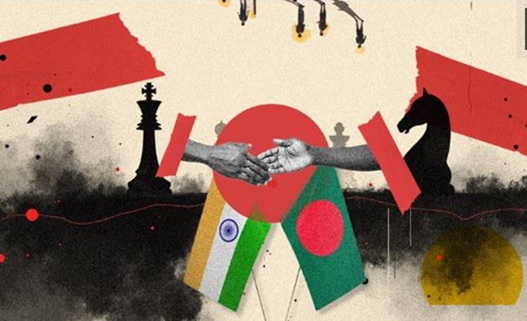
Bangladesh is witnessing widespread political unrest, violence, and institutional disruption amid the return of Bangladesh Nationalist Party (BNP) acting chairman Tarique Rahman after 17 years in exile. The crisis has been accompanied by rising anti-India rhetoric and the growing influence of Jamaat-e-Islami, raising serious concerns for regional stability and India’s strategic interests.
Background & Context
Since the Liberation War of 1971, Bangladesh’s political identity has been anchored in secular nationalism, with the Awami League as the principal custodian of this legacy. Over the past decade, under Sheikh Hasina, Bangladesh experienced political stability, strong economic growth, and deepening strategic ties with India.
However, underlying ideological fault lines—particularly between secular-nationalist forces and Islamist groups—have persisted. The current turmoil marks a decisive rupture from the post-1971 political consensus, with implications extending beyond Bangladesh’s internal politics to South Asian regional security.
Forces Driving the Current Turmoil in Bangladesh
A Planned Regime-Change Operation (July–August 2024)
- The unrest that began in mid-2024 has been projected as a popular uprising, but multiple indicators suggest a coordinated effort aimed at regime change.
- Bangladesh’s Chief Adviser Muhammad Yunus acknowledged in September 2024 that a close aide had acted as the key strategist.
- Jamaat-e-Islami, historically aligned with Pakistan and opposed to the 1971 liberation narrative, has emerged as a major beneficiary and influential force within the administration.
Dismantling the Post-1971 Political Order
- A core objective of the unrest has been the erosion of Bangladesh’s liberation-era political foundations.
- Since August 5, 2024, symbols, institutions, and narratives linked to the Liberation War and the Awami League have been systematically targeted.
- This represents an attempt to reshape national memory and redefine Bangladesh’s ideological orientation.
Minority Repression and Visible Islamisation
- The turmoil has been accompanied by heightened attacks on religious minorities, including Hindus, Buddhists, Christians, and Ahmadiyyas.
- Reported abuses include killings, sexual violence, destruction of property, and land seizures.
- The lynching of Dipu Chandra Das triggered international condemnation, highlighting the gravity of human rights violations.
- These developments point to an accelerated push towards overt Islamisation of public life.
Mobocracy and Media Control as Instruments of Power
Jamaat-e-Islami’s consolidation of influence has relied on coercive and extra-institutional methods:
- Mobocracy: Crowds surround courts, administrative offices, and officials to force compliance with demands.
- Institutional Capture: Jamaat-aligned individuals are replacing incumbents across bureaucracy, academia, and public institutions.
- Media Suppression: Attacks on journalists have increased sharply; offices of Prothom Alo and The Daily Star were vandalised, and journalists have reportedly been detained without due process.
Economic Unravelling and Strain on India Ties
- Political instability has disrupted the economic momentum built over the past decade.
- An economy that sustained 6.5–7% annual growth for nearly 15 years has slowed significantly.
- Key indicators include factory closures, rising unemployment, stalled private investment, and high inflation.
- Long-standing economic cooperation with India—spanning trade, energy, connectivity, and infrastructure—has come under strain.
Tarique Rahman’s Return: Political Impact After 17 Years
- BNP acting chairman Tarique Rahman’s return from exile positions him as a leading contender if elections are held.
- With the Awami League barred from contesting, any near-term election risks falling short of free and fair standards.
- Rahman’s return has generated public enthusiasm, partly driven by sympathy for his ailing mother.
- However, structural constraints persist:
- A restricted electoral field
- A fragmented BNP
- A strengthened and emboldened Jamaat-e-Islami
- Popular sentiment alone may not translate into decisive political change in the short term.
Rising Anti-India Rhetoric in Bangladesh
- Anti-India sentiment has historical roots; even in 1971, nearly one-fifth of the population opposed the Liberation War and India’s role.
- This ideological strand has coexisted with mainstream politics over decades.
- Despite this, India–Bangladesh relations have been underpinned by deep people-to-people ties:
- Trade and investment
- Tourism and medical travel
- Education and cultural exchanges
- The current escalation risks undermining these long-standing linkages.
India’s Strategic Priorities in the Current Crisis
First Priority: Reassure the Bangladeshi People
- India must emphasise solidarity with the people of Bangladesh, not merely the ruling dispensation.
- New Delhi has demonstrated restraint and goodwill by:
- Continuing trade and aid
- Keeping diplomatic channels open
- Agreeing to export 50,000 metric tonnes of rice
- Strategic patience combined with broad-based engagement remains essential.
Second Priority: Advocate Inclusive Elections
- India should consistently push for free, fair, and inclusive elections involving all major political actors, including the Awami League.
- Political exclusion risks prolonging instability, violence, and governance breakdown.
- Only an inclusive electoral process can restore legitimacy and long-term stability.
Why the India–Bangladesh Relationship Matters Deeply
Economic and Developmental Interdependence
- Bangladesh’s economic success under Sheikh Hasina was closely linked to cooperation with India.
- India has repeatedly acted as:
- First responder during crises
- Reliable development and trade partner
- While Bangladesh is engaging Pakistan, China, and Turkey, none can match India’s geographic proximity, speed of response, or depth of engagement.
Strategic and Security Significance for India
- India shares a 4,000+ km porous land border and a maritime boundary with Bangladesh, making cooperation vital for internal security.
- In the past, Pakistan-backed terror groups and Northeast insurgents used Bangladeshi territory as safe havens—an issue addressed decisively under Sheikh Hasina.
Growing Strategic Risks Since August 2024
- Reports indicate renewed Pakistani military and intelligence engagement with Bangladesh.
- Efforts to re-establish pre-1971 command-and-control linkages and expand military presence near the India–Bangladesh border raise serious security concerns.
- These developments could have spillover effects on India’s eastern and northeastern security environment.
The Road Ahead: Managing Instability in India’s Eastern Neighbourhood
India faces the challenge of balancing strategic restraint with proactive diplomacy. Supporting democratic inclusivity, safeguarding minority rights, maintaining economic engagement, and preventing external strategic encroachment will be critical. How India navigates Bangladesh’s current flux will significantly shape regional stability in South Asia.
FAQs
Q1. Why is Jamaat-e-Islami’s rise in Bangladesh a concern ?
It challenges the post-1971 secular political order and is linked to violence, minority repression, and anti-India positioning.
Q2. Why does Tarique Rahman’s return matter ?
His return reshapes opposition politics but does not fundamentally alter structural constraints or ensure free and fair elections.
Q3. How does the crisis affect India–Bangladesh relations ?
It strains economic cooperation, increases anti-India rhetoric, and raises security concerns along the shared border.
Q4. Why is Bangladesh strategically important for India ?
Due to shared borders, internal security implications, connectivity to the Northeast, and regional stability considerations.
Q5. What should India’s approach be going forward ?
Strategic restraint, people-centric engagement, support for inclusive elections, and vigilance against external security threats.
|






 Contact Us
  New Batch : 9555124124/ 7428085757
  Tech Support : 9555124124/ 7428085757