
- UPSC Exam
- State PCS
- One Day Exam
- Current Affairs
- PT Quiz
- Downlaods
- About Coaching
- Blog
- Videos

| Prelims: (Social Issues + CA) Mains: (GS 1 – Urbanisation; GS 2 – Governance; GS 3 – Inclusive Growth, Infrastructure) |
Recent analysis indicates that India’s urban growth is increasingly being driven by small towns rather than large metropolitan cities, marking a significant shift in the country’s urbanisation pattern. While megacities such as Delhi, Mumbai, Bengaluru, and Chennai continue to dominate policy discourse, it is smaller towns—often with populations below one lakh—that are emerging as key centres of economic activity, employment, and migration.
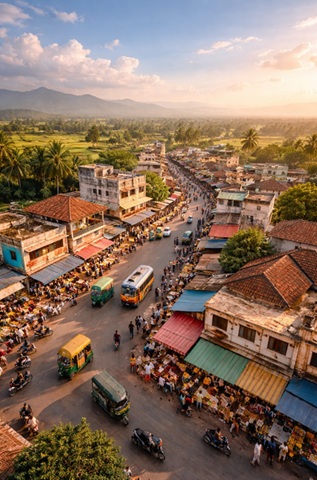
India has nearly 9,000 census and statutory towns, yet only about 500 qualify as large cities. The vast majority are small towns, many of which have historically received limited policy attention.
Traditionally, India’s urbanisation was viewed as:
However, a quieter transformation is underway. Small towns across different regions are increasingly absorbing population growth, economic activities, and migrant labour, indicating a structural shift in India’s economic geography.
The expansion of small towns is closely linked to changes in India’s development model.
From the 1970s to the 1990s, large cities functioned as hubs of:
Over time, these metros began experiencing over-accumulation, reflected in:
This reduced their ability to absorb new economic activity and labour.
As costs rose in large cities, economic activities increasingly moved to smaller towns, which offer:
Small towns are emerging as:
Small towns absorb:
These populations are integrated into urban economies, but often under precarious and informal conditions.
Urbanisation in small towns is not merely an extension of rural life but a deepening of urban processes under distinct conditions.
Key characteristics include:
Rather than inclusive growth, this pattern often results in the urbanisation of rural poverty.
At the same time, new local elites—such as:
gain control over land and labour, reinforcing socio-economic hierarchies while leaving workers vulnerable.
The rise of small towns exposes a growing mismatch between urban policy design and on-ground realities.
Small towns now represent the primary frontier of India’s urban expansion.
Their trajectory will shape:
If current trends continue unchecked, small towns risk reproducing the inequalities and ecological stresses of megacities, but without comparable institutional capacity.
At the same time, they offer an opportunity to reimagine urban development through:
A reoriented urban policy can transform small towns into engines of equitable and sustainable development, rather than sites of deepening inequality.
FAQs1. Why are small towns becoming important in India’s urbanisation ? Due to rising costs and congestion in metros, economic activities and migration are increasingly shifting to smaller towns. 2. How do small towns differ from megacities in their urbanisation pattern ? They rely heavily on informal employment, flexible labour markets, and weaker regulation, often leading to precarious livelihoods. 3. What challenges do small towns face ? Inadequate infrastructure, weak local governance, ecological stress, and limited policy attention. 4. Why is current urban policy inadequate for small towns ? Because most flagship programmes are metro-centric and do not address the specific needs of smaller urban centres. 5. What is the way forward for sustainable small-town growth ? Empowered municipalities, integrated planning, inclusive economic regulation, and political recognition of small towns’ importance. |



Our support team will be happy to assist you!

 Contact Us
  New Batch : 9555124124/ 7428085757
  Tech Support : 9555124124/ 7428085757