Context
During the recent visit of Brazilian President Luiz Inácio Lula da Silva to New Delhi, the two countries elevated their bilateral relations to a new level by signing a total of nine important agreements, including one on rare earth elements.
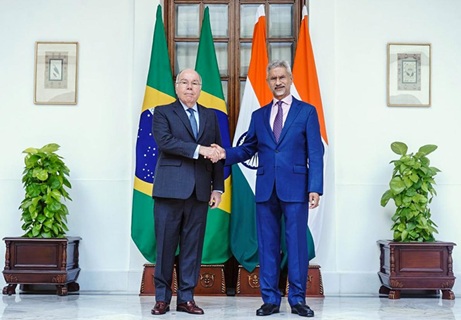
About India-Brazil Relations
Historical and Multilateral Background
- India and Brazil's relations are not limited to trade, but are based on shared democratic values and the foundation of South-South cooperation. Diplomatic relations, which began in 1948, have now evolved into a strategic partnership in areas such as energy, defense, and global governance.
- Both nations strongly advocate for a multipolar world order and reforms in the United Nations Security Council (UNSC) through global groupings such as BRICS, G20, IBSA, and BASIC.
Economic and Trade Relations
- Brazil has emerged as India's most important trading partner in the Latin American region. Currently, trade between the two countries is approximately $12-15 billion.
- While India exports diesel, pharmaceuticals, and engineering products, Brazil imports raw materials such as crude oil, gold, soybean oil, and iron ore.
- The two countries have set an ambitious target of increasing this trade to $30 billion by 2030. To facilitate trade, Brazil has also announced a 10-year visa for Indian businessmen.
Key Areas of Emerging Cooperation
- Mineral and Rare Earth Security
- Aiming to reduce dependence on China, India has signed an agreement with Brazil to exploit rare earth minerals. Brazil has vast reserves of these minerals, which India will leverage for its EV (electric vehicle) and defense industries.
- Defense and Digital Innovation
- Along with cooperation in defense production and maritime security, the two countries have developed a roadmap for a 'Digital Partnership' for future technologies such as Artificial Intelligence (AI), semiconductors, and blockchain.
- Energy and Climate Change
- In the field of renewable energy, Brazil's biofuels expertise and India's solar energy capabilities are strengthening the 'Global Biofuel Alliance'.
Conclusion
This visit is a decisive step towards diversifying global supply chains and making the voice of the 'Global South' more effective in international forums. This partnership will not only reduce dependence on countries like China but will also lay a strong foundation for the digital economy of the future.






 Contact Us
  New Batch : 9555124124/ 7428085757
  Tech Support : 9555124124/ 7428085757