Prelims: (Security+ CA)
Mains: (GS 2 – Governance; GS 3 – Security, Infrastructure) |
Why in News ?
The Union Government has constituted the Bureau of Port Security (BoPS) as a statutory body under the Merchant Shipping Act, 2025, aimed at strengthening port, ship, and maritime security governance across India’s coastline.

Background & Context
India’s growing integration with global trade has led to rapid expansion of its port infrastructure, coastal shipping, and inland waterways. While this has improved logistics efficiency and economic competitiveness, it has simultaneously increased vulnerabilities related to maritime terrorism, smuggling, cyber threats, and illegal migration.
Past incidents such as the 26/11 Mumbai attacks exposed gaps in coastal and port security coordination, leading to reforms in operational preparedness. However, regulatory oversight remained fragmented, prompting the need for a central statutory authority to ensure uniform security standards across ports.
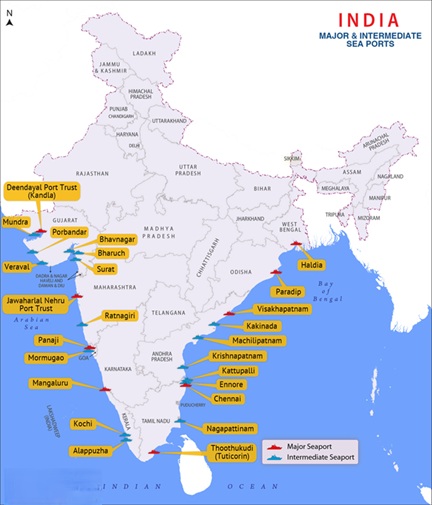
India’s Maritime and Coastal Landscape
- India has a coastline of over 7,500 km
- As of 2025:
- 12 major ports (under Union government control)
- 217 non-major ports
- 66 cargo-handling ports
- Remaining ports support fishing and coastal activities
- Major ports handle more than half of India’s maritime cargo
- Rapid growth in:
- Port capacity
- Coastal shipping
- Inland waterway cargo movement
Security Implications
- Increased exposure to:
- Terrorism
- Arms and drug trafficking
- Human trafficking and illegal migration
- Cyber intrusions into port systems
Need for a Dedicated Port Security Authority
Earlier, coastal and port security responsibilities were distributed across multiple agencies, including:
- Indian Navy
- Indian Coast Guard
- CISF
- State Maritime Police
- Port Authorities
Challenges
- Lack of a single nodal regulator
- Coordination gaps
- Duplication of efforts
- Uneven implementation of security norms
Rationale
- Establish a central regulatory authority, similar to the Bureau of Civil Aviation Security (BCAS) in aviation
Bureau of Port Security (BoPS): Mandate and Structure
- Constituted under Section 13 of the Merchant Shipping Act, 2025
- Functions under the Ministry of Ports, Shipping and Waterways
- Modelled on the Bureau of Civil Aviation Security (BCAS)
- Nature:
- Regulatory and supervisory, not operational
Scope
- Security of:
- Ships
- Port facilities
- Maritime infrastructure
- Applicable to:
- Major ports
- Non-major ports
Key Functions of the Bureau of Port Security
- Formulation and enforcement of security standards
- Oversight of:
- Maritime terrorism
- Arms and drug trafficking
- Human trafficking
- Illegal migration
- Piracy and poaching
- Ensuring compliance with:
- International Ship and Port Facility Security (ISPS) Code
- Coordination with:
- Indian Navy
- Coast Guard
- CISF
- State governments
Cybersecurity Focus
- Ports are increasingly reliant on:
- Digital logistics systems
- Automated cargo handling
- Integrated communication networks
- BoPS will:
- Monitor cybersecurity preparedness
- Coordinate with national cybersecurity agencies
- Protect port IT and operational technology systems from cyber threats
Role of CISF in Security Implementation
- CISF designated as a recognised security organisation
- Responsibilities:
- Preparation of standardised port security plans
- Conduct of security assessments
- Training of private security agencies deployed at ports
- Security implementation to follow a:
- Graded and risk-based approach
- Based on vulnerability, trade volume, location, and threat perception
- Objective:
- Balance security imperatives with ease of doing business
Maritime Growth and Strategic Context
- Port cargo handled:
- 974 million tonnes (2014)
- Nearly 1,600 million tonnes (2025)
- Ship turnaround time:
- Coastal shipping volumes:
- Inland waterway cargo:
- Increased nearly eightfold
Strategic Alignment
- Supports Maritime India Vision 2030
- Aims to create:
- World-class ports
- Green shipping ecosystem
- Secure maritime domain
Concerns and Criticism
- Some coastal States argue:
- Recent port legislation increases Union control over non-major ports
- Raises concerns regarding maritime federalism
- Criticism of:
- Wide inspection and regulatory powers under new port laws
- These concerns relate to:
- Broader legislative framework
- Not exclusively to BoPS
FAQs
Q1. What is the Bureau of Port Security (BoPS) ?
A statutory body established under the Merchant Shipping Act, 2025, to regulate port and ship security.
Q2. Which ministry oversees BoPS ?
The Ministry of Ports, Shipping and Waterways.
Q3. Is BoPS an operational agency ?
No. It performs regulatory, supervisory, and coordination functions.
Q4. What international code does BoPS enforce ?
The International Ship and Port Facility Security (ISPS) Code.
Q5. Why is BoPS important for India ?
It strengthens maritime security amid rapid growth in ports, trade, and digitalisation.
|






 Contact Us
  New Batch : 9555124124/ 7428085757
  Tech Support : 9555124124/ 7428085757