


Preliminary Examination QuestionQuestion. What is the major advantage of ethanol's high octane rating? (a) It necessarily increases the energy content of the fuel. (b) It helps reduce engine knocking. (c) It completely eliminates fuel consumption. (d) It reduces carbon dioxide emissions from vehicles to zero. Main Examination QuestionQuestion: Discuss the significance of the amendments to the Central Motor Vehicles Rules for E100 fuel. Also, analyse the technological and economic challenges associated with the expansion of flex-fuel vehicles. |
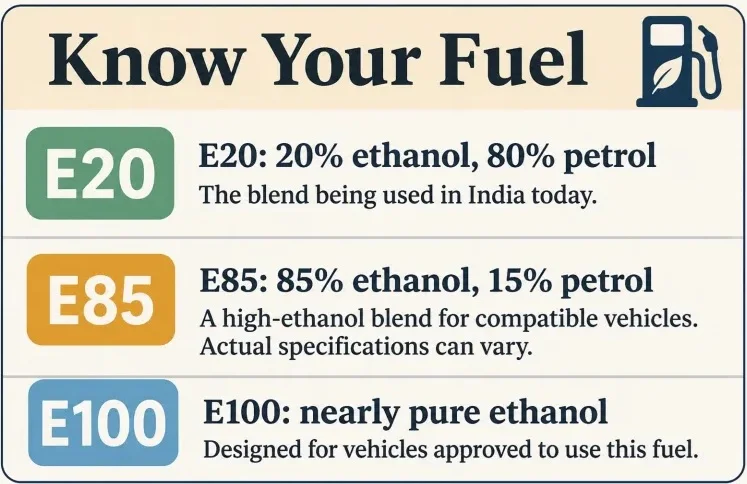
Question 1. What is E100 fuel?E100 is a fuel consisting of approximately pure ethanol. To use it, a vehicle must be specifically designed and certified for compatibility with this fuel. Question 2. Does the amendment to the E100 rules mean that all petrol vehicles can run on E100?No. The amendment relates to the certification of flex-fuel vehicles. E100 should be used in a conventional petrol or E20 vehicle only if the vehicle manufacturer explicitly confirms that the vehicle is compatible with it. Question 3. What is the main difference between E20, E85 and E100?The three fuels differ in their ethanol content. E20 contains approximately 20% ethanol, E85 contains approximately 85% ethanol, and E100 contains approximately 100% ethanol. Question 4. Why may a vehicle deliver lower mileage on E100?Ethanol contains less energy per litre than petrol. Therefore, a vehicle may require more fuel to cover the same distance. Question 5. Why is ethanol blended with petrol?The main objectives are to reduce dependence on crude oil imports, promote the domestic ethanol industry, and create additional markets for farmers and agriculture-based industries. |




