Why in news?
Chhattisgarh celebrates its Foundation Day on 1 November every year, commemorating its establishment as a separate state in 2000 following its separation from Madhya Pradesh.
Key Facts
|
Particular
|
Details
|
|
Formation Day
|
1 November 2000
|
|
Formation Act
|
Madhya Pradesh Reorganisation Act, 2000
|
|
Parent State
|
Madhya Pradesh
|
|
State number at formation
|
26th state of India
|
|
Capital
|
Raipur
|
|
First Chief Minister
|
Ajit Jogi
|
|
First Governor
|
D.N. Sahay
|
|
High Court
|
Chhattisgarh High Court, Bilaspur
|
|
Major river
|
Mahanadi
|
|
Famous waterfall
|
Chitrakote
|
|
Famous festival
|
Bastar Dussehra
|
|
Popular identity
|
Rice Bowl of Central India
|
|
Important mineral
|
Iron ore and coal
|
Historical Background
- Chhattisgarh before independence
- The region now known as Chhattisgarh has a long history associated with ancient kingdoms and regional political formations.
- Historically, parts of the region were associated with Dakshina Kosala, Kalachuri rulers, Nagavanshi traditions, Maratha administration and British colonial administration.
- The name Chhattisgarh is traditionally associated with the historical concept of thirty-six forts, although the exact historical origin of the name is debated.
- Following independence, the region became part of Madhya Pradesh in 1956.
- Why was a separate state demanded?
- The demand for a separate Chhattisgarh was based on several regional concerns.
- Regional identity: The region had distinct cultural, linguistic and historical traditions.
- Administrative accessibility: Supporters argued that a separate state would make governance more accessible to people living in geographically remote areas.
- Economic development: Despite its mineral wealth, several parts of the region experienced developmental challenges.
- Tribal welfare: The region has a significant tribal population, and the movement highlighted the need for better attention to tribal development and local governance.
- Formation of Chhattisgarh
- The Government of India and the Madhya Pradesh Legislature undertook the necessary constitutional and legislative process for the creation of the new state.
- Parliament passed the Madhya Pradesh Reorganisation Act, 2000. Under Section 3 of the Act, Chhattisgarh was formed from the specified territories of Madhya Pradesh.
- On 1 November 2000, Chhattisgarh officially came into existence. Ajit Jogi became the first Chief Minister of Chhattisgarh.
Constitutional and Legislative Framework
|
Particular
|
Details
|
|
Name of legislation
|
Madhya Pradesh Reorganisation Act
|
|
Year
|
2000
|
|
Act number
|
Act 28 of 2000
|
|
Date of enactment
|
25 August 2000
|
|
Effective date
|
1 November 2000
|
|
New state created
|
Chhattisgarh
|
|
Parent state
|
Madhya Pradesh
|
Geographical Significance
|
Feature
|
Details
|
|
Location
|
Central India
|
|
Capital
|
Raipur
|
|
Major river
|
Mahanadi
|
|
Other important rivers
|
Indravati, Hasdeo, Shivnath and Arpa
|
|
Important plateau
|
Chhattisgarh Plain
|
|
Mountain system
|
Maikal and surrounding hill ranges
|
|
Natural resources
|
Coal, iron ore, bauxite and limestone
|
Mahanadi River
- The Mahanadi is one of the most important rivers of Chhattisgarh.
- It originates in the Sihawa hills of present-day Dhamtari district and flows through Chhattisgarh and Odisha before draining into the Bay of Bengal.
- The river is important for irrigation, agriculture, drinking water and industrial activities.
- The Hirakud Dam in Odisha is one of the major multipurpose projects associated with the Mahanadi River system.
Natural Resources and Mineral Wealth
|
Mineral
|
Major industrial application
|
|
Coal
|
Thermal power generation
|
|
Iron ore
|
Iron and steel production
|
|
Bauxite
|
Aluminium industry
|
|
Limestone
|
Cement manufacturing
|
|
Dolomite
|
Steel and refractory industries
|
|
Tin ore
|
Industrial applications
|
Major industrial centres
- Bhilai: Known for the Bhilai Steel Plant.
- Korba: An important centre of coal mining and thermal power generation.
- Raipur: A major commercial and industrial centre.
- Bailadila: Famous for high-grade iron ore deposits.
Bhilai Steel Plant
- The Bhilai Steel Plant is one of India's major integrated steel plants.
- It was established with Soviet assistance and has played an important role in India's industrial development.
- The plant is particularly associated with the production of railway rails and other steel products.
Tribal Heritage and Cultural Identity
- Chhattisgarh has a rich tribal population and a distinctive cultural heritage.
- Important tribal communities include Gond, Baiga, Halba, Muria, Maria, Oraon and Kanwar.
- Their traditional knowledge systems, folk music, dances, handicrafts and forest-based livelihoods form an important part of the state's identity.
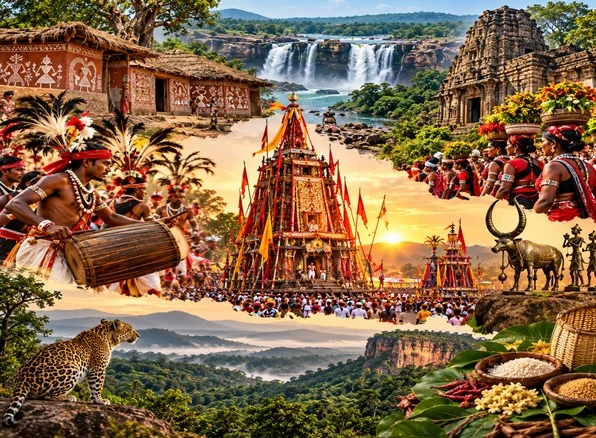
Bastar Dussehra: A unique cultural festival
- Unlike the conventional Dussehra celebrations associated with the victory of Lord Rama over Ravana, Bastar Dussehra is primarily associated with the worship of Goddess Danteshwari.
- It is famous for its elaborate rituals, traditional processions and participation of tribal communities.
Traditional art and handicrafts
- The state is known for several traditional crafts, including Dhokra metal craft, Bell-metal work, Wooden carvings, Tribal jewellery, Bamboo handicrafts and Traditional terracotta art.
Natural and Archaeological Heritage
- Chitrakote Waterfall: Located on the Indravati River in Bastar, Chitrakote is one of India's most spectacular waterfalls. It is widely known as the Niagara Falls of India because of its broad horseshoe-shaped appearance.
- Kanger Valley National Park: Kanger Valley National Park is known for its rich biodiversity, forests, limestone caves and wildlife. The park is particularly famous for the Kutumsar and Kailash caves.
- Sirpur: Sirpur is an important archaeological and historical site. It contains remains of ancient Buddhist, Hindu and Jain religious establishments. The site reflects the region's historical importance as a centre of religious and cultural exchange.
Economic Significance
- Agriculture: The state is traditionally associated with rice cultivation. It is popularly known as the Rice Bowl of Central India. Major crops include Rice, Maize, Pulses, Oilseeds and Sugarcane.
- Energy sector: Chhattisgarh is an important contributor to India's power generation capacity because of its coal reserves and thermal power infrastructure.
- Industrial development: Steel, aluminium, cement and power industries are among the major industrial activities of the state.
Tribal Development and Environmental Challenges
- Regional inequality: Economic development remains uneven across districts.
- Tribal welfare: Access to education, healthcare, infrastructure and livelihood opportunities requires continued attention.
- Forest conservation: Mining and industrial expansion create pressures on forest ecosystems.
- Displacement: Development projects can affect forest-dependent and tribal communities.
- Naxalism and internal security: Parts of the Bastar region have experienced Left-Wing Extremism, creating challenges for governance and development.
Prelims MCQs
Q. Chhattisgarh was created as a separate state under which of the following legislations?
(a) Madhya Pradesh Reorganisation Act, 2000
(b) States Reorganisation Act, 1956
(c) Bihar Reorganisation Act, 2000
(d) Uttar Pradesh Reorganisation Act, 2000
Mains Practice Question
Q. Examine the socio-economic and administrative factors behind the creation of Chhattisgarh in 2000.
|
FAQ
When is Chhattisgarh Foundation Day celebrated?
1 November.
In which year was Chhattisgarh formed?
2000.
Who was its first Chief Minister?
Ajit Jogi.
What is the capital of Chhattisgarh?
Raipur.
Why is Chhattisgarh called the Rice Bowl of Central India?
Because of the historical importance of rice cultivation in its agricultural economy.
|