(Prelims: Current Events of International Importance)
(Mains, General Studies Paper 2: Bilateral, Regional, and Global Groups and Agreements Related to and/or Affecting India's Interests, Impact of Policies and Politics of Developed and Developing Countries on India's Interests) |
Context
In recent years, the Arctic region has become an emerging center of global geopolitics. While melting ice due to climate change is providing new trade routes and resources, it has also intensified competition between superpowers. In this context, US President Donald Trump's intervention in Greenland and claims of Sino-Russian influence over Greenland reflect international concern about China's role in the Arctic. While analysts believe that China's presence is currently limited, its long-term strategy and ambitions have significant global implications.
China's Presence with Russia's Support
- Experts believe that any increase in China's influence in the Arctic region will be possible primarily with Russia's support. Military and strategic cooperation between the two countries has increased following the Russian invasion of Ukraine in 2022.
- In recent years, China and Russia have intensified joint military exercises and surveillance operations. A bomber patrol with Russian assistance near Alaska in 2024 is a prime example.
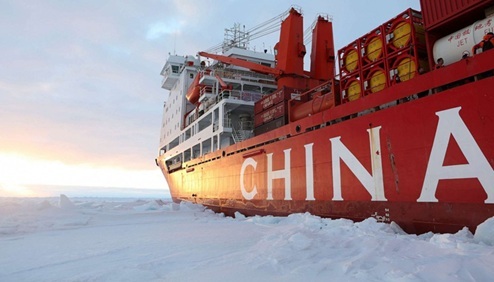
- China possesses several modern icebreaker vessels equipped with deep-sea submarines. These can map the seafloor, which could be militarily useful in the future.
- China has also deployed satellites to monitor the Arctic. However, China claims that all these activities are for scientific research purposes.

History of China's Interest in the Arctic
- China signed the Spitsbergen Treaty on July 1, 1925, and began participating in Arctic affairs and expanding the scope of its activities.
- In 1999, China sent an expedition to conduct research in scientific fields including the ocean, biological species, the atmosphere, geological conditions, and sea ice.
- On July 28, 2004, China's first Arctic scientific base, the Yellow River Station, was established on the Norwegian island of Svalbard.
- China has invested more than US$90 billion in infrastructure, assets, and projects in the Arctic Circle. These investments are primarily in the energy and mineral sectors.
- In 2016, Russian liquefied natural gas (LNG) producer Novatek signed an agreement with China for a US$12 billion loan to finance the Yamal LNG project.
- In January 2023, a Chinese communications construction company signed a deal with Russian Titanium Resources (Rustiton) to help develop the Pizemskoye mining project in the Komi Republic near the Arctic Circle.
China's White Paper on the Arctic
- On January 26, 2018, the State Council Information Office of the People's Republic of China published a white paper titled "China's Arctic Policy."
- This white paper explains the status and recent changes in the Arctic, China's policy goals, and basic principles on the Arctic:
- Deepening exploration and understanding of the Arctic
- Protecting the Arctic environment and addressing climate change
- Utilizing Arctic resources in a lawful and rational manner
- Actively participating in Arctic governance and international cooperation
- Promoting peace and stability in the Arctic
Reasons for China's Ambition
- China's interest in the Arctic region is not limited to security. According to the US Geological Survey, Greenland holds the world's eighth-largest reserves of rare earth elements. These elements are crucial for electric vehicles, advanced technology, and military equipment.
- In 2018, China launched the "Polar Silk Road" project, an Arctic version of its Belt and Road Initiative. China aims to establish itself as a "polar superpower" by 2030.
- Toward this end, China has established research centers in Iceland and Norway and participated in infrastructure investments, such as liquefied natural gas projects in Russia and a railway line in Sweden.
Opposition to Chinese Expansion
- Suspicions persist about Chinese investment in Europe and North America. Chinese proposals to purchase a former naval base in Greenland and an airport in Finland were rejected.
- In 2019, Greenland refused to select Huawei for its 5G network.
- A large rare earth mining project in Greenland's Kvanefjeld region has been halted by Chinese companies in 2021 due to environmental concerns. Another mining project in southern Greenland was awarded to a New York-based company in 2024 following US lobbying.
- However, Russia is the only country where China has enjoyed relatively free rein, investing heavily in ports and resource projects.
Seeking Opportunities Through New Trade Routes
- Melting ice in the Arctic is opening up new sea routes, which China is seeking to exploit. The Polar Silk Road aims to connect China with Europe through these routes.
- In October, China and Russia agreed to develop the Northern Sea Route (NSR). Last year, a Chinese ship traveled to Britain via this route in just 20 days, almost half the time compared to the Suez Canal route.
- As an alternative route, the Northwest Passage passes through the Canadian archipelago and could reduce dependence on the Russia-China dominated routes.
Impacts of Growing Chinese Activities in the Arctic
China's growing activities in the Arctic region are having a profound impact on the global order, not only geopolitically but also economically and environmentally.
1. Strategic & Geopolitical Impacts
- Growing Partnership with Russia: Following Western sanctions, Russia has become dependent on Chinese investment and technology for development in the Arctic. This 'China-Russia Axis' is challenging the influence of Western countries (especially NATO) in the region.
- Fear of Military Presence: Western countries view China's scientific activities (such as the research vessel 'Xuelong') as dual-use. There are fears that scientific data could be used for submarine operations and military surveillance.
- Ambition to Become a Polar Great Power: China aims to become a 'Polar Great Power' by 2030, which will enhance its role in global governance.
2. Economic Impact and the Polar Silk Road
New Trade Routes: China is developing the Northern Sea Route through the Polar Silk Road. This route could reduce the distance between Asia and Europe by approximately 30-40% compared to the traditional Strait of Malacca and Suez Canal.
- Energy Security: The Arctic is estimated to contain approximately 13% of the world's oil and 30% of its natural gas reserves. China wants to strengthen its energy security by gaining access to these resources.
- Mineral Wealth: China is also eyeing the region's rare earth metals, lithium, and cobalt, which are essential for future technology.
3. Impact on India
- Impact on Monsoon: The melting of Arctic ice is directly linked to India's monsoon cycle. If China's uncontrolled industrial activities increase global warming, it will have a negative impact on Indian agriculture and the economy.
- Strategic Balance: If China becomes Russia's sole major partner in the Arctic, it may be challenging for India to maintain its traditional strategic balance with Russia.
4. Environmental and Governance Challenges
- Ecological Risks: China's large-scale infrastructure projects (such as ports and railway lines) threaten to harm the Arctic's sensitive environment.
- Territorial Sovereignty: China's assertion that the Arctic is the heritage of all humanity is a concern for countries (such as Canada, Norway, and the United States) that hold territorial sovereignty there.
Conclusion
- China's Arctic strategy focuses primarily on commercial opportunities, energy security, and long-term strategic capability building. While its military presence is currently limited, it is laying the groundwork for the future through scientific, economic, and diplomatic activities.
- It is clear that the Arctic will become a platform for both cooperation and competition in the coming decades. China's role is leading this region to become a pivotal arena not only for regional but also for global geopolitics.






 Contact Us
  New Batch : 9555124124/ 7428085757
  Tech Support : 9555124124/ 7428085757