- Perumbidugu Mutharaiyar II, also known as Suvaran Maran and Shatrubhayankara, was a powerful South Indian ruler of the 8th century (c. 705–745 CE).
- He belonged to the Mutharaiyar dynasty, which initially served as feudatories of the Pallavas but later emerged as an independent and influential power as Pallava authority weakened.
- A commemorative postage stamp was issued in his honour by Vice President C. P. Radhakrishnan.
- On this occasion, Prime Minister Narendra Modi described him as a ruler endowed with vision, wisdom, and strategic brilliance, and encouraged the youth to learn about his remarkable life.
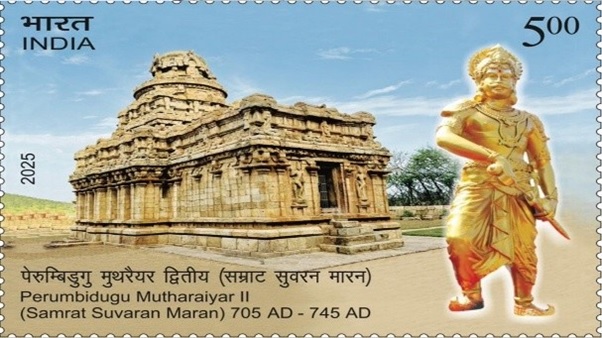
Perumbidugu Mutharaiyar: A Powerful Administrator and Warrior
- According to historical records, Suvaran Maran fought bravely in several battles alongside Pallava king Nandivarman.
- Over time, he established control over large parts of Thanjavur, Pudukkottai, Perambalur, Tiruchirappalli, and the Cauvery river basin.
- Due to his strong administrative capabilities and military prowess, he earned the title “Shatrubhayankara” (one who inspires fear among enemies).
Religious Tolerance and Intellectual Patronage
- During the Pallava period, Hinduism was witnessing a revival amid strong Jain and Buddhist influences.
- The Mutharaiyar rulers played an important role in this transitional phase.
- Historical accounts mention that Jain acharya Vimalachandra engaged in philosophical debates at Suvaran Maran’s court with Shaiva, Buddhist, Pashupata, and Kapalika scholars.
- This reflects that his reign was open to religious dialogue and intellectual debate.
- Historian D. G. Mahajan notes that Vimalachandra’s debates in the court of Suvaran Maran (Shatrubhayankara) highlight the vibrant intellectual and ideological activity of the time.
Historic Contributions to Temple Architecture
- The Mutharaiyar dynasty occupies a significant place in the development of South Indian temple architecture.
- According to Prof. K. V. Soundara Rajan (Studies in Indian Temple Architecture, 1975), the Mutharaiyars:
- Constructed early cave temples and structural temples,
- Whose architectural features later influenced Chola temple architecture.
- Scholars argue that even before the rise of the Cholas, the Mutharaiyars had already initiated the tradition of complex stone temples.
- Later, Vijayalaya Chola captured Thanjavur, defeating the Mutharaiyars.
Commemorative Stamp: Contemporary Context and Significance
Issuing a postage stamp in honour of Perumbidugu Mutharaiyar II:
- Represents an effort to provide national recognition to lesser-known or forgotten rulers of Tamil Nadu.
- Highlights Tamil cultural heritage and the administrative and architectural contributions of early South Indian dynasties.
- Serves as an important step toward raising awareness among the youth about regional historical heroes and their legacy.







 Contact Us
  New Batch : 9555124124/ 7428085757
  Tech Support : 9555124124/ 7428085757