
- UPSC Exam
- State PCS
- One Day Exam
- Current Affairs
- PT Quiz
- Downlaods
- About Coaching
- Blog
- Videos

| Prelims: (International Relations + CA) Mains: (GS 2 – India–US Relations; GS 3 – External Sector, Trade Policy) |
After the Supreme Court of the United States struck down tariffs imposed under the International Emergency Economic Powers Act (IEEPA), President Donald Trump invoked Section 122 of the Trade Act, 1974 to reimpose trade levies.
He initially announced a 10% universal tariff, later raising it to 15% — the maximum allowed under Section 122. However, the measure is temporary and can remain in force for only about five months unless approved by the US Congress.
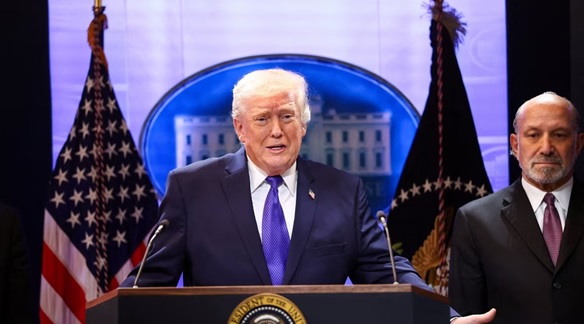
The Supreme Court ruling significantly curtailed the President’s ability to impose sweeping tariffs using emergency powers. IEEPA was originally designed for sanctions and asset freezes, not broad-based trade levies.
With that route closed, the administration shifted to Section 122 — a rarely used balance-of-payments provision allowing temporary tariffs up to 15% for 150 days unless extended by Congress.
This marks a shift from executive-driven emergency tariffs to more legally constrained mechanisms.
Countries Better Off Under Flat Rate
Under the temporary flat 15% tariff, several major economies now face lower duties compared to earlier differential and punitive tariffs. These include:
For many of these countries, the 15% rate is lower than the previously imposed reciprocal or penalty-based tariffs.
Conversely, some countries that earlier faced lower duties may now be subject to relatively higher rates under the uniform structure, including:
India had been facing cumulative tariffs of up to 50% since August 2025 due to reciprocal measures and penalties linked to Russian oil imports.
Following a recent trade framework and removal of the oil penalty:
Additionally, around 55% of India’s exports to the US may revert to standard Most Favoured Nation (MFN) rates after IEEPA-based measures were struck down.
China had faced cumulative tariffs of roughly 45%, including reciprocal and fentanyl-related levies under IEEPA.
With IEEPA invalidated, the flat 15% tariff could temporarily place India and China on comparable footing — unless fresh measures are introduced under other statutory provisions.
The Supreme Court ruling:
This weakens the administration’s leverage in trade negotiations, as partners may adopt firmer negotiating stances.
Limited Congressional Path
To restore broader tariff authority, the President would require Congressional approval — difficult given slim legislative majorities and upcoming midterm elections.
Political Risks
Alternative Tools
The administration may rely on:
However, these involve procedural safeguards and narrower scope compared to IEEPA.
Continued Sectoral Tariffs
Section 232 tariffs remain in force:
Meanwhile, about 40% of India’s exports — including smartphones, petroleum products, and pharmaceuticals — remain exempt.
With reciprocal tariffs struck down:
India has reportedly postponed high-level trade engagements to reassess legal and strategic implications.
Short-Term Relief
Lower average tariffs improve export competitiveness.
Strategic Caution
India anticipates that the US may deploy alternative statutory mechanisms.
Trade Diplomacy
The evolving landscape underscores the importance of:
FAQs1. Why did the US shift to Section 122 tariffs? Because the Supreme Court struck down IEEPA-based tariffs, limiting executive emergency powers. 2. How long can the 15% tariff remain in force? Up to 150 days unless extended by Congress. 3. Is India better off under the new regime? Yes, compared to earlier cumulative tariffs of up to 50%, the 15% structure is relatively favourable. 4. Do other US tariff provisions still apply? Yes, Section 232 and Section 301 tariffs remain valid in specific sectors. 5. What does this mean for global trade? It signals stronger judicial oversight and a move toward more legally constrained, rules-based tariff measures. |



Our support team will be happy to assist you!

 Contact Us
  New Batch : 9555124124/ 7428085757
  Tech Support : 9555124124/ 7428085757