
- UPSC Exam
- State PCS
- One Day Exam
- Current Affairs
- PT Quiz
- Downlaods
- About Coaching
- Blog
- Videos

| Prelims : (International Relations, CA) Mains : (GS 2 – India–US Relations, Global Trade Governance; GS 3 – External Sector, Trade Policy, Manufacturing) |
The United States Trade Representative has launched a Section 301 investigation into several economies, including India and China, over concerns about structural excess capacity and overproduction in key manufacturing sectors.
The probe comes shortly after the Supreme Court of the United States struck down tariffs imposed under the International Emergency Economic Powers Act, forcing the US administration to rely on other trade enforcement mechanisms.
The investigation will examine economies with large trade surpluses or underutilised industrial capacity, which the US believes may distort global trade and affect American manufacturing.
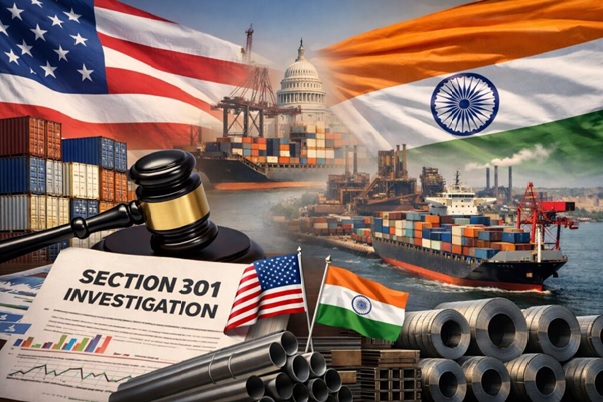
Section 301 is part of the Trade Act of 1974 (Sections 301–310).
It authorises the United States Trade Representative to investigate foreign trade practices that may violate international agreements or unfairly restrict US commerce.
Section 301 is therefore one of the most powerful tools in US trade enforcement policy.
Historically, it has been used to impose tariffs during trade disputes, most prominently during the US–China trade tensions beginning in 2018.
Trade analysts indicate that the current investigation is moving rapidly under an accelerated timeline.
Key procedural steps include :
If the investigation concludes that excess capacity or government policies are distorting trade, the US may impose additional tariffs or trade restrictions on the targeted countries.
According to the USTR’s notice, India is being examined for structural excess capacity in several manufacturing sectors.
The US highlighted that India recorded approximately $58 billion trade surplus with the United States in 2025, raising concerns in Washington over trade imbalances.
The investigation mentions several sectors where the US believes India may have export-oriented surplus capacity :
One of the key concerns relates to solar manufacturing, where India’s production capacity is estimated to be almost three times higher than domestic demand, suggesting reliance on exports.
The investigation comes at a time when India and the United States are negotiating a bilateral trade agreement aimed at expanding economic cooperation.
However, uncertainty surrounding potential US tariffs may complicate the negotiations.
Washington argues that government-supported industrial overcapacity in certain countries :
These concerns are linked to broader US efforts to reshore supply chains and create domestic jobs.
According to the Global Trade Research Initiative, the investigation highlights sectors where India’s industrial expansion could attract scrutiny.
Experts note that India’s export growth is primarily demand-driven, supported by competitive industries and diversified markets. However, the probe signals that India’s manufacturing expansion will face increasing scrutiny from trading partners.
The United States has several domestic laws that allow it to impose tariffs or trade restrictions.
This law allows the US President to regulate commerce during national emergencies.
The Trump administration invoked it in 2025 to impose tariffs, but the Supreme Court of the United States ruled in 2026 that the law cannot be used for tariff imposition, limiting its application.
This provision allows the US President to impose temporary tariffs of up to 15% for 150 days to address balance-of-payments problems.
In February 2026, the US government invoked this section to impose 10% tariffs on imports from multiple countries.
This law allows trade restrictions on national security grounds.
It has previously been used to impose tariffs on :
Section 301 addresses unfair trade practices and allows the US to impose retaliatory tariffs if foreign policies are deemed unjustifiable or discriminatory.
Under this provision, the USTR can self-initiate investigations under Section 301 without waiting for industry complaints.
This is the mechanism currently being used to initiate the investigation into India and other countries.
The probe introduces uncertainty into India–US economic ties, particularly at a time when both countries are negotiating deeper trade cooperation.
If the investigation leads to tariffs, Indian exports in key sectors such as steel, solar equipment, and textiles may face higher barriers in the US market.
The investigation reflects growing global concerns over excess manufacturing capacity, which can lead to price distortions and trade disputes.
India’s push for manufacturing expansion through initiatives like industrial incentives and production-linked schemes could attract greater scrutiny from trading partners.
The United States remains one of India’s largest export destinations, making the outcome of the investigation significant for India’s external trade sector.
FAQs1. What is Section 301 of the US Trade Act ? Section 301 of the Trade Act of 1974 allows the US government to investigate and respond to foreign trade practices that harm US commerce, including through tariffs or other restrictions. 2. Why has the US launched a Section 301 probe into India ? The US is examining whether structural excess manufacturing capacity and trade surpluses in certain sectors may distort global trade. 3. Which sectors in India are under scrutiny ? Key sectors include solar modules, steel, petrochemicals, textiles, healthcare products, construction materials, and automobiles. 4. Could the investigation lead to tariffs on Indian exports ? Yes. If the US concludes that unfair trade practices exist, it may impose tariffs or other trade restrictions. 5. Why is this investigation important for India ? The probe could influence India–US trade negotiations, export competitiveness, and the future of India’s manufacturing expansion strategy. |



Our support team will be happy to assist you!

 Contact Us
  New Batch : 9555124124/ 7428085757
  Tech Support : 9555124124/ 7428085757