
- UPSC Exam
- State PCS
- One Day Exam
- Current Affairs
- PT Quiz
- Downlaods
- About Coaching
- Blog
- Videos

| Prelims: (Economics + CA) Mains: (GS 3 – Agriculture, External Sector, Inclusive Growth; GS 2 – Federalism & Trade Policy) |
Apple traders and political leaders in Jammu and Kashmir have expressed concern over reduced import duties on apples from the United States and the European Union under recent trade agreements.
They argue that lower tariffs could undermine the region’s horticulture sector, which forms the backbone of its rural economy.
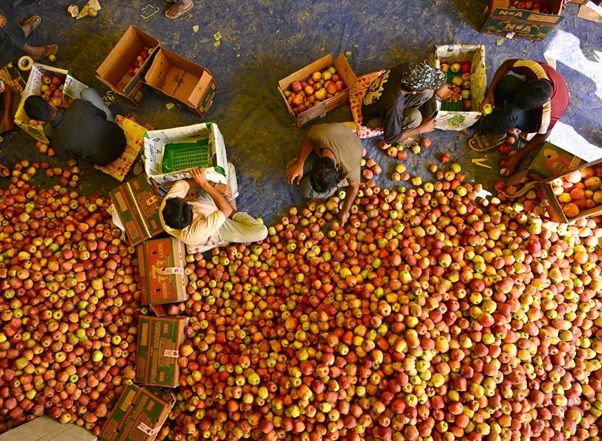
US Apple Imports
India has reduced the basic customs duty on apples imported from the United States from 50% to 25%, while imposing a Minimum Import Price (MIP) of ₹80 per kilogram.
Under the India–EU trade framework:
Political leaders in J&K have termed these moves potentially harmful to domestic orchardists.
Apple cultivation is central to the region’s economy. According to the J&K Economic Survey 2025–26:
In 2024, J&K produced around 21 lakh metric tonnes of apples, contributing over 70% of India’s total apple output.
This makes the region the backbone of India’s apple supply chain.
Fragmentation limits mechanisation and economies of scale.
India produces about 7–8 tonnes per hectare, compared to:
Higher productivity abroad is driven by:
Popular global varieties like Gala apples are well established in Western markets.
Though India has recently introduced Gala cultivation, issues remain regarding:
This creates a perception gap in quality when compared to imports.
J&K has invested heavily in controlled-atmosphere (CA) cold storage infrastructure to stabilise prices.
Reduced import duties may allow fresh apples from countries like New Zealand to enter the Indian market at competitive prices during the off-season.
Possible consequences:
Political leaders and trade bodies in J&K have urged the Centre to:
They argue that without improvements in productivity and quality, local producers cannot compete effectively.
Trade-Off in Trade Policy
Competitiveness Imperative
The debate highlights the need for:
Technological upgradation.
Federal Concerns
The issue reflects tension between national trade diplomacy and regional economic interests.
For J&K Economy-Apple cultivation supports livelihoods, rural income, and social stability.
For Agricultural Reform-Trade exposure could push productivity improvements but may cause short-term distress.
For Consumer Welfare-Lower prices could benefit urban consumers.
For Trade Strategy-India must balance market access commitments with safeguards for sensitive sectors.
FAQs1. Why are J&K apple traders concerned? Reduced import duties may allow cheaper foreign apples to undercut local produce. 2. How important is apple cultivation to J&K? It contributes over 70% of India’s apple production and supports millions of livelihoods. 3. What is a Tariff Rate Quota (TRQ)? It allows a fixed quantity of imports at reduced duty, beyond which higher tariffs apply. 4. What structural issues affect J&K orchardists? Small landholdings, lower productivity, and quality gaps. 5. What is the long-term solution? Improving productivity, modernising infrastructure, and enhancing competitiveness rather than relying solely on tariff protection. |



Our support team will be happy to assist you!

 Contact Us
  New Batch : 9555124124/ 7428085757
  Tech Support : 9555124124/ 7428085757