Why in News ?
-
The wall of Kumbhalgarh Fort, located in Rajsamand district of Rajasthan and often called the “Great Wall of India,” has been recognized in a UNESCO survey as the world’s second longest continuous (intact) wall.
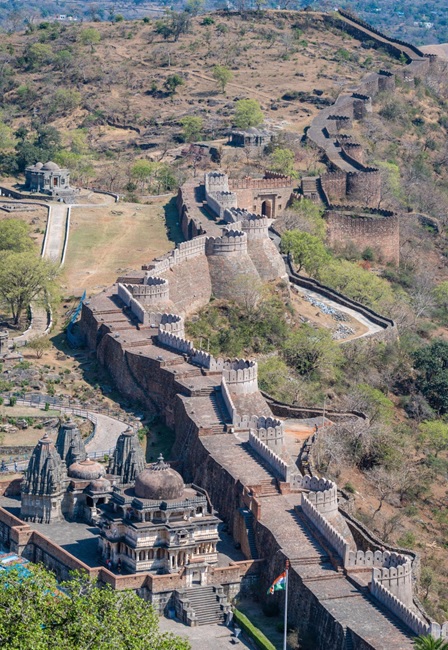
Kumbhalgarh Fort :
- The Kumbhalgarh Fort and its massive wall are a remarkable example of Rajput military architecture and engineering. Located about 84 km from Udaipur (Rajasthan) in the Aravalli hills, this 15th-century fort holds historical significance as its wall is considered the second longest continuous wall in the world after the Great Wall of China.
- This impregnable fort was built by the powerful ruler of Mewar, Rana Kumbha, between 1443 and 1458 AD. The chief architect of the fort was the famous architect “Mandan.”
- UNESCO declared Kumbhalgarh a World Heritage Site in 2013 under the group “Hill Forts of Rajasthan.”
The Great Wall of India :
The wall of Kumbhalgarh is one of the greatest engineering achievements of medieval India :
- Massive Length : The fort’s defensive wall is approximately 36 km long, running across mountain ridges and valleys.
- Width : The wall is around 15 to 25 feet wide. According to historical accounts and local legends, it is so wide that eight horses can run side by side on it.
- Security System : The wall includes strong bastions and specially designed arrow slits for archers. The fort has seven massive and highly secure gates (locally called “pols”) for entry.
Because of its unique geographical location and strong fortifications, the fort was considered “invincible.”
Major Attractions of the Fort :
Within the 36 km long wall lies not just a palace but an entire self-sustained city :
- 360+ Ancient Temples : The fort complex contains more than 360 temples, including around 300 Jain temples and several Hindu temples. The Nilkanth Mahadev Temple, known for its intricate stone carvings, is especially notable.
- Badal Mahal (Palace of Clouds) : Located at the highest point of the fort, it offers stunning views of the Aravalli hills. On clear days, even the sand dunes of the Thar Desert can be seen from here.
- Birthplace of a Great Warrior : The fort is also the birthplace of the legendary and brave warrior Maharana Pratap.







 Contact Us
  New Batch : 9555124124/ 7428085757
  Tech Support : 9555124124/ 7428085757