Prelims: Narcotics Control Bureau (NCB), NCORD Mechanism, Drug Trafficking, Narco-Terrorism, Narcotic Drugs and Psychotropic Substances
Mains: GS Paper II Government Policies and Inter-agency Coordination
GS Paper III Internal Security, Organised Crime, Terror Financing and Drug Trafficking |
Why in News?
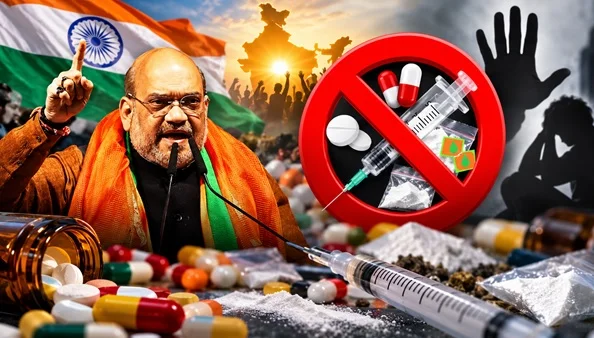
Union Home Minister Amit Shah has unveiled a three-year roadmap and vision document aimed at making India “drug-free” by 2029.
Important Point
- The period 2026–2029 will be pursued in mission mode against the narcotics menace.
- The government has identified drug trafficking as a major national security challenge.
- The strategy will focus on Supply Reduction, Demand Reduction and Harm Reduction.
- A four-pillar roadmap has been prepared to strengthen India's anti-narcotics architecture.
What is the Drug-Free India 2029 Roadmap?
The roadmap seeks to transform India's fight against narcotics into a coordinated, continuous and outcome-oriented national campaign.
Under the mission-mode approach, each objective will have:
- A specific timeline
- A responsible ministry/agency
- Measurable outcomes
- Quarterly reviews
- Result-based accountability
The larger objective is not merely to seize drugs but to dismantle the entire narcotics ecosystem, including traffickers, suppliers, distributors, financiers and associated networks.
Three Major Outcomes
The strategy is built around three broad outcomes:
- Supply Reduction: The government seeks to disrupt the availability and trafficking of illegal drugs by targeting the entire supply chain. The approach will focus on identifying kingpins, suppliers, distributors, associates and trafficking networks, rather than concentrating only on individual seizures.
- Demand Reduction: Reducing the demand for narcotics is considered essential for achieving a drug-free society. This involves awareness, prevention and interventions aimed particularly at protecting vulnerable sections of society and younger generations.
- Harm Reduction: The strategy also recognises the need to reduce the social and health-related damage caused by substance abuse. It seeks to complement law enforcement with measures addressing the consequences of drug dependence.
Four-Pillar Roadmap
Pillar 1: Intelligence and Operation-Based Enforcement
The government plans to strengthen intelligence-led anti-narcotics operations. Instead of focusing primarily on seizures, enforcement agencies will target the entire criminal network behind drug trafficking.
Pillar 2: Precursor and Synthetic Drugs Control
Greater attention will be given to controlling precursor chemicals and synthetic drugs. Precursor chemicals are substances that may have legitimate industrial or pharmaceutical uses but can also be diverted for manufacturing illicit drugs. Synthetic drugs pose an emerging challenge because they can be manufactured through chemical processes without depending entirely on traditional narcotic crops.
Pillar 3: Demand and Harm Reduction
Enforcement alone cannot eliminate the narcotics problem. Awareness, prevention and rehabilitation-related interventions become important components of the broader anti-drug strategy.
Pillar 4: Capacity Building and Coordination
Drug trafficking frequently involves multiple states, agencies and international networks.
Therefore, the roadmap emphasises better:
- Institutional capacity
- Intelligence sharing
- Inter-agency coordination
- Centre-State cooperation
- Training and technological capabilities
What is the NCORD Mechanism?
- The Narco Coordination Centre (NCORD) mechanism provides an institutional framework for coordination among various agencies involved in combating narcotics trafficking.
- A four-tier NCORD mechanism was established to improve coordination from the national level down to the local level.
- The government has also sought to integrate State and Union Territory police forces into the national anti-narcotics strategy.
- Dedicated Anti-Narcotics Task Forces (ANTFs) have been established across States and Union Territories.
Drug Seizures in India
According to figures cited by the Union Home Minister:
|
Period
|
Narcotics & Psychotropic Substances Seized
|
|
2004–2014
|
26 lakh kg
|
|
2014–July 2026
|
More than 1.19 crore kg
|
The government has highlighted this increase as an indicator of intensified enforcement against narcotics networks. However, seizure data should be interpreted carefully because higher seizures can reflect stronger enforcement, greater interdiction, changes in trafficking volumes, or a combination of these factors.
Drugs and National Security
Drug trafficking is not merely a law-and-order or public-health challenge. It can have significant implications for India's internal and national security.
Narco-Terrorism
- Illegal narcotics generate large amounts of illicit money.
- This nexus between narcotics trafficking and terrorism is commonly described as Narco-Terrorism.
- The government has therefore increasingly treated narcotics control as an important component of the country's national security strategy.
Significance of the Drug-Free India Mission
- National Security: Breaking narcotics networks can help disrupt organised crime and potential terror-financing channels.
- Protection of Youth: Drug dependence can adversely affect health, education, productivity and the future prospects of young people.
- Organised Crime Control: Drug trafficking networks may overlap with money laundering, arms trafficking and other forms of transnational organised crime.
- Centre-State Coordination: NCORD and Anti-Narcotics Task Forces can strengthen coordination between central agencies and State police forces.
- Network-Based Enforcement: Targeting kingpins and financial networks can potentially create a greater deterrent effect than isolated seizures.
Major Challenges
- Porous Borders: India's extensive land and maritime boundaries create significant surveillance and interdiction challenges.
- Synthetic Drugs: Synthetic narcotics can be produced in clandestine laboratories, making detection and control more difficult.
- Darknet and Technology: Encrypted communication, darknet marketplaces and digital payment mechanisms can facilitate new forms of drug trafficking.
- International Networks: Major narcotics networks often operate across jurisdictions, requiring international intelligence and law-enforcement cooperation.
- Money Laundering: Tracing the proceeds of narcotics trafficking and disrupting financial networks remains crucial.
- Rehabilitation: A purely enforcement-driven strategy cannot address addiction unless accompanied by prevention, treatment and rehabilitation mechanisms.
Way Forward
- India needs a whole-of-government and whole-of-society approach to achieve the goal of a drug-free country.
- Technology-driven surveillance, stronger control of precursor chemicals, financial intelligence and coordinated action against interstate and international trafficking networks will remain crucial.
Conclusion
- The Drug-Free India by 2029 roadmap marks an attempt to move India's anti-narcotics policy beyond isolated seizures towards a network-centric and coordinated national strategy.
- Its success will depend not only on dismantling trafficking networks but also on controlling illicit finances, synthetic drugs and precursor chemicals while simultaneously reducing demand and strengthening prevention, treatment and rehabilitation.
Prelims MCQ
Q. Consider the following statements regarding India's anti-narcotics strategy:
- NCORD is associated with coordination among agencies dealing with narcotics control.
- India's new strategy emphasises supply reduction, demand reduction and harm reduction.
- The Golden Crescent traditionally includes Afghanistan, Pakistan and Iran.
Which of the statements given above are correct?
A. 1 and 2 only
B. 2 and 3 only
C. 1 and 3 only
D. 1, 2 and 3
Mains Question
“Drug trafficking in India has evolved from a law-and-order challenge into a multidimensional national security threat.” Discuss in the context of organised crime, narco-terrorism and India's evolving anti-narcotics strategy.
|
FAQs
What is India's target for becoming drug-free?
The government has announced a roadmap aimed at achieving a Drug-Free India by 2029, with 2026–2029 being pursued as a mission-mode period.
What are the three outcomes of the strategy?
The three outcomes are Supply Reduction, Demand Reduction and Harm Reduction.
What are the four pillars of the roadmap?
The four pillars are intelligence and operation-based enforcement; precursor and synthetic drugs control; demand and harm reduction; and capacity building and coordination.
What is NCORD?
NCORD stands for Narco Coordination Centre and is a mechanism designed to strengthen coordination among agencies involved in narcotics control.
What is narco-terrorism?
Narco-terrorism broadly refers to the nexus in which proceeds from illegal narcotics trafficking are used to support or finance terrorist activities and networks
|







 Contact Us
  New Batch : 9555124124/ 7428085757
  Tech Support : 9555124124/ 7428085757