Prelims: CSIR-NAL, Gas Turbine Engine, Brayton Cycle, UAVs, Indigenous Defence Technology, Aerospace Propulsion
Mains: GS Paper II: Government Policies and Interventions, Aatmanirbhar Bharat GS Paper III: Defence Technology, Indigenisation of Defence, Science and Technology, Defence Manufacturing
Keywords: CSIR-NAL, NJ-05, NJ-50, NJ-100, Micro Gas Turbine Engine, Indigenous Propulsion, UAVs, Drone Interceptors, Missile Systems, Brayton Cycle, Atmanirbhar Bharat, Defence Indigenisation |
Why in News?
The CSIR-National Aerospace Laboratories (CSIR-NAL) unveiled three indigenous micro and small gas turbine engines — NJ-05, NJ-50 and NJ-100 at the SSB Auditorium, CSIR Headquarters, New Delhi, on 25 August 2026.
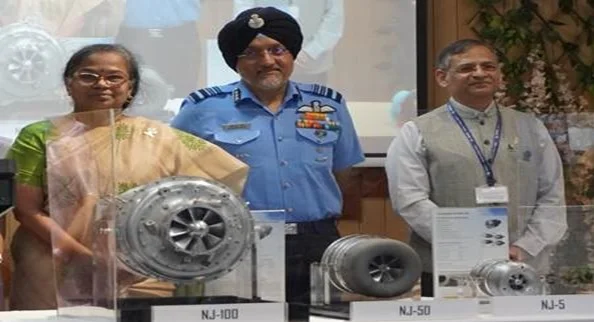
Important Points
- NJ-05: 5 kg thrust
- NJ-50: 50 kg thrust
- NJ-100: 100 kg thrust
- The engines have been developed indigenously by CSIR-NAL.
- They are intended for compact defence and aerospace platforms.
- Potential applications include tactical UAVs, drone interceptors and compact missile systems.
- The NJ-100 was developed using data obtained from earlier flight tests of the scaled-down NJ-5 technology demonstrator.
- The NJ engine family demonstrates an indigenous thrust range extending from 5 kg to 100 kg.
What is a Micro Gas Turbine Engine?
- A gas turbine engine is an internal combustion engine that generates thrust or shaft power by compressing air, mixing it with fuel and burning the mixture before expanding the hot gases through a turbine.
- Micro and small gas turbine engines apply the same basic principle in a smaller and lighter configuration.
- Their compact size and high power-to-weight characteristics make them useful for lightweight aerospace platforms where space and weight are major constraints.
How Does a Gas Turbine Engine Work?
The basic working process can be understood as:
Air Intake → Compression → Fuel Injection → Combustion → Turbine → Exhaust → Thrust
Air first enters the engine and is compressed. Fuel is then mixed with the compressed air and burned inside the combustion chamber. The resulting high-temperature and high-pressure gases expand through the turbine and exhaust system, producing useful power and thrust.
Brayton Cycle
Gas turbine engines primarily operate on the Brayton Cycle, an important thermodynamic cycle used in gas turbines and jet propulsion.
The major stages are:
- Compression of air
- Heat addition/combustion
- Expansion of hot gases
- Heat rejection/exhaust
Key Technologies Involved
- High-RPM Turbomachinery: Micro gas turbines operate at very high rotational speeds. Designing compressors, turbines, bearings and shafts capable of operating safely at such speeds is a major technological challenge.
- High-Temperature Combustion: Efficient combustion at high temperatures is essential for generating sufficient thrust while maintaining engine reliability and efficiency.
- Precision Manufacturing: Small turbine engines require high manufacturing precision because even minor variations in turbine blades, compressors or other components can affect engine performance.
- Lightweight Materials: Aerospace propulsion systems require materials capable of combining low weight, high strength and resistance to high temperatures.
Defence Applications
The indigenous engines can potentially support several categories of compact defence platforms.
- Tactical UAVs: Small gas turbine engines can provide propulsion for unmanned platforms requiring higher speed and endurance.
- Drone Interceptors: Compact propulsion systems can support high-speed platforms designed to intercept hostile drones.
- Compact Missile Systems: Small turbine engines can be relevant for missile systems requiring sustained propulsion within limited dimensions.
- Target Drones: Such engines can also support aerial targets used for training and testing air-defence systems.
Significance for India
- Indigenous Propulsion Capability: Propulsion technology is one of the most complex areas of aerospace engineering. Indigenous development can strengthen India's domestic technological capability in small gas turbine systems.
- Reduced Import Dependence: Domestic production of compact engines can reduce dependence on foreign propulsion systems and associated components.
- Boost to Drone Ecosystem: India's expanding military UAV and counter-drone requirements create demand for reliable indigenous propulsion technologies.
- Defence Indigenisation: The development supports the broader objective of increasing indigenous content in defence platforms under Atmanirbhar Bharat.
- Opportunities for Private Industry: CSIR-NAL has called for participation from Indian aerospace startups and industrial manufacturers, opening possibilities for technology transfer, manufacturing and supply-chain development.
- Technology Scaling: The progression from NJ-05 to NJ-100 demonstrates the potential to scale indigenous gas turbine technology across different thrust requirements.
Role of CSIR-NAL
- The National Aerospace Laboratories (NAL) is a constituent laboratory of the Council of Scientific and Industrial Research (CSIR).
- It is one of India's major civilian aerospace research institutions and works in areas such as aerospace structures, aerodynamics, propulsion, flight systems and related technologies.
- CSIR-NAL Director Dr. Abhay A. Pashilkar described the laboratory as a multi-stage integrator and emphasised the need for manufacturing support from Indian aerospace startups and industry.
Institutional Support
- Air Marshal Tejinder Singh, Chief of Integrated Defence Staff, attended the unveiling event as Chief Guest.
- Dr. N. Kalaiselvi, Director General of CSIR and Secretary, Department of Scientific and Industrial Research (DSIR), linked the development of indigenous aerospace subsystems with India's Atmanirbhar Bharat initiative.
Challenges
- Manufacturing high-precision turbine components
- Developing high-temperature resistant materials
- Maintaining reliability at very high RPM
- Achieving efficient fuel consumption
- Scaling laboratory technology for mass production
- Ensuring flight certification and operational reliability
- Developing a sustainable domestic supply chain
Way Forward
- India will need to move from successful indigenous development towards flight validation, certification and large-scale industrial production.
- Greater collaboration among CSIR-NAL, defence organisations, private aerospace companies, startups and MSMEs can help create a domestic ecosystem for compact propulsion systems.
- Further development of higher-thrust variants and improvements in fuel efficiency, materials and manufacturing technologies could expand their applications across India's UAV and missile ecosystem.
Prelims MCQs
Q1. Gas turbine engines primarily operate on which thermodynamic cycle?
(a) Rankine Cycle
(b) Otto Cycle
(c) Brayton Cycle
(d) Carnot Cycle
Mains Question
“Indigenous propulsion technology is critical for achieving self-reliance in India's emerging unmanned and defence aerospace ecosystem.” Discuss in the context of CSIR-NAL's indigenous micro and small gas turbine engines.
|
FAQs
What are the three engines unveiled by CSIR-NAL?
NJ-05, NJ-50 and NJ-100.
What are their thrust ratings?
They produce 5 kg, 50 kg and 100 kg thrust respectively.
Which cycle is used in gas turbine engines?
Gas turbine engines primarily operate on the Brayton Cycle.
Where can these engines be used?
They can support tactical UAVs, drone interceptors and compact missile systems.
What is CSIR-NAL?
It is a constituent aerospace research laboratory of CSIR.
|






 Contact Us
  New Batch : 9555124124/ 7428085757
  Tech Support : 9555124124/ 7428085757