Prelims: (Culture + International Relations + CA)
Mains: (GS 1: Indian Culture, Heritage; GS 2: Foreign Policy, Cultural Diplomacy) |
Why in News ?
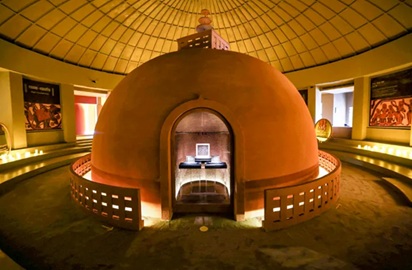
The Prime Minister inaugurated “The Light and The Lotus: Relics of the Awakened One”, an international exposition of the sacred Piprahwa relics in New Delhi. The event followed the successful repatriation of priceless Buddhist relics that had been taken out of India during the colonial era and were nearly auctioned abroad, highlighting India’s evolving strategy of heritage diplomacy and peace-based soft power.
Background & Context
India’s foreign policy increasingly leverages its civilisational heritage as a source of soft power, particularly through Buddhism, which connects India with large parts of Asia and beyond. In recent years, India has focused on reclaiming looted antiquities, protecting sacred heritage, and positioning itself as a moral leader in global affairs.
The Piprahwa episode demonstrates a non-coercive diplomatic model, combining legal assertion, ethical reasoning, and private-public cooperation to safeguard global cultural heritage.
Significance of the Prime Minister’s Message
Strength with Humanity
- The Prime Minister underscored that strength is necessary against enemies of humanity, but dialogue and peace must guide conflict resolution.
- This reflects India’s doctrine of strategic restraint combined with moral leadership.
Buddha’s Philosophy as India’s Worldview
- The Buddha’s message of coexistence over domination was projected as India’s guiding principle in the 21st century.
- The civilisational ideal of “Sarvajan Hitaya, Sarvajan Sukhaya” was reaffirmed as India’s ethical compass.
Piprahwa Relics: Historical Background
Discovery and Composition
- Excavated in 1898 by William Claxton Peppé from a Buddhist stupa at Piprahwa (Siddharthnagar district, Uttar Pradesh), near the India–Nepal border.
- The relics include:
- 349 gemstones (pearls, rubies, sapphires, topaz, gold sheets)
- Bone fragments and ash believed to be of Lord Buddha
- Reliquaries, sandstone coffers, and soapstone and crystal caskets
Colonial-Era Dispossession
- Under the Indian Treasure Trove Act, 1878, the British Crown claimed most relics.
- A portion remained with the Peppé family, held privately for over 127 years, reflecting colonial inequities in heritage ownership.
Rescue from Auction and Repatriation (2025)
Threat of Auction
- Sotheby’s Hong Kong listed the relics for auction in 2025, with an estimated value exceeding USD 100 million.
- The relics were treated as antique collectibles, disregarding their sacred and civilisational significance.
India’s Response
- The Ministry of Culture issued a legal notice demanding the auction’s withdrawal.
- India asserted that the relics are inalienable religious and cultural heritage, protected under domestic law and international conventions.
- The Archaeological Survey of India (ASI) and diplomatic channels were mobilised.
Innovative Resolution
- The Godrej Group purchased the collection and facilitated its return to India.
- The relics were loaned to the National Museum for five years.
- This avoided ethical dilemmas associated with the State commercially purchasing sacred antiquities.
Shared Buddhist Heritage and India’s Soft Power
Global Spiritual Connect
- The relics have inspired millions during exhibitions in Thailand, Mongolia, Vietnam, Russia, and other countries.
- Indian diplomats are often revered as representatives of the “Land of Buddha”, enhancing India’s moral stature.
Symbolic Diplomacy
- India has gifted Bodhi tree saplings to countries such as China, Japan, Korea, and Mongolia.
- A notable example is a Bodhi tree in Hiroshima, symbolising peace and reconciliation after nuclear devastation.
Preservation of Buddhist Heritage
International Initiatives
- Restoration of 11 pagodas in Bagan (Myanmar)
- Post-earthquake assistance to Nepal’s heritage sites
Domestic Efforts
- Development of the Buddhist Circuit connecting major pilgrimage centres
- Promotion of Pali as a classical language
- Infrastructure upgrades to improve accessibility and conservation of Buddhist sites
Challenges and Way Ahead
- Colonial-era legal ambiguities: Strengthen global cooperation on cultural property protection
- Grey areas in international law: Proactively use diplomacy and soft power for repatriation
- Commercialisation of sacred objects: Balance legal, ethical, and spiritual dimensions
- Limited enforceability of UNESCO conventions for pre-1970 removals
Way forward includes creating a global database of alienated Indian antiquities and expanding cultural diplomacy through Buddhism, yoga, and civilisational narratives.
Analysis: Why the Piprahwa Episode Matters
- Demonstrates non-coercive, values-based diplomacy
- Reinforces India’s role as custodian of Buddhist heritage
- Strengthens India’s soft power in Asia and beyond
- Sets a model for ethical recovery of sacred artefacts
FAQs
Q1. Why are the Piprahwa relics considered sacred ?
They include bone fragments and ash believed to be of Lord Buddha, making them objects of deep religious reverence.
Q2. Why was the auction of the relics controversial ?
Because sacred Buddhist relics were treated as commercial collectibles, ignoring their religious and cultural significance.
Q3. How does this episode reflect India’s soft power ?
It showcases India’s ability to influence global perceptions through cultural heritage, moral authority, and diplomacy.
Q4. What role did private actors play in repatriation ?
The Godrej Group enabled the return without commercialising sacred heritage.
Q5. How does Buddhism strengthen India’s foreign policy ?
Buddhism provides a shared civilisational link with many countries, reinforcing peace-based diplomacy and cultural goodwill.
|






 Contact Us
  New Batch : 9555124124/ 7428085757
  Tech Support : 9555124124/ 7428085757