| Prelims: (International Relations + CA) Mains: (GS 2 – India & World Affairs; GS 3 – Security & Energy Security; GS 3 – Internal Security & Diaspora; GS 2 – International Institutions & Diplomacy) |
On February 28, 2026, Israel conducted a daylight strike on Tehran, calling it a pre-emptive operation against Iran’s nuclear infrastructure. US President Donald Trump confirmed American involvement, and the US Department of Defense named the operation Operation Epic Fury.
Iran retaliated with missile strikes on Israeli territory and expanded attacks to US military facilities across Qatar, Bahrain, Jordan, Kuwait, and the UAE, transforming a bilateral confrontation into a broader regional crisis.
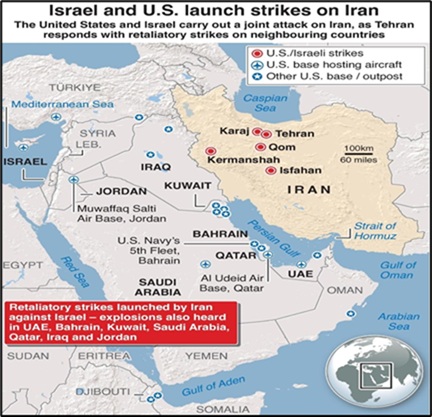
The rivalry between Israel and Iran has evolved from ideological hostility to proxy confrontations across Syria, Lebanon, and Gaza. Israel perceives Iran’s nuclear programme as an existential threat, while Iran positions itself as a counterweight to Israeli and US influence in West Asia.
The 2015 nuclear agreement (JCPOA) sought to restrict Iran’s uranium enrichment in exchange for sanctions relief. However, the US withdrawal in 2018 reignited tensions. Subsequent indirect talks, including recent Geneva negotiations mediated by Oman, failed to yield a breakthrough.
Iran insists on its sovereign right to enrich uranium for peaceful purposes. The US and Israel argue that enrichment levels approach weapons-grade capability.
The strike was framed as preventive, aiming to degrade Iran’s nuclear infrastructure before it crossed a perceived red line.
The scale and daylight execution marked a departure from covert operations historically associated with Israel–Iran tensions.
Iran launched missiles toward northern Israel; Israeli air defence systems intercepted incoming projectiles.
Subsequently, Iran expanded retaliation by targeting US-linked facilities:
This widened the theatre of conflict beyond bilateral confrontation.
The strikes mark a transition from indirect proxy warfare to overt state-to-state military engagement.
The involvement of Gulf states hosting US bases increases the probability of a multi-country conflict.
Threats to disrupt the Strait of Hormuz — through which nearly one-fifth of global oil trade passes — could destabilise global energy markets.
The breakdown of diplomatic talks weakens multilateral non-proliferation frameworks and increases the likelihood of accelerated nuclearisation.
India has significant exposure:
Airspace closures and disruptions necessitate contingency evacuation planning.
Nearly 60% of India’s crude imports originate from West Asia. Disruption of maritime routes could trigger price spikes, inflationary pressure, and current account strain.
FAQs1. Why did Israel and the US strike Tehran ? They described it as a pre-emptive action aimed at halting Iran’s alleged progress toward nuclear weapons capability. 2. How did Iran respond ? Iran launched missiles at Israel and expanded attacks to US military facilities in several Gulf countries. 3. Why is the Strait of Hormuz important in this crisis ? It is a critical oil transit chokepoint; disruption could trigger global energy shocks. 4. How does the escalation affect India ? India faces risks to its diaspora safety, energy security, and diplomatic balancing between strategic partners. |
| Prelims: (Economics + CA) Mains: (GS 3 – Indian Economy & Public Sector Reforms; GS 3 – Fiscal Policy; GS 2 – Governance & Policy Implementation) |
Since the announcement of the revamped Disinvestment Policy (2020) and the Public Sector Enterprises (PSE) Policy, 2021, the Union Government initially emphasised strategic disinvestment and privatisation.
However, recent policy developments — including the launch of the National Monetisation Pipeline (NMP) 2.0 — indicate a clear shift from outright asset sales to value extraction through dividends and asset monetisation.
The current approach prioritises leasing of brownfield assets and higher dividend payouts instead of large-scale privatisation.
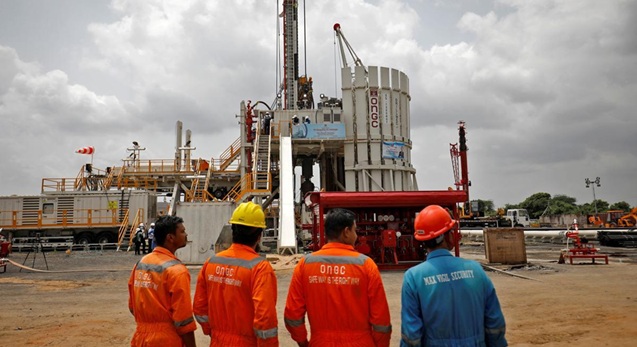
India’s disinvestment journey began in the early 1990s as part of economic liberalisation reforms. Initially, the focus was on minority stake sales to mobilise fiscal resources without relinquishing control.
The policy gained sharper ideological clarity post-2020, when the government announced a revamped framework emphasising:
The underlying rationale was that the government should minimise direct business operations, allowing private firms to manage enterprises more efficiently.
The Public Sector Enterprises Policy (2021) categorised sectors as strategic and non-strategic, proposing:
This signalled an intent to reduce the state’s commercial footprint.
Temporary Surge
In 2022–23, disinvestment revenue reached ₹35,294 crore — aided by stake sales in companies such as:
This ended a four-year declining trend.
Disinvestment proceeds fell sharply thereafter:
Policy signals reflecting reduced emphasis on privatisation include:
Challenges included:
These factors made several CPSEs unattractive to investors.
Under the 2020 Consistent Dividend Policy, the Department of Investment and Public Asset Management (DIPAM) advised CPSEs to:
Dividend receipts rose significantly:
Dividend income now exceeds disinvestment proceeds.
Launched in 2021, NMP focuses on monetising brownfield infrastructure assets via leasing arrangements.
Key features:
Approximately 90% of the ₹6 lakh crore target (2021–25) has reportedly been achieved.
This marks a significant expansion of monetisation as a fiscal tool.
1. Fiscal Stability
Provides predictable revenue through dividends and lease payments instead of one-time asset sales.
2. Political Acceptability
Asset monetisation faces less resistance compared to full-scale privatisation.
3. Retention of Ownership
The government retains control while unlocking asset value.
4. Improved Asset Utilisation
Private participation enhances operational efficiency in infrastructure use.
5. Macroeconomic Management
Helps fund infrastructure development without significantly expanding fiscal deficits.
Fiscal Risks
Excessive dividend extraction may reduce reinvestment capacity of CPSEs, weakening long-term growth.
Structural Inefficiencies
Monetisation does not resolve managerial inefficiencies within CPSEs.
Market Risks
Private participation depends on economic conditions; revenues may fluctuate.
Policy Inconsistency
Shifting from privatisation to monetisation may create uncertainty among investors.
Governance Concerns
Need for transparent bidding, strong regulation, and professional management.
FAQs1. What is the key difference between disinvestment and asset monetisation ? Disinvestment involves sale of government equity, often with transfer of ownership. Asset monetisation leases assets while retaining ownership. 2. Why has the government reduced emphasis on privatisation ? Limited investor interest, political resistance, and structural inefficiencies in CPSEs have slowed strategic sales. 3. What is the objective of the National Monetisation Pipeline ? To generate revenue by leasing brownfield infrastructure assets without transferring ownership. 4. Why are dividend receipts rising ? The government has encouraged CPSEs to distribute higher dividends under revised policy guidelines. 5. What is the main risk of over-reliance on dividends ? Excessive payouts may reduce reinvestment capacity, affecting long-term growth and competitiveness. |
| Prelims: (Science & Technology + CA) Mains: (GS 3 – Defence & Security; GS 3 – Science & Technology; GS 3 – Indigenisation of Technology & Self-Reliance) |
The President of India recently undertook a sortie in the indigenous LCH Prachand at Air Force Station Jaisalmer, Rajasthan.
The event underscores India’s growing confidence in domestically developed defence platforms and highlights advancements in indigenous aerospace manufacturing.

India’s armed forces traditionally relied on imported attack helicopters for battlefield operations, particularly in high-altitude regions such as Ladakh and Siachen. However, operational challenges in mountainous terrain and the need for altitude-specific combat platforms necessitated indigenous development.
The Light Combat Helicopter (LCH) programme was conceived to fill a critical capability gap — providing a helicopter capable of operating effectively in both desert environments and high-altitude warfare zones.
India’s evolving security environment — including high-altitude border tensions and the need for rapid-response aerial firepower — has reinforced the importance of:
The induction of Prachand marks a shift from dependency to capability creation in critical defence platforms.
This makes it particularly suited for operations in areas such as the Himalayas, where thin air and harsh climatic conditions pose technical challenges.
1. Strategic Autonomy in Defence
The development of Prachand strengthens India’s self-reliance in critical military hardware, reducing import dependency and enhancing supply chain security.
2. High-Altitude Warfare Edge
India faces persistent challenges along mountainous borders. Prachand’s altitude capability provides tactical superiority in such theatres.
3. Boost to Indigenous Aerospace Industry
4. Enhanced Deterrence Capability
Induction of advanced indigenous platforms improves India’s deterrence posture and operational readiness.
5. Economic and Strategic Multiplier
Prachand represents a convergence of policy reform, technological capability, and strategic necessity.
FAQs1. What makes LCH Prachand unique globally ? It is the only attack helicopter capable of landing and taking off at altitudes up to 5,000 metres. 2. Who developed LCH Prachand ? It has been developed by Hindustan Aeronautics Limited (HAL). 3. Why is high-altitude capability important for India ? India has significant mountainous border regions where conventional helicopters face operational limitations. 4. How does Prachand enhance survivability ? It includes armoured protection, stealth features, crash-resistant landing gear, and countermeasure systems against missiles. 5. How does LCH Prachand contribute to Atmanirbhar Bharat ? It reduces dependence on foreign military imports and strengthens indigenous defence manufacturing capacity. |
| Prelims: (International Relations + CA) Mains: (GS 2 – Bilateral Relations; GS 3 – Mineral Resources & Energy Security; GS 3 – Indigenisation of Technology & Supply Chain Resilience; GS 3 – Industrial Policy & Advanced Manufacturing) |
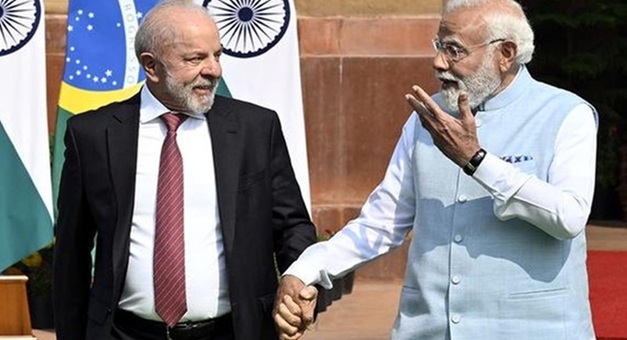
India and Brazil signed a Memorandum of Understanding (MoU) on rare earths and critical minerals during the visit of President Luiz Inácio Lula da Silva to India in February 2026.
The agreement aims to deepen cooperation across the entire mineral value chain — including exploration, mining, processing, refining, and recycling — to secure reliable access to strategic resources essential for advanced manufacturing, clean energy, electronics, and defence sectors.
The Global Critical Minerals Race
Critical minerals such as lithium, cobalt, nickel, graphite, and rare earth elements are indispensable for:
The concentration of supply chains in a few countries has created strategic vulnerabilities. As geopolitical tensions intensify, nations are prioritising supply chain diversification and resource diplomacy.
India has adopted a multi-pronged approach to strengthen its position across the critical mineral value chain.
1. National Critical Mineral Mission
In January 2025, the Union Cabinet approved the National Critical Mineral Mission (2024–25 to 2030–31) to accelerate domestic exploration, beneficiation, processing, and recovery from end-of-life products.
2. Identification of Critical Minerals
In July 2023, India released a list of 30 critical minerals essential for strategic and industrial sectors.
3. Legal and Regulatory Reforms
The Mines and Minerals (Development and Regulation) Amendment Act, 2023 empowered the Centre to auction blocks for critical and strategic minerals. Multiple auction rounds have since been conducted.
4. Overseas Resource Diplomacy
Through Khanij Bidesh India Ltd. (KABIL), India is pursuing overseas acquisitions and partnerships in countries such as Argentina and Chile to diversify sourcing.
5. Trade and Cost Rationalisation
Customs duties on certain critical minerals and recyclable scrap have been reduced to enhance domestic processing capacity.
6. Boosting Advanced Manufacturing
India aims to begin domestic production of rare-earth permanent magnets by end-2026 to reduce import dependence in sectors such as EVs and defence.
1. Access to Untapped Mineral Wealth
Brazil holds significant reserves of rare earths, lithium, bauxite, manganese, and other strategic minerals. Only about 30% of its potential reserves have been explored. The MoU opens pathways for Indian participation in exploration and downstream processing.
2. Supply Chain Diversification
By expanding partnerships beyond traditional suppliers, India reduces over-dependence on a limited number of countries, enhancing resilience against export controls or geopolitical shocks.
3. Enhanced Bargaining Power
Diversification improves India’s leverage in global mineral markets, strengthening its negotiating position on pricing and long-term contracts.
4. Boost to Domestic Manufacturing
Reliable mineral supply encourages private-sector investment in downstream industries such as battery manufacturing, electronics, and renewable energy components.
5. Standards and Sustainability Alignment
Harmonising sourcing and environmental standards may help Indian firms access global markets that demand traceable and responsible mineral supply chains.
India joined Pax Silica on February 20, 2026 — a US-led initiative aimed at securing the “silicon stack,” covering raw materials, manufacturing equipment, advanced computing, and AI hardware.
The India–Brazil MoU complements Pax Silica by strengthening upstream access to critical raw materials essential for semiconductor ecosystems.
However:
1. Value Addition Beyond Raw Exports
Brazil can move beyond exporting unprocessed ores and expand refining, processing, and recycling capacity.
2. Attracting Investment
Indian investment and long-term procurement commitments enhance project viability and financing prospects .
3. Diversified Strategic Partnerships
Partnership with India strengthens Brazil’s position in global supply chain negotiations and reduces reliance on traditional buyers.
4. Industrial Development
The agreement supports Brazil’s objective of strengthening its domestic mineral value chain and promoting industrial upgrading.
1. Strategic Resource Security
Ensures stable access to minerals vital for energy transition, defence, and digital transformation.
2. South–South Cooperation
The MoU reflects growing cooperation between emerging economies in reshaping global supply chains.
3. Energy Transition Enablement
Critical minerals are foundational for renewable energy systems and electric mobility.
4. Industrial Competitiveness
Secured supply chains enhance manufacturing competitiveness and reduce production uncertainties.
5. Geopolitical Signalling
The agreement signals India’s proactive mineral diplomacy amid intensifying global competition.
FAQs1. What is the objective of the India–Brazil Critical Minerals MoU ? To cooperate across exploration, mining, processing, refining, and recycling of rare earths and critical minerals. 2. Why are critical minerals important for India ? They are essential for electric vehicles, renewable energy, semiconductors, defence systems, and advanced electronics. 3. How does the MoU enhance India’s strategic position ? It diversifies supply sources, strengthens bargaining power, and improves long-term supply security. 4. Is Brazil part of the Pax Silica initiative ? No. The MoU is a bilateral arrangement, though it complements broader supply chain security initiatives. 5. How does this agreement benefit Brazil ? It attracts investment, supports value addition, diversifies partnerships, and enhances strategic leverage in global markets. |

Our support team will be happy to assist you!


 Contact Us
  New Batch : 9555124124/ 7428085757
  Tech Support : 9555124124/ 7428085757