- UPSC Exam
- State PCS
- One Day Exam
- Current Affairs
- PT Quiz
- Downlaods
- About Coaching
- Blog
- Videos

| Prelims : (Polity + Governance + CA) Mains : GS 2 – Governance, Policy Reforms, Law Making; GS 3 – Indian Economy, Ease of Doing Business |
Prelims
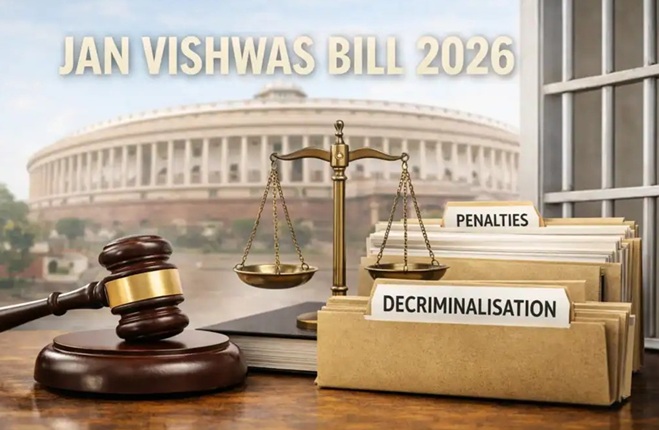
Q. With reference to the Jan Vishwas (Amendment of Provisions) Bill, 2026, consider the following statements :
Select the correct answer :
(a) 1 and 2
(b) 2 and 3
(c) 1 and 3
(d) All of the above
Mains
“Decriminalisation of minor offences is essential for improving governance and economic efficiency.” Discuss in the context of the Jan Vishwas Bill, 2026.
FAQs1. What is the Jan Vishwas Bill, 2026 ? It is a legislative reform aimed at decriminalising minor offences and simplifying compliance. 2. How many provisions have been decriminalised ? A total of 717 provisions have been decriminalised. 3. What is its main objective ? To promote ease of doing business and ease of living through rationalised laws. 4. Does it remove all penalties ? No, it replaces criminal penalties with civil penalties in many cases. 5. Why is it important ? It reduces compliance burden, improves governance, and boosts economic activity. |
| Prelims : (Economy + Current Affairs) Mains : GS 3 – Indian Economy, External Sector, Banking & Financial Markets |
Prelims
Q. With reference to Non-Deliverable Derivatives (NDDs), consider the following statements :
They involve physical delivery of the underlying currency.
They are commonly used for currencies with capital controls.
They are settled in freely convertible foreign currency.
Select the correct answer:
(a) 2 and 3
(b) 1 and 2
(c) 1 and 3
(d) All of the above
Mains
“Offshore currency markets increasingly influence domestic exchange rate stability.” Examine in the context of RBI’s recent restrictions on NDDs.
FAQs1. What are NDDs ? They are offshore derivative contracts that are settled in cash without actual exchange of the domestic currency. 2. Why do NDD markets exist ? They exist due to capital controls that restrict free trading of currencies like the Indian rupee in global markets. 3. Why is RBI restricting NDDs ? To curb speculative trading, reduce volatility, and strengthen the domestic forex market. 4. How do NDDs affect the rupee ? They influence market expectations and can exert pressure on the rupee through speculative positions. 5. What is the long-term solution ? Developing strong domestic forex markets and gradually moving towards greater capital account liberalisation. |
| Prelims : (International Relations + CA) Mains : GS 2 – International Relations, Global Governance, UN Peacekeeping |

Prelims
Q. With reference to the United Nations Interim Force in Lebanon (UNIFIL), consider the following statements :
It was established in 1978 by the UN Security Council.
It includes a maritime component to secure sea borders.
It has full authority to use force against any armed group in Lebanon.
Select the correct answer :
(a) 1 and 2
(b) 2 and 3
(c) 1 and 3
(d) All of the above
Mains
“UN peacekeeping missions face increasing challenges in conflict-prone regions.” Discuss in the context of UNIFIL.
FAQs1. What is UNIFIL ? It is a UN peacekeeping mission deployed in southern Lebanon to maintain peace and stability. 2. When was UNIFIL established ? It was established in 1978 by the UN Security Council. 3. What is its main role ? To monitor ceasefire, support the Lebanese government, and maintain peace. 4. Does India participate in UNIFIL ? Yes, India is a key troop-contributing country. 5. Why is it in news recently ? Due to the killing of peacekeepers, highlighting security risks in the region. |
| Prelims : (Polity + Current Affairs) Mains : GS 2 – Governance, Elections, Representation of People, Constitutional Provisions |
Prelims
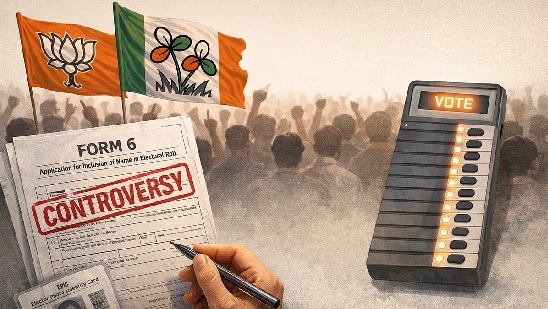
Q. With reference to voter enrolment in India, consider the following statements :
Select the correct answer :
(a) 1 only
(b) 1 and 2
(c) 2 and 3
(d) 1, 2 and 3
Mains
“Ensuring accuracy and inclusiveness in electoral rolls is a key challenge for Indian democracy.” Discuss in the context of recent controversies related to Form 6 enrolment.
FAQs1. What is Form 6 ? It is the official application form used for enrolling new voters in electoral rolls. 2. Who verifies Form 6 applications ? The Booth Level Officer conducts field verification, while the ERO takes the final decision. 3. Can a person be registered in multiple states ? No, duplicate voter registration is illegal under electoral laws. 4. Why is there controversy in West Bengal ? Due to allegations of large-scale, last-minute voter enrolment that may violate rules. 5. What is the main concern ? The potential impact on electoral integrity and fairness of elections. |
| Prelims : (Polity & Governance + CA) Mains : GS 2 – Governance, E-Governance, Welfare Schemes, Digital Administration |

Prelims
Q. With reference to the SAMPANN Platform, consider the following statements:
Select the correct answer:
(a) 1 and 2
(b) 2 and 3
(c) 1 and 3
(d) All of the above
Mains
“Digital platforms like SAMPANN are transforming governance in India.” Discuss their role in improving efficiency and transparency in public service delivery.
FAQs1. What is the SAMPANN Platform ? It is a digital system for managing pension sanction, processing, and disbursement. 2. Who manages the platform ? It is managed by the Office of the Controller General of Communication Accounts (CGCA). 3. What is its key benefit ? It ensures timely and direct transfer of pension to beneficiaries’ bank accounts. 4. When was it launched ? It was launched on 29th December 2018. 5. Why is it significant ? It enhances transparency, efficiency, and accountability in pension management. |
| Prelims : (Economy + CA) Mains : (GS 3 – Indian Economy, Infrastructure, Energy Security, Industrial Growth) |
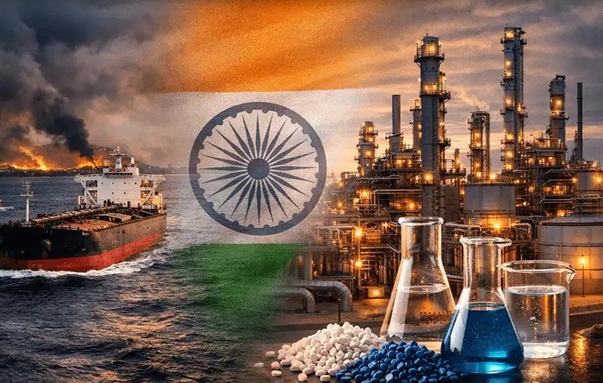
Petrochemicals refer to chemical products derived primarily from crude oil and natural gas, and they form the backbone of modern industrial production. These chemicals act as essential inputs across a wide range of sectors, thereby creating strong forward and backward linkages in the economy.
Petrochemicals play a crucial role in shaping industrial growth and economic development due to their widespread applicability and strategic importance.
India is both a producer and importer of petrochemicals; however, domestic production has not kept pace with rising industrial demand, making imports essential.
The government’s decision to exempt customs duty on key petrochemical products is a targeted and time-bound intervention aimed at stabilising supply and reducing cost pressures.
The policy decision is also closely linked to rising crude oil prices and disruptions in shipping routes caused by geopolitical tensions, including conflicts involving Iran, which have increased the cost of petrochemical inputs globally.
The exemption is expected to provide immediate relief to several industries by reducing input costs and ensuring supply continuity.
Overall, the measure is aimed at preventing industrial slowdown and cushioning the economy from external supply shocks.
The customs duty exemption reflects a strategic policy response to external economic shocks and highlights the government’s focus on industrial stability.
Despite its immediate benefits, the policy raises several concerns that need careful consideration.
The current policy reflects the classic dilemma between immediate crisis management and long-term structural reform.
✔ Core Challenge : Balancing immediate economic stabilisation with sustainable industrial resilience and self-reliance
India needs to adopt a comprehensive and forward-looking strategy to strengthen its petrochemical sector and reduce vulnerability to external shocks.
Prelims
Q. Petrochemicals are primarily derived from :
(a) Coal and biomass
(b) Crude oil and natural gas
(c) Metallic minerals
(d) Agricultural produce
Mains
“Discuss the role of petrochemicals in India’s industrial economy. Examine how recent customs duty exemptions reflect the challenges of managing global supply disruptions.”
FAQs1. Why has customs duty been exempted on petrochemicals ? To address supply disruptions, reduce input costs, and stabilise industrial production amid global uncertainties. 2. Which sectors benefit the most ? Textiles, automobiles, pharmaceuticals, and plastics are the major beneficiaries. 3. What is the duration of the exemption ? The exemption is valid till June 30, 2026. 4. What is the key concern associated with this policy ? The main concerns include fiscal loss and continued dependence on imports. 5. What is the long-term solution ? Strengthening domestic production capacity and diversifying supply sources. |

Our support team will be happy to assist you!


 Contact Us
  New Batch : 9555124124/ 7428085757
  Tech Support : 9555124124/ 7428085757