New
Hindi Medium: (Delhi) - GS Foundation (P+M) : 8th June 2026, 6:30 PM Hindi Medium: (Prayagraj) - GS Foundation (P+M) : 1st June 2026, 5:30 PM English Medium: (Prayagraj) - GS Foundation (P+M) : 7th June 2026, 8:00 AM Hindi Medium: (Delhi) - GS Foundation (P+M) : 8th June 2026, 6:30 PM Hindi Medium: (Prayagraj) - GS Foundation (P+M) : 1st June 2026, 5:30 PM English Medium: (Prayagraj) - GS Foundation (P+M) : 7th June 2026, 8:00 AM

Current Affairs for 04 June 2026

India’s Seafood Exports Reach Record High in FY 2025–26

Why in News ?

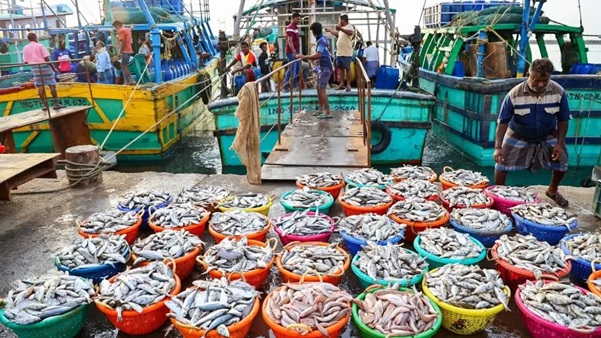
India’s seafood exports touched an all-time high in both volume and value during FY 2025–26, despite challenging global market conditions. The sector continues to play a vital role in food security, employment generation, export earnings, and sustainable livelihoods.
Key Highlights

All-Time High Exports

India exported 19,72,018 metric tonnes (MT) of seafood valued at USD 8.46 billion (₹73,890.46 crore) during FY 2025–26, registering the highest-ever export performance in terms of both quantity and value.

Frozen Shrimp Remained the Leading Export Item

  • Frozen shrimp continued to dominate India’s seafood exports, accounting for 40.19% of the total export quantity and 66.52% of total export earnings in US dollar terms. During the year, India exported 7,92,647 MT of frozen shrimp valued at USD 5,624.48 million (₹49,037.93 crore). Shrimp exports recorded a growth of 13.16% in rupee value and 8.64% in dollar value compared to the previous year.
  • The United States remained the largest importer of Indian frozen shrimp, importing 2,56,128 MT, followed by China (1,69,505 MT), the European Union (1,35,599 MT), Southeast Asia (83,810 MT), Japan (40,776 MT), the Middle East (30,478 MT), and other countries (76,351 MT). Exports of Litopenaeus vannamei (L. vannamei) and Black Tiger shrimp recorded growth in both volume and value.

Other Major Export Items

  • Frozen fish emerged as the second-largest exported seafood product, generating USD 643.70 million (₹5,658.37 crore) in export earnings. It was followed by dried seafood products, which earned USD 577.44 million (₹5,079.09 crore) and registered an impressive growth of 78.05% in rupee value terms.
  • Exports of frozen squid reached 1,02,060 MT, generating USD 513.84 million (₹4,493.80 crore). Frozen cuttlefish exports also recorded positive growth, increasing by 13.32% in quantity and 16.25% in dollar value, with exports totaling 67,157 MT valued at USD 331.96 million.
  • Chilled seafood products earned USD 71.27 million, while exports of live seafood products reached USD 62.43 million, registering a growth of 11.46% in dollar value terms.

Top Export Destinations

  • The United States and China remained the principal importers of Indian seafood during FY 2025–26.
  • The United States was the largest importer in value terms, importing seafood worth USD 2,328.74 million (₹20,263.27 crore) and a total volume of 2,79,193 MT. Frozen shrimp accounted for 93.55% of the value of India’s seafood exports to the United States. However, exports to the US declined by 10.82% in rupee value, 14.22% in dollar value, and 19.51% in volume.
  • China emerged as the largest destination in terms of quantity, importing 4,90,369 MT of Indian seafood valued at USD 1,611.32 million.
  • The European Union remained the third-largest destination in value terms, importing 2,97,518 MT worth USD 1,592.09 million. It was followed by Southeast Asia, which imported 4,51,756 MT valued at USD 1,348.97 million. Japan continued to be the fifth-largest importer with 1,05,228 MT worth USD 452.91 million, while the Middle East imported 76,743 MT valued at USD 283 million.

Top Ports Handling Seafood Exports

The top three ports handling seafood export cargo during FY 2025–26 were:

  1. Visakhapatnam Port 
  2. Jawaharlal Nehru Port 
  3. Cochin Port 

Key Policy Recommendations to Enhance Sector Competitiveness

To strengthen the competitiveness of India’s seafood sector, several policy measures have been recommended:

  • Central Scheme for Development of Indigenous Broodstock to reduce dependence on expensive and pathogen-prone imported broodstock. 
  • Central Scheme for Meeting Global Quality Standards for Seafood Products to ensure Indian seafood products comply with international quality and safety requirements. 
  • Ease of Export Measures to address country-specific export restrictions and mitigate rising freight costs. 
  • Creation of an umbrella body such as the Seafood Sector Governing Council (SSGC) to improve collaboration, infrastructure support, policy coordination, and sectoral development. 

Key Measures Taken by the Government

  • The Marine Products Export Development Authority, under the Ministry of Commerce and Industry, continues to serve as the dedicated agency for promoting seafood exports from India.
  • The government has also implemented flagship initiatives such as the Pradhan Mantri Matsya Sampada Yojana and the Fisheries and Aquaculture Infrastructure Development Fund to strengthen fisheries and aquaculture infrastructure.

Additional measures include:

  • Enhanced duty-free import limits for specified inputs used in seafood processing. 
  • Promotion of SHAPHARI certification to improve quality assurance and traceability. 

Key Challenges Persisting in India’s Seafood Sector

Despite its strong performance, the sector continues to face several challenges.

Non-Tariff Measures

  • Stringent quality regulations in importing countries remain a major hurdle. For instance, the United States rejected three seafood products from India in 2023 due to violations of Maximum Residue Level (MRL) standards.

Trade Duties

  • Anti-Dumping Duties (ADD) and Countervailing Duties (CVD) imposed by importing countries continue to affect the competitiveness of Indian seafood exports.

Raw Material Constraints

  • Exporters often face difficulties in sourcing quality raw materials due to seasonality and inconsistent supply.

Inadequate Cold Storage Infrastructure

  • Seafood products require strict temperature control throughout the supply chain. Even minor deviations can compromise freshness, texture, quality, and shelf life, making cold-chain infrastructure a critical requirement for the sector.

MAHA Water Mission: Objectives, Funding, Focus Areas and Significance

Why in News:

The Union Minister of Science & Technology recently launched the MAHA Water Mission.

Mission Objectives

  • It serves as a national platform linking science, industry, startups, academia, and communities.
  • The mission promotes innovations from laboratory research to field-level deployment.
  • It aims to strengthen India's long-term water security through scalable solutions.

Priority Focus Areas

  • It focuses on water resource assessment and sustainable management.
  • It promotes innovations in drinking water supply.
  • It addresses water quality and ecological health concerns.
  • It supports water-use efficiency and circular economy practices.
  • It strengthens climate resilience and adaptation in the water sector.

Funding and Institutional Framework

  • The mission has an outlay of ₹200 crore for five years.
  • Funding is jointly provided by the Anusandhan National Research Foundation (ANRF) and the Ministry of Jal Shakti.
  • Selected multidisciplinary consortia can receive support of up to ₹20 crore.

Innovation and Policy Relevance

  • The programme supports universities, national laboratories, startups, MSMEs, and industry partners.
  • It promotes technology validation and deployment for critical water challenges.

Kadamparai Pumped Storage Hydro Power Plant

Why in News ?

Tamil Nadu's only reversible pumped storage hydropower plant, the Kadamparai Pumped Storage Hydro Power Plant, is currently operating at nearly 25% of its installed capacity as it has exceeded its designed operational life. This has raised concerns regarding its modernization and refurbishment.

Location and Background

  • The Kadamparai Pumped Storage Hydro Power Plant is a 400 MW hydropower project located in the Kadamparai River Basin in Tamil Nadu. 
  • Commissioned in 1987, it was the first pumped storage power plant in the state and remains unique due to its reversible two-way turbine technology. 
  • The project has played a crucial role in balancing electricity demand and supply for several decades.

Working Mechanism

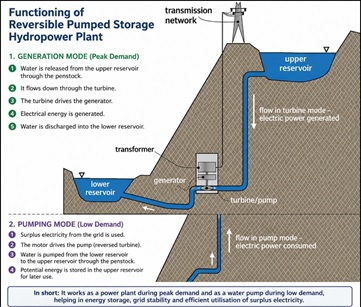
  • The project operates using two reservoirs an upper reservoir at Kadamparai Dam and a lower reservoir at Lower Aliyar Dam. 
  • During periods of peak electricity demand, water is released from the upper reservoir to the lower reservoir through turbines, generating electricity.
  • During off-peak hours, when surplus electricity is available, the same turbines operate in reverse mode and pump water back to the upper reservoir. This enables the storage of energy for future use.

Role in Renewable Energy Integration

  • The Kadamparai project serves as an important energy storage facility for renewable energy sources such as wind and solar power. Excess electricity generated during periods of high renewable output can be used to pump water back to the upper reservoir. 
  • The stored water can later be used to generate electricity when renewable generation declines or demand rises.

Significance for Energy Security

  • Pumped storage hydropower projects are often referred to as “water batteries” because they store energy on a large scale. They help stabilize the power grid, manage fluctuations in electricity demand and supply, and facilitate greater integration of renewable energy into the grid. 
  • Such projects are essential for supporting India's clean energy transition and achieving its renewable energy targets.

Challenges and the Way Forward

  • After nearly four decades of operation, the plant's aging equipment and declining efficiency have reduced its performance. Upgrading turbines, modernizing infrastructure, and undertaking life-extension measures are necessary to restore its operational efficiency. 
  • Revitalizing the Kadamparai project will strengthen Tamil Nadu’s power system and contribute to India's long-term energy security and sustainability goals.

Majuli Island: Geography, Culture, Tribes and Climate History

Why in News ?

  • A recent scientific study has reconstructed nearly 4,000 years of climate and vegetation history of Majuli Island, providing valuable insights into long-term environmental changes in the Brahmaputra floodplain. 
  • The findings help researchers understand how climate variability, monsoon patterns, and river dynamics have shaped the island's ecosystem and human settlements over millennia.


Geographical Importance

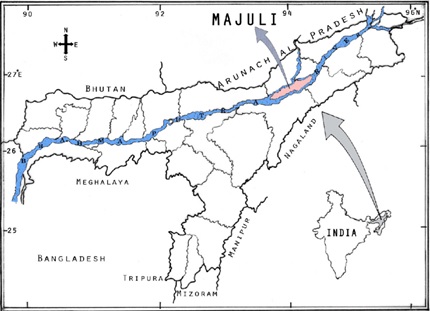
  • Majuli is situated in the middle of the mighty Brahmaputra River in the state of Assam. 
  • It is widely recognized as the world's largest inhabited river island. 
  • Covering a vast floodplain landscape, Majuli serves as an important ecological zone supporting wetlands, grasslands, and riverine biodiversity. 
  • In 2016, Majuli was officially declared the first island district of Assam. 

Formation and Physical Features

  • The island was formed through centuries of sediment deposition and channel migration by the Brahmaputra and its tributaries. 
  • The Brahmaputra River forms its southern boundary, while the Kherkutia Xuti channel and the Subansiri River define its northern side. 
  • Majuli's landscape consists of fertile alluvial soils, marshlands, oxbow lakes, and seasonal floodplains. 
  • The island faces severe challenges from riverbank erosion, frequent flooding, and shifting river courses, leading to significant land loss over the past century. 
  • These geomorphological changes continue to influence settlement patterns and agricultural practices. 

Society and Economy

  • Agriculture remains the backbone of Majuli's economy, with rice cultivation being the primary occupation. 
  • Traditional rice varieties such as Komal Saul (soft rice) and Bao Dhan (deep-water rice) are well adapted to the flood-prone environment. 
  • Fishing, livestock rearing, handloom weaving, pottery, and handicrafts also contribute significantly to local livelihoods. 
  • The island's economy reflects a close relationship between local communities and the river ecosystem. 

Tribes and Communities

  • Majuli is home to diverse ethnic groups, creating a rich multicultural society. 
  • The major indigenous communities include the Mishing, Deori, Sonowal Kachari, Ahom, and Koch groups. 
  • The Mishing tribe, one of the largest communities on the island, is known for its stilt houses (Chang Ghar), traditional weaving, and vibrant festivals such as Ali-Aye-Ligang. 
  • These communities have developed unique flood-adaptive lifestyles and sustainable resource-use practices over generations. 

Cultural Heritage

  • Majuli is regarded as the spiritual and cultural heartland of Assamese Neo-Vaishnavism. 
  • The Bhakti movement in Assam was led by Srimanta Sankardeva and his disciple Madhavdeva during the 15th–16th centuries. 
  • The island is renowned for its Satras (Vaishnavite monasteries), which function as centres of religion, art, literature, education, and social reform. 
  • Prominent Satras include Auniati Satra, Kamalabari Satra, and Dakhinpat Satra. 
  • Majuli is famous for traditional mask-making (Mukha Shilpa), pottery without the use of a potter's wheel, boat-building craftsmanship, folk music, and the classical Sattriya Dance, which is recognized as one of India's eight classical dance forms. 

Climate and Environmental History

  • The recent climate reconstruction study indicates that Majuli has experienced significant shifts in rainfall intensity, vegetation cover, and flood regimes over the last 4,000 years. 
  • Variations in monsoon strength influenced forest expansion, grassland development, and agricultural potential across different periods. 
  • The study highlights the close relationship between climate change, river dynamics, and human adaptation in the Brahmaputra valley. 
  • Understanding this long-term environmental history is crucial for developing strategies to address contemporary challenges such as erosion, flooding, and climate change. 

Halma Tradition: A Unique Heritage of Collective Action, Voluntary Labour, and Environmental Conservation in Bhil Society

Why in News ?

  • Recently, residents of Borpada village in Jhabua district of Madhya Pradesh revived the traditional Halma practice of the Bhil community to clean and restore a public well. 
  • This initiative not only serves as an example of water conservation but also demonstrates the power of community unity and public participation. 

What is the Halma Tradition ?

  • Halma is an ancient collective tradition practiced by the Bhil tribal community of Madhya Pradesh. Its fundamental meaning is working together for a common cause without wages, contracts, or formal orders. 
  • It is not merely voluntary labour but a living expression of responsibility toward the community, mutual cooperation, and social trust. 
  • The spirit of Halma is based on the belief that every member of society shares in the joys, sorrows, and needs of others. 

Historical Background

  • The roots of Halma go back to a time when tribal communities had neither significant financial resources nor government support, nor a developed market system. To survive difficult circumstances, people relied on mutual cooperation as their greatest asset. 
  • Out of this necessity emerged traditions like Halma, through which the entire community came together to accomplish tasks for an individual, a family, or the collective good. 

How Does Halma Work ?

  • Whenever a family or community faces a major task, such as Construction of a house ,Repair of agricultural embankments,Restoration of ponds or wells ,Construction of irrigation structures ,Organization of community events they invoke Halma.
  • In response, dozens or even hundreds of villagers voluntarily gather at the designated site, bringing their own tools, food, and labour, and work together until the task is completed. 

Key Features

  • There is no formal leader. 
  • No wages are paid. 
  • No written contract is involved. 
  • Participation is driven by voluntary spirit and a sense of social responsibility. 

Social and Cultural Features of Halma

1. Collective Responsibility

Halma considers every individual an integral part of the community. The problem of one person is regarded as the concern of the entire community.

2. Mutual Cooperation

If an individual helps others today, they can expect support from the community when they need assistance in the future.

3. Building Social Capital

The tradition strengthens trust, unity, and social relationships among community members.

4. Democratic Participation

Decisions and actions under Halma are carried out collectively. No hierarchical authority or power structure dominates the process.

5. Preservation of Cultural Heritage

The tradition helps preserve the cultural identity and traditional knowledge systems of the Bhil community.

Role of Halma in Environmental Conservation

  • In recent years, Halma has expanded beyond social activities and has been increasingly used to address environmental challenges. 
  • The following activities are being undertaken through Halma: 

Water Conservation

  • Restoration of traditional ponds, wells, and water bodies 
  • Cleaning and deepening of water sources 
  • Construction of rainwater harvesting structures 

Afforestation

  • Plantation drives on barren hills 
  • Community-led forest conservation 

Soil Conservation

  • Construction of contour trenches 
  • Measures to prevent soil erosion 

Biodiversity Conservation

  • Protection of habitats of local flora and fauna 
  • Utilization of traditional ecological knowledge 

Importance in Combating Climate Change

Community initiatives such as Halma can play a significant role in mitigating the impacts of climate change.

Through Halma:

  • Groundwater levels improve. 
  • Water availability increases in drought-prone regions. 
  • Green cover expands. 
  • Carbon sequestration capacity increases. 
  • Local ecosystems become more resilient and sustainable. 

Relevance in the Modern Context

  • At a time when society is increasingly moving toward individualism, Halma reminds us of the importance of collective action and cooperation. 
  • The tradition demonstrates that development does not depend solely on government schemes or financial resources; active community participation and social solidarity can also be powerful drivers of change. 
  • In tribal regions of Madhya Pradesh, particularly Jhabua and Alirajpur, Halma has produced numerous successful examples of water conservation, ecological restoration, and community development. 
« »
  • SUN
  • MON
  • TUE
  • WED
  • THU
  • FRI
  • SAT
Have any Query?

Our support team will be happy to assist you!

OR