
Current Affairs for 05 November 2026

VISTAR Scheme 2026: Cabinet Approves ₹4,371 Crore to Modernise India’s Statistical System

Why in News?

  • On 4 November 2026, the Union Cabinet, chaired by Prime Minister Narendra Modi, approved the Viksit Bharat Initiative for Statistical Transformation, Analytics & Research (VISTAR) Scheme.
  • The scheme has a total financial outlay of ₹4,371.10 crore for five years, from FY 2026–27 to FY 2030–31.

Key Facts at a Glance

Particular

Details

Scheme

VISTAR Scheme

Full Form

Viksit Bharat Initiative for Statistical Transformation, Analytics & Research

Approval Date

4 November 2026

Approved By

Union Cabinet

Chairperson

Prime Minister Narendra Modi

Total Outlay

₹4,371.10 crore

Implementation Period

FY 2026–27 to FY 2030–31

Duration

5 years

Type

Central Sector Scheme

Nodal Ministry

Ministry of Statistics and Programme Implementation (MoSPI)

Surveys Proposed

59

Previous Major Surveys

43

Economic Census

8th Economic Census

State Support Framework

SSS 2.0

Technologies

AI, ML, Digital Data Processing

Long-term Vision

Viksit Bharat 2047

Objectives of the VISTAR Scheme

  1. Statistical Modernisation: Develop a dynamic, technology-driven and future-ready national statistical system.
  2. Timely Data Availability: Improve the frequency, accuracy and accessibility of official statistics.
  3. Digital Transformation: Integrate AI, ML and automated data-processing technologies.
  4. Data Integration: Improve interoperability and harmonisation across statistical databases.
  5. Strengthening Local Statistics: Expand district-level and city-level statistical information.
  6. Evidence-Based Governance: Support policy formulation, monitoring and resource allocation using reliable data.

Three Major Components of the VISTAR Scheme

Component

Major Provisions

1. Comprehensive Statistical Operations and Strengthening of Ecosystem

Expansion of national surveys, AI integration, digitalisation and statistical research

2. Support for Statistical Strengthening (SSS 2.0)

Financial and technical assistance to States and Union Territories for strengthening statistical capabilities

3. Economic Census (EC)

Conducting the 8th Economic Census and developing the National Statistical Business Register

Key Features of the VISTAR Scheme

1. Expansion of National Statistical Surveys

  • MoSPI proposes to conduct 59 surveys during the 16th Finance Commission cycle, compared with 43 major surveys conducted previously.
  • The expanded survey programme aims to address critical information gaps across different sectors.
  • It will improve the availability of reliable statistical evidence for government programmes and policy decisions.

2. Integration of Artificial Intelligence and Machine Learning

  • AI and ML will be incorporated into regular statistical workflows, particularly data processing, validation and analysis.
  • End-to-end digitalisation will help modernise data collection, processing and dissemination.
  • The initiative aims to develop harmonised, machine-readable and AI-ready statistical datasets.

3. Introduction of New Statistical Indicators

MoSPI plans to introduce new indicators to improve the measurement of economic activities.

Proposed Indicator

Purpose

Headline Index of Services Production

Measure changes in production or output across the services sector

Index of Unincorporated Sector Enterprises

Improve statistical monitoring of enterprises operating in the unincorporated sector

These indicators are proposed under the scheme and should not be treated as already operational.

4. Use of Alternative Data Sources

  • Traditional surveys will be complemented by alternative sources, including mobile phone data, retail scanner data and e-commerce information.
  • These sources can help address information gaps and reduce the burden on survey respondents.
  • Data harmonisation, interoperability, sharing protocols and privacy-by-design principles will support more secure and integrated statistical systems.

5. Strengthening State and District-Level Statistics

  • Under SSS 2.0, States and Union Territories will receive financial assistance through a redesigned, deliverable-linked framework.
  • MoSPI will provide technical support to expand estimates at district level and for cities with populations of at least one million.
  • The initiative will also strengthen the compilation of State and District GDP estimates and State-level Index of Industrial Production (IIP) data.

6. Capacity Building and Research

  • The scheme will provide internship opportunities for students.
  • Academic and research institutions will be encouraged to submit research proposals.
  • These measures aim to strengthen statistical research, technical expertise and institutional capacity.

Major National Surveys Covered Under VISTAR

Survey

Full Form

Major Focus

PLFS

Periodic Labour Force Survey

Employment, unemployment and labour market indicators

HCES

Household Consumption Expenditure Survey

Household expenditure and consumption patterns

ASUSE

Annual Survey of Unincorporated Sector Enterprises

Economic activities and characteristics of unincorporated non-agricultural enterprises

IIP

Index of Industrial Production

Changes in industrial production

8th Economic Census under VISTAR

  • MoSPI will conduct the 8th Economic Census in collaboration with States and Union Territories.
  • The exercise will collect information about non-farm establishments, their economic activities and workers employed.
  • Data collection will extend to Gram Panchayat and municipal ward levels.
  • The census will support the assessment of India's unorganised economic sector.
  • It will also provide the foundation for developing a National Statistical Business Register (SBR), facilitating targeted enterprise surveys.
  • The findings are expected to improve estimates of the unorganised sector's contribution to GDP. 

Significance of the VISTAR Scheme

  • Evidence-Based Policymaking: Reliable and timely statistics will help governments formulate and evaluate development policies.
  • Economic Planning: Improved economic indicators will support better assessment of growth, employment and industrial activities.
  • Strengthening Cooperative Federalism: Financial and technical support will enhance the statistical capabilities of States and Union Territories.
  • Local-Level Development: District-level and city-level information will facilitate targeted development programmes.
  • Digital Governance: AI-enabled processing and integrated datasets will improve administrative efficiency.
  • Viksit Bharat 2047: Modern statistical infrastructure will strengthen the monitoring and evaluation of India's long-term development objectives.

Challenges

  • Data Privacy and Security: Greater use of alternative data sources may create risks relating to personal information and data protection.
  • Digital Infrastructure Gaps: Differences in technological capacity among States may affect implementation.
  • Data Quality: Integrating conventional surveys with digital and alternative datasets requires careful validation.
  • Institutional Coordination: Effective implementation will require cooperation between central agencies, States and statistical institutions.
  • Skill Requirements: AI-driven statistical systems require trained professionals and continuous technical capacity building.

Way Forward

  • Strengthen Data Governance: Establish robust data protection, transparency and accountability mechanisms.
  • Improve State Capacity: Provide sustained training, financial assistance and digital infrastructure support.
  • Ensure Statistical Reliability: Maintain scientific methodology, independent validation and quality-control standards.
  • Promote Interoperability: Develop common data standards and efficient data-sharing arrangements.
  • Encourage Research: Expand collaboration with universities, research institutions and statistical experts.
  • Monitor Implementation: Evaluate progress through measurable indicators, regular assessments and institutional reviews.

Conclusion

The VISTAR Scheme represents a major initiative to modernise India's official statistical system through digital transformation, AI integration and expanded statistical surveys. By strengthening state-level statistical capabilities and improving economic data collection, the scheme can support more accurate, transparent and evidence-based policymaking. Its effective implementation will be important for strengthening India's statistical infrastructure and advancing the objectives of Viksit Bharat 2047.

Prelims Practice Question

Q. With reference to the VISTAR Scheme, consider the following statements:

  1. It is a Central Sector Scheme implemented by the Ministry of Statistics and Programme Implementation.
  2. It proposes to conduct the 8th Economic Census in collaboration with States and Union Territories.
  3. It aims to integrate Artificial Intelligence and Machine Learning into statistical processes.

Which of the statements given above are correct?

(a) 1 and 2 only

(b) 2 and 3 only

(c) 1 and 3 only

(d) 1, 2 and 3

Mains Practice Question

Q. Discuss the role of the VISTAR Scheme in modernising India's statistical infrastructure and strengthening evidence-based policymaking.

FAQs

1. What is the VISTAR Scheme?

The VISTAR Scheme is a Central Sector initiative approved in November 2026 to modernise India's official statistical system through digital technologies, advanced analytics and stronger data governance.

2. What is the total budget of the VISTAR Scheme?

The Union Cabinet approved ₹4,371.10 crore for the five-year period from FY 2026–27 to FY 2030–31.

3. Which ministry is responsible for implementing VISTAR?

The Ministry of Statistics and Programme Implementation (MoSPI).

4. What are the three components of the VISTAR Scheme?

Comprehensive Statistical Operations and Strengthening of Ecosystem, Support for Statistical Strengthening, and Economic Census.

5. How many surveys are proposed under VISTAR?

MoSPI proposes to conduct 59 surveys during the 16th Finance Commission cycle.

International Day for Preventing the Exploitation of the Environment in War and Armed Conflict

Why in news?

The International Day for Preventing the Exploitation of the Environment in War and Armed Conflict is observed annually on 6 November to draw global attention to the environmental consequences of armed conflicts.

Key facts

Particular

Details

Observance

6 November

Established by

United Nations General Assembly

Established in

2001

Resolution

A/RES/56/4

Adopting body

56th Session of UN General Assembly

Key environmental organisation

UNEP

Important convention

ENMOD Convention, 1976

Important legal framework

Additional Protocol I, 1977

Important articles

Articles 35(3) and 55

ICC provision

Article 8(2)(b)(iv)

Related concept

Environmental Peace building

ILC development

28 Draft Principles, 2019

Background and History

  • 1976: Convention on the Prohibition of Military or Any Other Hostile Use of Environmental Modification Techniques (ENMOD) was adopted.
  • 1977: Additional Protocols I and II to the Geneva Conventions were adopted, providing important protections relevant to the environment during armed conflicts.
  • 2001: UN General Assembly declared 6 November as the International Day through Resolution A/RES/56/4.
  • 2008: UNEP established its Environmental Cooperation for Peace building programme.
  • 2016: United Nations Environment Assembly adopted Resolution UNEP/EA.2/Res.15 on the protection of the environment in areas affected by armed conflict.
  • 2019: International Law Commission adopted 28 Draft Principles on Protection of the Environment in Relation to Armed Conflicts.

Why does the Environment become a Victim of War?

  • Deforestation: Forests are cleared or burned for military operations.
  • Water Pollution: Oil spills, chemicals and damaged infrastructure contaminate water sources.
  • Soil Degradation: Explosives, landmines and toxic substances damage agricultural land.
  • Biodiversity Loss: Wildlife habitats are destroyed, threatening endangered species.
  • Air Pollution: Bombings, industrial fires and burning oil facilities release harmful pollutants
  • Resource Exploitation: Timber, minerals, oil and other natural resources may be illegally extracted to finance armed groups.

Important Global Facts and Statistics

Key Fact

Details

Natural resources and conflict

At least 40% of internal conflicts over the previous 60 years were linked to natural resource exploitation, according to the UNEP finding cited by the UN.

Conflict recurrence

Conflicts involving natural resources were found to be twice as likely to relapse.

Biodiversity hotspots

Armed conflicts have occurred in more than two-thirds of the world's biodiversity hotspots over six decades.

Long-term consequences

Environmental damage can continue beyond the period of conflict and across national boundaries.

International Legal Frameworks for Environmental Protection during War

A. ENMOD Convention, 1976

  • Full name: Convention on the Prohibition of Military or Any Other Hostile Use of Environmental Modification Techniques.
  • Adopted by the UN General Assembly on 10 December 1976, through Resolution 31/72.
  • Opened for signature on 18 May 1977.
  • Entered into force on 5 October 1978.
  • It prohibits the hostile use of environmental modification techniques as a means of warfare when they produce widespread, long-lasting or severe effects. 

B. Additional Protocol I to the Geneva Conventions, 1977

  • Adopted on 8 June 1977.
  • Article 35(3): Prohibits methods or means of warfare intended or expected to cause widespread, long-term and severe damage to the natural environment.
  • Article 55: Specifically deals with the protection of the natural environment during warfare and prohibits environmental damage that prejudices the health or survival of the population.

C. Rome Statute of the International Criminal Court, 1998

  • The Rome Statute established the International Criminal Court (ICC).
  • Article 8(2)(b)(iv) recognises certain attacks causing environmental damage as a war crime.
  • It covers intentionally launching an attack with knowledge that it will cause widespread, long-term and severe damage to the natural environment, where such damage would be clearly excessive in relation to the anticipated concrete and direct overall military advantage.
  • This particular provision applies to international armed conflicts.

D. International Law Commission (ILC), 2019

  • The International Law Commission adopted 28 Draft Principles on the Protection of the Environment in Relation to Armed Conflicts in 2019.
  • These principles address environmental protection across three stages: Before, during and after armed conflict.
  • Their objective is to strengthen environmental protection through international law and promote environmental recovery after conflicts. 

Role of International Organisations

  • United Nations (UN): Promotes international cooperation and environmental protection during conflicts.
  • UNEP: Assesses environmental damage and supports environmental recovery.
  • International Committee of the Red Cross (ICRC): Promotes compliance with International Humanitarian Law (IHL).
  • International Criminal Court (ICC): Prosecutes individuals for crimes within its jurisdiction, including qualifying environmental war crimes.
  • UNDP: Supports recovery, sustainable development and institutional rebuilding in conflict-affected regions.

Examples of Environmental Destruction during Armed Conflicts

  • Vietnam War: Use of Agent Orange caused extensive deforestation and long-term chemical contamination.
  • Gulf War (1990-91): Burning oil wells in Kuwait caused severe air pollution and environmental damage.
  • Iraq Conflict: Burning oil facilities and industrial sites released toxic pollutants into the environment.
  • Ukraine Conflict: Military activities have created risks of land contamination, forest fires and pollution of soil and water.

Environmental Peace building: Meaning and Importance

  • The use of environmental cooperation and sustainable natural resource management to prevent conflicts, build trust between communities and promote lasting peace.
  • It recognises that competition over water, forests, minerals and agricultural land can contribute to conflict, while cooperation over these resources can support peace.
  • Its major objectives include:
    • Preventing conflicts arising from natural resource scarcity.
    • Promoting cooperation over shared water resources.
    • Rebuilding ecosystems damaged during warfare.
    • Supporting sustainable livelihoods in conflict-affected communities.
    • Integrating environmental protection into peacebuilding policies.

Prelims MCQ

Q. Consider the following statements regarding the ENMOD Convention:

  1. It was adopted in 1976.
  2. It prohibits the hostile use of environmental modification techniques.
  3. It was adopted under the framework of the United Nations.

Which of the statements given above are correct?

A. 1 and 2 only
B. 2 and 3 only
C. 1 and 3 only
D. 1, 2 and 3

Mains Practice Question

Q. Discuss the impact of armed conflicts on natural ecosystems and biodiversity. 

FAQs

When is the International Day for Preventing the Exploitation of the Environment in War and Armed Conflict observed?

It is observed annually on 6 November.

When was this international day established?

It was established in 2001 by the United Nations General Assembly.

Which UN resolution established this day?

UN General Assembly Resolution A/RES/56/4.

Which articles of Additional Protocol I protect the natural environment?

Articles 35(3) and 55.

Which UN organisation plays a major role in assessing environmental damage caused by armed conflicts?

The United Nations Environment Programme (UNEP).

Cabinet extends Fast Track Special Courts Scheme till 2031: Key facts, Background, Major Objectives and Challenges

Why in news?

On 4 November 2026, the Union Cabinet approved the continuation and expansion of the Fast Track Special Courts Scheme for the period 2026-27 to 2030–31.

Key Facts

Particular

Details

Scheme

Fast Track Special Courts (FTSCs)

Approved by

Union Cabinet

Approval date

4 November 2026

Extension period

1 April 2026-31 March 2031

Total duration

5 years

Existing courts

779

Proposed courts

850

Additional courts

71

Total financial outlay

₹3,788.04 crore

Central Government share

₹2,353.15 crore

States/UTs share

₹1,434.89 crore

Central funding source

Nirbhaya Fund

Nodal Department

Department of Justice

Main beneficiaries

Women and children who are victims of sexual offences

What are Fast Track Special Courts (FTSCs)?

  • Dedicated courts established to ensure the speedy trial and disposal of specific categories of criminal cases.
  • In India, Fast Track Special Courts under this centrally sponsored scheme primarily deal with pending rape cases and cases involving sexual offences against children under the Protection of Children from Sexual Offences (POCSO) Act, 2012.
  • These courts aim to reduce delays in judicial proceedings by providing dedicated judicial officers, prosecutors and supporting personnel.

Major Objectives of FTSCs

  • Speedy Justice: Ensure faster disposal of rape and POCSO cases.
  • Reduce Pendency: Reduce the backlog of pending sexual offence cases.
  • Victim Protection: Provide a safe and supportive environment for survivors.
  • Child-Friendly Justice: Facilitate sensitive handling of child victims.
  • Judicial Efficiency: Improve the efficiency of the criminal justice system through dedicated resources.

Background: When and Why Was the Scheme Launched?

  • The Fast Track Special Courts Scheme was launched on 2 October 2019 by the Central Government.
  • Its introduction was closely associated with the need to strengthen the judicial mechanism for dealing with sexual offences, particularly following the Criminal Law (Amendment) Act, 2018.

Important developments

  • 2012: Protection of Children from Sexual Offences (POCSO) Act was enacted.
  • 2013: Criminal Law (Amendment) Act strengthened legal provisions relating to sexual offences.
  • 2018: Criminal Law (Amendment) Act introduced stricter provisions, including enhanced punishment for rape and sexual offences against children.
  • 25 July 2019: Supreme Court issued directions in Suo Motu Writ (Criminal) No. 1/2019 regarding special courts for POCSO cases.
  • 2 October 2019: Centrally Sponsored Scheme for Fast Track Special Courts was launched.
  • 2026: Union Cabinet approved its continuation until 31 March 2031 and expansion to 850 courts.

Supreme Court's Role

  • On 25 July 2019, the Supreme Court issued directions in Suo Motu Writ (Criminal) No. 1/2019 concerning the establishment of exclusive Special Courts in districts having more than 100 pending cases under the POCSO Act.
  • This direction became an important foundation for the establishment of dedicated Fast Track Special Courts across the country. 

Financial Structure of the Scheme

  • The government has approved a total financial outlay of ₹3,788.04 crore for the five-year extension.
  • The funding will be shared between the Central Government and participating States/UTs.

What is the Nirbhaya Fund?

  • The Nirbhaya Fund is a non-lapsable corpus established by the Government of India in 2013 to support initiatives aimed at improving the safety and security of women.
  • It was created following the 2012 Delhi gang rape case, which generated nationwide concern about women's safety.

Particular

Details

Established

2013

Established by

Government of India

Nature

Non-lapsable corpus

Purpose

Women's safety and security

Funding source for FTSC

Central Government's share

How will each Fast Track Special Court function?

Position

Number

Responsibility

Judicial Officer

1

Presides over proceedings and conducts trials.

Special Public Prosecutor

1

Represents the prosecution and presents the case before the court.

Support Staff

6

Provides administrative, clerical and other court-related assistance.

Total dedicated personnel

8

Supports the functioning of each court.

What is the POCSO Act, 2012?

  • The Protection of Children from Sexual Offences (POCSO) Act, 2012 is a special legislation enacted to protect children from sexual assault, sexual harassment and pornography.
  • It came into force on 14 November 2012.
  • The Act provides a child-friendly system for reporting, recording evidence, investigation and trial of offences.

Important Features of the POCSO Act

Feature

Details

Full Name

Protection of Children from Sexual Offences Act

Year

2012

Effective Date

14 November 2012

Nodal Ministry

Ministry of Women and Child Development

Definition of Child

Any person below 18 years of age

Nature

Gender-neutral legislation

Special Courts

Provision for Special Courts for speedy trials

Main Objective

Protection of children from sexual offences

Important Provisions of the POCSO Act

  • Section 3: Penetrative Sexual Assault
  • Section 5: Aggravated Penetrative Sexual Assault
  • Section 7: Sexual Assault
  • Section 9: Aggravated Sexual Assault
  • Section 11: Sexual Harassment
  • Section 13: Use of Child for Pornographic Purposes
  • Section 28: Designation of Special Courts
  • Section 29: Presumption as to Certain Offences
  • Section 30: Presumption of Culpable Mental State
  • Section 33: Procedure and Powers of Special Courts
  • Section 35: Period for Recording Evidence of Child and Disposal of Case

Existing Status and Performance of Fast Track Special Courts

Indicator

Status

Participating States/UTs

29

Functional FTSCs

779

Exclusive POCSO Courts

399

Total cases disposed of since inception

4,02,457

Proposed number of courts

850

What are Vulnerable Witness Deposition Centres (VWDCs)?

  • These centres aim to provide a supportive environment for vulnerable witnesses, particularly children and survivors of sexual offences, while recording their statements.
  • Key Features are: 
    • Safe Environment: Provides a more comfortable environment for vulnerable witnesses.
    • Reduced Trauma: Helps reduce the psychological stress associated with court proceedings.
    • Privacy: Supports privacy and protection during testimony.
    • Child-Friendly Facilities: Encourages age-appropriate arrangements for child witnesses.
    • Better Testimony Process: Helps witnesses participate in judicial proceedings with greater confidence.

Role of the Department of Justice in Implementation

  • Monitoring: Tracking the performance of FTSCs through the online FTSC Dashboard.
  • Progress Reviews: Collecting periodic reports from participating States and UTs.
  • Coordination: Consulting High Courts and State Governments.
  • Financial Monitoring: Reviewing expenditure statements and utilisation of funds.
  • Expansion: Identifying additional districts based on case pendency.
  • Performance Evaluation: Monitoring disposal of pending rape and POCSO cases.

Challenges in the Effective Implementation of FTSCs

  • Judicial Vacancies: Shortage of judges can affect the functioning of specialised courts.
  • Infrastructure Gaps: Several districts require better courtrooms and supporting facilities.
  • Increasing Case Pendency: New cases may continue to enter the judicial system faster than cases are disposed of.
  • Victim Protection: Survivors may face social stigma, intimidation and psychological pressure during trials.
  • Quality of Investigation: Delays in investigation and collection of evidence can slow down trials even in specialised courts.

Prelims MCQ

Q. With reference to Fast Track Special Courts (FTSCs), consider the following statements:

  1. The scheme was launched in October 2019.
  2. The scheme deals with pending rape and POCSO Act cases.
  3. The Central Government's contribution under the extended scheme will be funded through the Nirbhaya Fund.

Which of the statements given above are correct?

A. 1 and 2 only
B. 2 and 3 only
C. 1 and 3 only
D. 1, 2 and 3

Mains Practice Question

Q. Critically examine the role of the POCSO Act, 2012, in protecting children from sexual offences. 

FAQs

What is the Fast Track Special Courts Scheme?

Centrally Sponsored Scheme launched in 2019 to ensure speedy trials of pending rape and POCSO Act cases.

When was the scheme extended until 2031?

On 4 November 2026.

How many Fast Track Special Courts are proposed under the extended scheme?

A total of 850 courts, compared with the existing 779.

Which fund will finance the Central Government's contribution?

The Nirbhaya Fund.

When was the POCSO Act implemented?

14 November 2012.

Indian Universities Slip in QS Asia Rankings; No IIT or IISc in Top 50

Why in News?

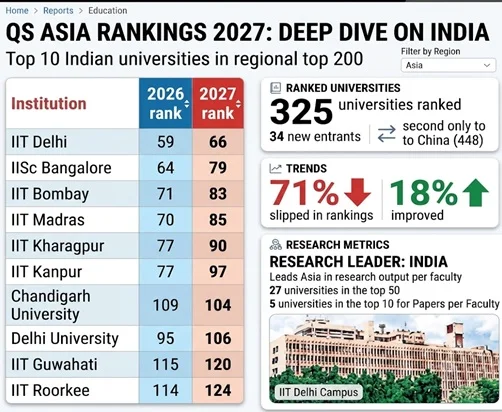
  • Indian universities have failed to secure a place in the top 50 of the QS World University Rankings: Asia 2027 for the second consecutive year. The rankings, released by QS Quacquarelli Symonds, show that all six of India's highest-ranked institutions have slipped in the latest edition.
  • Despite the decline in rankings, India has increased its overall representation, with 325 universities featured in the list, compared to 294 in the previous year.

Key Highlights of QS Asia University Rankings 2027

  • No Indian university in the Top 50: For the second consecutive year, no Indian institution has secured a position among Asia's top 50 universities.
  • IIT Delhi leads India: IIT Delhi is India's highest-ranked institution at 66th position, down from 59th last year.
  • IISc Bengaluru: Its ranking has dropped from 64th to 79th.
  • IIT Bombay: It has slipped from 71st to 83rd position.
  • IIT Madras: Its position has declined from 70th to 85th.
  • IIT Kharagpur: It has fallen from 77th to 90th.
  • IIT Kanpur: It has dropped from 77th to 99th.
  • Delhi University: It has moved from 95th to 106th position, falling outside the top 100.

India's Growing Presence in Asian Rankings

Despite the decline in the positions of leading institutions, India's overall representation in the QS Asia Rankings has increased significantly.

  • India has 325 universities in the 2027 rankings, compared to 294 in 2026.
  • India is the second most represented higher education system in Asia.
  • The latest edition includes 34 new Indian universities.
  • Since 2016, the number of ranked Indian institutions has increased from 24 to 325, representing growth of more than 1,250%.
  • This growth is higher than that of several other major Asian higher education systems, including China, Indonesia, Japan and South Korea.

India's Strengths in Research and Doctoral Education

Although Indian universities have slipped in overall rankings, the country continues to perform strongly in research output and doctoral education.

1. Strong Research Output

  • India leads Asia in research output relative to academic staff, measured through the QS Papers per Faculty indicator.
  • A total of 27 Indian universities feature in Asia's top 50 for this indicator.
  • Five Indian universities are among the top 10, while two are in the top five.

2. Strength in Doctoral Education

  • Fifteen Indian universities share the first position in Asia for the proportion of academic staff holding PhD qualifications.
  • This highlights India's growing capacity in advanced research and higher education.

Research Impact Remains a Major Challenge

Despite strong research output, India has not achieved comparable performance in research impact.

  • Only three Indian universities feature in Asia's top 50 for Citations per Paper.
  • This indicator measures how frequently published research is cited by other researchers.
  • The gap suggests that higher research output has not yet translated into equally strong global research recognition and influence.

Indian Universities That Improved Their Rankings

  • While most leading Indian institutions experienced a decline, some universities improved their positions.
  • These include:
    • Chandigarh University
    • Lovely Professional University
    • Jamia Millia Islamia

What Did QS Say?

  • QS Senior Vice-President Ben Sowter highlighted India's growing research capacity but emphasised the need to improve research impact and international recognition.
  • According to him, India has established a strong foundation in research, but it must now focus on translating research output into greater academic influence and international recognition.

Conclusion

The QS Asia University Rankings 2027 present a mixed picture of India's higher education system. The increasing number of Indian universities in the rankings reflects the expansion of higher education and research capacity. However, the decline of leading institutions highlights the need to improve research quality, citations, international collaboration and global academic reputation.

India must focus not only on increasing the number of ranked universities but also on improving their overall academic performance and international competitiveness.

Prelims Practice Question 

1. With reference to the QS World University Rankings: Asia 2027, consider the following statements:

  1. QS Quacquarelli Symonds releases the QS World University Rankings.
  2. IIT Delhi is the highest-ranked Indian institution in the QS Asia Rankings 2027.
  3. India has the highest number of universities in Asia's top 50 for Citations per Paper.

Which of the statements given above is/are correct?

(a) 1 and 2 only
(b) 2 and 3 only
(c) 1 and 3 only
(d) 1, 2 and 3

Mains Practice Question

Q. Despite significant growth in research output and doctoral capacity, Indian universities continue to face challenges in global academic rankings. Discuss the major reasons behind this gap and suggest measures to improve the global competitiveness of India's higher education system.

FAQs

1. What is the QS World University Rankings: Asia?

It is an annual ranking of Asian universities released by QS Quacquarelli Symonds to evaluate their academic performance, research, internationalisation and other indicators.

2. Which is India's highest-ranked institution in the QS Asia Rankings 2027?

IIT Delhi is India's highest-ranked institution, securing the 66th position.

3. How many Indian universities are included in the QS Asia Rankings 2027?

A total of 325 Indian universities feature in the rankings, compared to 294 in the previous year.

4. What is the Papers per Faculty indicator?

It measures research output relative to the number of academic staff at a university.

5. What does Citations per Paper measure?

It measures the research impact of published academic papers based on how frequently other researchers cite them.

upsc english
« »
  • SUN
  • MON
  • TUE
  • WED
  • THU
  • FRI
  • SAT