Why in news?
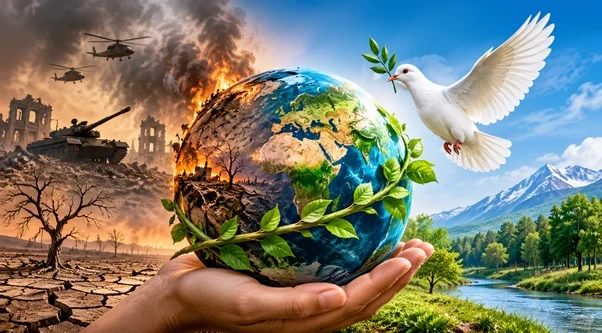
The International Day for Preventing the Exploitation of the Environment in War and Armed Conflict is observed annually on 6 November to draw global attention to the environmental consequences of armed conflicts.
Key facts
|
Particular
|
Details
|
|
Observance
|
6 November
|
|
Established by
|
United Nations General Assembly
|
|
Established in
|
2001
|
|
Resolution
|
A/RES/56/4
|
|
Adopting body
|
56th Session of UN General Assembly
|
|
Key environmental organisation
|
UNEP
|
|
Important convention
|
ENMOD Convention, 1976
|
|
Important legal framework
|
Additional Protocol I, 1977
|
|
Important articles
|
Articles 35(3) and 55
|
|
ICC provision
|
Article 8(2)(b)(iv)
|
|
Related concept
|
Environmental Peace building
|
|
ILC development
|
28 Draft Principles, 2019
|
Background and History
- 1976: Convention on the Prohibition of Military or Any Other Hostile Use of Environmental Modification Techniques (ENMOD) was adopted.
- 1977: Additional Protocols I and II to the Geneva Conventions were adopted, providing important protections relevant to the environment during armed conflicts.
- 2001: UN General Assembly declared 6 November as the International Day through Resolution A/RES/56/4.
- 2008: UNEP established its Environmental Cooperation for Peace building programme.
- 2016: United Nations Environment Assembly adopted Resolution UNEP/EA.2/Res.15 on the protection of the environment in areas affected by armed conflict.
- 2019: International Law Commission adopted 28 Draft Principles on Protection of the Environment in Relation to Armed Conflicts.
Why does the Environment become a Victim of War?
- Deforestation: Forests are cleared or burned for military operations.
- Water Pollution: Oil spills, chemicals and damaged infrastructure contaminate water sources.
- Soil Degradation: Explosives, landmines and toxic substances damage agricultural land.
- Biodiversity Loss: Wildlife habitats are destroyed, threatening endangered species.
- Air Pollution: Bombings, industrial fires and burning oil facilities release harmful pollutants
- Resource Exploitation: Timber, minerals, oil and other natural resources may be illegally extracted to finance armed groups.
Important Global Facts and Statistics
|
Key Fact
|
Details
|
|
Natural resources and conflict
|
At least 40% of internal conflicts over the previous 60 years were linked to natural resource exploitation, according to the UNEP finding cited by the UN.
|
|
Conflict recurrence
|
Conflicts involving natural resources were found to be twice as likely to relapse.
|
|
Biodiversity hotspots
|
Armed conflicts have occurred in more than two-thirds of the world's biodiversity hotspots over six decades.
|
|
Long-term consequences
|
Environmental damage can continue beyond the period of conflict and across national boundaries.
|
International Legal Frameworks for Environmental Protection during War
A. ENMOD Convention, 1976
- Full name: Convention on the Prohibition of Military or Any Other Hostile Use of Environmental Modification Techniques.
- Adopted by the UN General Assembly on 10 December 1976, through Resolution 31/72.
- Opened for signature on 18 May 1977.
- Entered into force on 5 October 1978.
- It prohibits the hostile use of environmental modification techniques as a means of warfare when they produce widespread, long-lasting or severe effects.
B. Additional Protocol I to the Geneva Conventions, 1977
- Adopted on 8 June 1977.
- Article 35(3): Prohibits methods or means of warfare intended or expected to cause widespread, long-term and severe damage to the natural environment.
- Article 55: Specifically deals with the protection of the natural environment during warfare and prohibits environmental damage that prejudices the health or survival of the population.
C. Rome Statute of the International Criminal Court, 1998
- The Rome Statute established the International Criminal Court (ICC).
- Article 8(2)(b)(iv) recognises certain attacks causing environmental damage as a war crime.
- It covers intentionally launching an attack with knowledge that it will cause widespread, long-term and severe damage to the natural environment, where such damage would be clearly excessive in relation to the anticipated concrete and direct overall military advantage.
- This particular provision applies to international armed conflicts.
D. International Law Commission (ILC), 2019
- The International Law Commission adopted 28 Draft Principles on the Protection of the Environment in Relation to Armed Conflicts in 2019.
- These principles address environmental protection across three stages: Before, during and after armed conflict.
- Their objective is to strengthen environmental protection through international law and promote environmental recovery after conflicts.
Role of International Organisations
- United Nations (UN): Promotes international cooperation and environmental protection during conflicts.
- UNEP: Assesses environmental damage and supports environmental recovery.
- International Committee of the Red Cross (ICRC): Promotes compliance with International Humanitarian Law (IHL).
- International Criminal Court (ICC): Prosecutes individuals for crimes within its jurisdiction, including qualifying environmental war crimes.
- UNDP: Supports recovery, sustainable development and institutional rebuilding in conflict-affected regions.
Examples of Environmental Destruction during Armed Conflicts
- Vietnam War: Use of Agent Orange caused extensive deforestation and long-term chemical contamination.
- Gulf War (1990-91): Burning oil wells in Kuwait caused severe air pollution and environmental damage.
- Iraq Conflict: Burning oil facilities and industrial sites released toxic pollutants into the environment.
- Ukraine Conflict: Military activities have created risks of land contamination, forest fires and pollution of soil and water.
Environmental Peace building: Meaning and Importance
- The use of environmental cooperation and sustainable natural resource management to prevent conflicts, build trust between communities and promote lasting peace.
- It recognises that competition over water, forests, minerals and agricultural land can contribute to conflict, while cooperation over these resources can support peace.
- Its major objectives include:
- Preventing conflicts arising from natural resource scarcity.
- Promoting cooperation over shared water resources.
- Rebuilding ecosystems damaged during warfare.
- Supporting sustainable livelihoods in conflict-affected communities.
- Integrating environmental protection into peacebuilding policies.
Prelims MCQ
Q. Consider the following statements regarding the ENMOD Convention:
- It was adopted in 1976.
- It prohibits the hostile use of environmental modification techniques.
- It was adopted under the framework of the United Nations.
Which of the statements given above are correct?
A. 1 and 2 only
B. 2 and 3 only
C. 1 and 3 only
D. 1, 2 and 3
Mains Practice Question
Q. Discuss the impact of armed conflicts on natural ecosystems and biodiversity.
|
FAQs
When is the International Day for Preventing the Exploitation of the Environment in War and Armed Conflict observed?
It is observed annually on 6 November.
When was this international day established?
It was established in 2001 by the United Nations General Assembly.
Which UN resolution established this day?
UN General Assembly Resolution A/RES/56/4.
Which articles of Additional Protocol I protect the natural environment?
Articles 35(3) and 55.
Which UN organisation plays a major role in assessing environmental damage caused by armed conflicts?
The United Nations Environment Programme (UNEP).
|