
| Prelims: Chief Justice of India, Supreme Court, Article 124, Indian Judiciary Mains: GS Paper II – Indian Constitution, Structure and Functioning of the Judiciary, Judicial Independence and Constitutional Governance Keywords: CJI Museum, Judicial Heritage, Supreme Court of India, Constitutional Democracy, Judicial History, O.P. Jindal Global University |
|
Particulars |
Details |
|
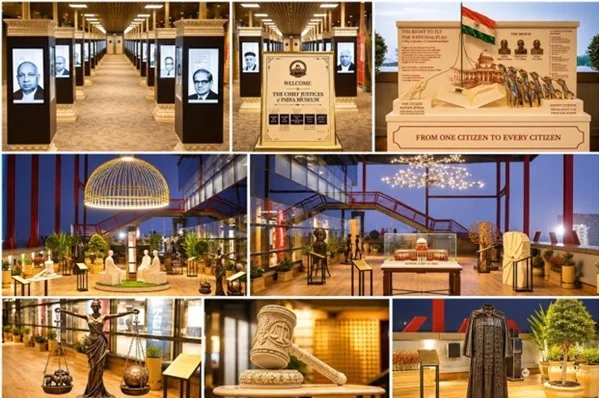
Museum title |
Guardians of the Republic |
|
Location |
Sonipat, Haryana |
|
Institution |
O.P. Jindal Global University |
|
Inauguration |
25 November 2026 |
|
Former CJIs participating |
10 |
|
Galleries |
5 |
|
Busts of Supreme Court judges |
Over 280 |
|
High Court models |
25 |
|
Landmark judgments |
20 |
|
Interactive biographical pillars |
20 |
|
Language-based tapestries |
22 |
|
Special attraction |
Holographic courtroom |
|
Gallery |
Major Features |
|
Pathways of Justice |
Historical evolution of justice and social reforms |
|
Pillars of Justice |
Judicial leadership, biographies and High Court models |
|
Hall of Constitutional Voices |
Oral histories and constitutional perspectives |
|
Keystones of Justice |
Landmark judgments and constitutional principles |
|
Ideas of Justice |
Artistic representations of judicial responsibilities |
The museum also uses digital technology, sculptures and interactive exhibits to make India's constitutional and judicial journey more accessible.
The Chief Justice of India is the head of the Supreme Court and occupies the highest judicial office in the country.
|
Particulars |
Details |
|
Constitutional provision |
Article 124 |
|
Appointing authority |
President of India |
|
Appointment convention |
Senior-most suitable Supreme Court judge |
|
Retirement age |
65 years |
|
First CJI |
Justice H.J. Kania |
|
Resignation submitted to |
President of India |
|
Removal |
Presidential order following a parliamentary address under Article 124(4) |
|
Removal grounds |
Proved misbehaviour or incapacity |
|
Article |
Provision |
|
Article 32 |
Right to constitutional remedies |
|
Article 50 |
Separation of judiciary from executive |
|
Article 124 |
Establishment and constitution of Supreme Court |
|
Article 129 |
Supreme Court as a court of record |
|
Article 131 |
Original jurisdiction of Supreme Court |
|
Article 136 |
Special Leave Petition |
|
Article 137 |
Review of judgments |
|
Article 141 |
Supreme Court decisions binding on all courts |
|
Article 142 |
Power to ensure complete justice |
|
Article 143 |
Advisory jurisdiction |
|
Article 214 |
High Courts for states |
|
Case |
Year |
Significance |
|
Kesavananda Bharati Case |
1973 |
Basic Structure Doctrine |
|
Maneka Gandhi Case |
1978 |
Expanded interpretation of Article 21 |
|
Minerva Mills Case |
1980 |
Limited amending power of Parliament |
|
S.R. Bommai Case |
1994 |
Federalism and judicial review of President's Rule |
|
Vishaka Case |
1997 |
Prevention of workplace sexual harassment |
|
Union of India v. Naveen Jindal |
2004 |
Right to fly the national flag, subject to restrictions |
|
K.S. Puttaswamy Case |
2017 |
Right to privacy as a fundamental right |
|
Navtej Singh Johar Case |
2018 |
Decriminalisation of consensual same-sex relations between adults |
The establishment of India's first Chief Justices of India Museum represents an important step towards preserving judicial heritage and promoting constitutional literacy. It can strengthen public understanding of the judiciary and reinforce democratic values, judicial independence and the rule of law.
Prelims Practice QuestionQ. Consider the following statements regarding the Chief Justices of India Museum:
Which of the statements given above is/are correct? (a) 1 and 2 only Mains Practice QuestionQ. Discuss the role of judicial independence and constitutional literacy in strengthening India's democratic institutions. How can judicial heritage museums contribute to this objective? |
1. Where was India's first CJI Museum inaugurated?At O.P. Jindal Global University in Sonipat, Haryana. 2. What is the title of the CJI Museum?The museum is titled Guardians of the Republic. 3. When was India's first CJI Museum inaugurated?It was inaugurated on 25 November 2026. 4. How many former CJIs participated in its inauguration?Ten former Chief Justices participated in its inauguration. 5. Which Article deals with the establishment of the Supreme |