Prelims: Project Elephant, Asian Elephant, Radio-Collaring Technology, Wildlife (Protection) Act, 1972, Elephant Corridors.
Mains: GS Paper III – Biodiversity, Environment Conservation, Human-Wildlife Conflict and Wildlife Management.
Keywords: Mission Chakkakompan, Kerala Forest Department, Human-Elephant Conflict, Wildlife Conservation, Coexistence Collective, Radio Collaring, Western Ghats. |
Why in News?
- The Kerala Forest Department's Mission Chakkakompan has sparked controversy after the Coexistence Collective criticised the operation to radio-collar a wild elephant and demanded an investigation.
- The three-day operation, conducted between November 25 and 27, 2026, in Kerala's Idukki district, was suspended after officials failed to immobilise the elephant. On November 28, forest officials confirmed that the elephant was healthy and remained under observation near Anayirankal Dam.
Background
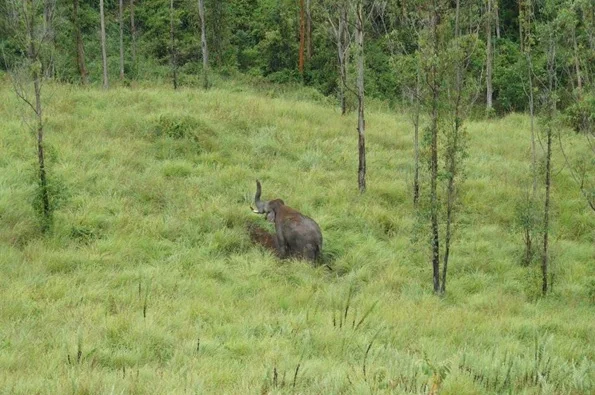
- Chakkakompan, also known as Chakkakomban, is a wild male Asian elephant frequently spotted in the Chinnakanal region of Idukki.
- Its name is associated with its habit of eating jackfruit.
- The elephant has repeatedly entered human settlements, raising concerns regarding public safety and agricultural losses.
- In 2023, another wild elephant named Arikomban was captured and relocated from the same region.
- These incidents highlight the growing challenges of human-elephant coexistence in the Western Ghats.
Key Points
1. What is Mission Chakkakompan?
- It is a wildlife management operation initiated by the Kerala Forest Department.
- Its primary objective is to monitor the movements of Chakkakompan through radio-collaring technology.
- The mission aims to reduce human-elephant encounters without permanently keeping the elephant in captivity.
- The operation involved forest officials, veterinary experts and trained Kumki elephants.
2. Why is the Mission Controversial?
The controversy highlights several broader concerns regarding wildlife management:
- Animal welfare and the risks associated with repeated tranquillisation.
- Scientific justification for capturing wild elephants.
- Accountability and transparency in wildlife management operations.
- Balancing public safety with the protection of endangered species.
- Addressing the underlying causes of human-elephant conflict rather than focusing solely on individual animals.
3. What is Radio-Collaring Technology?
Radio-collaring is a wildlife monitoring technique in which an electronic tracking device is fitted around an animal's neck to study its movements and behaviour.
|
Technology
|
Function
|
|
GPS
|
Tracks geographical location
|
|
VHF
|
Enables radio-based tracking
|
|
GSM
|
Transmits information through mobile networks
|
|
Satellite Communication
|
Supports remote wildlife monitoring
|
|
Geofencing
|
Generates alerts near designated boundaries
|
Radio-collaring can help forest departments understand elephant movement patterns and develop early warning mechanisms.
4. About the Asian Elephant
|
Particular
|
Details
|
|
Scientific Name
|
Elephas maximus
|
|
IUCN Status
|
Endangered
|
|
CITES
|
Appendix I
|
|
Wildlife (Protection) Act, 1972
|
Schedule I
|
|
National Status
|
National Heritage Animal
|
|
World Elephant Day
|
12 August
|
Asian elephants play an important ecological role through seed dispersal, vegetation management and maintaining forest ecosystems.
5. Major Causes of Human-Elephant Conflict
- Habitat Loss: Expansion of agriculture, settlements and infrastructure.
- Habitat Fragmentation: Disruption of traditional elephant movement routes.
- Encroachment: Increasing human activities near forest boundaries.
- Food Availability: Agricultural crops attract elephants towards settlements.
- Climate Change: Changes in rainfall, vegetation and water availability.
- Development Projects: Roads, railway lines and other infrastructure obstruct wildlife movement.
6. Project Elephant
Project Elephant was launched by the Government of India in 1992 as a Centrally Sponsored Scheme under the Ministry of Environment, Forest and Climate Change (MoEFCC).
Its major objectives include:
- Protection of elephants and their natural habitats.
- Conservation and restoration of elephant corridors.
- Mitigation of human-elephant conflict.
- Welfare of captive elephants.
- Promotion of scientific research and population monitoring.
Significance of Radio-Collaring
- Early Warning System: Alerts communities about approaching elephants.
- Scientific Research: Provides information about migration and feeding behaviour.
- Wildlife Conservation: Supports evidence-based habitat management.
- Public Safety: Helps authorities undertake preventive interventions.
- Corridor Identification: Assists in identifying important elephant movement routes.
- Non-Lethal Intervention: Provides an alternative to more extreme conflict-management measures.
Relevance for India
- India supports approximately 60% of the world's wild Asian elephant population, making it particularly important for global elephant conservation.
- In August 2026, a five-year regional action plan with a proposed outlay of ₹999.87 crore was unveiled to address human-elephant conflict across Andhra Pradesh, Karnataka, Kerala and Tamil Nadu.
- The plan emphasises habitat protection, community participation, scientific monitoring and early warning systems.
Challenges
- Risks associated with wildlife capture and sedation.
- Increasing economic losses among forest-dependent communities.
- Inadequate and delayed compensation mechanisms.
- Limited technical infrastructure for continuous wildlife monitoring.
- Fragmentation of elephant corridors.
- Lack of coordination among neighbouring states.
- Difficulty in balancing human safety and animal welfare.
Way Forward
- Scientific Management: Ensure independent veterinary and ecological assessment before wildlife interventions.
- Elephant Corridor Restoration: Protect traditional movement routes through landscape-level conservation.
- Technology Integration: Use GPS tracking, thermal imaging and AI-based early warning systems.
- Community Participation: Involve local residents in wildlife conservation and conflict mitigation.
- Compensation Mechanism: Ensure timely compensation for crop damage and loss of human life.
- Institutional Accountability: Conduct transparent reviews of controversial wildlife operations.
- Inter-State Cooperation: Strengthen coordination among elephant-range states.
Conclusion
Mission Chakkakompan highlights the complex relationship between wildlife conservation, animal welfare and human safety. India must move beyond reactive wildlife management towards a scientific, participatory and habitat-based approach that promotes sustainable human-elephant coexistence.
Prelims Practice Question
Q. With reference to Asian elephants in India, consider the following statements:
- Asian elephants are classified as Endangered on the IUCN Red List.
- Project Elephant was launched in 1992 as a Centrally Sponsored Scheme.
- Asian elephants are protected under Schedule II of the Wildlife (Protection) Act, 1972.
Which of the statements given above are correct?
(a) 1 and 2 only
(b) 2 and 3 only
(c) 1 and 3 only
(d) 1, 2 and 3
Mains Practice Question
Q. Human-wildlife conflict in India is increasingly becoming a challenge to sustainable development. Discuss the role of modern technology, community participation and habitat conservation in mitigating human-elephant conflict.
|
FAQs
Q1. What is Mission Chakkakompan?
An operation to monitor a wild elephant using radio-collaring.
Q2. Where was Mission Chakkakompan launched?
In the Chinnakanal region of Kerala’s Idukki district.
Q3. What is radio-collaring technology?
A technology used to track wildlife movements remotely.
Q4. When was Project Elephant launched in India?
It was launched in 1992 by the Government.
Q5. What is the IUCN status of Asian elephants?
Asian elephants are classified as Endangered by IUCN.
|