Why in news?
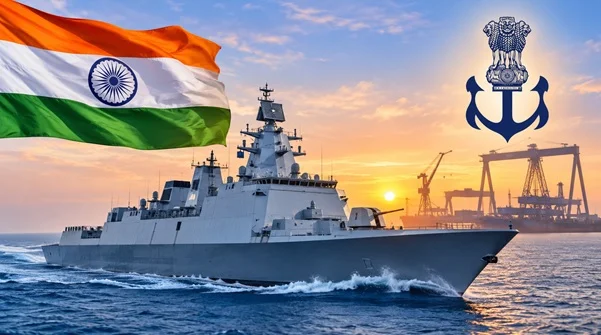
On 27 November 2026, GRSE, a defence public sector undertaking (DPSU) based in Kolkata, delivered Vindhyagiri (Yard 3024), the seventh and final stealth frigate under the Indian Navy's Project 17A (P17A) programme.
What is Vindhyagiri?
|
Particular
|
Details
|
|
Name
|
Vindhyagiri
|
|
Yard Number
|
Y-3024
|
|
Project
|
Project 17A
|
|
Class
|
Nilgiri-class
|
|
Category
|
Advanced Guided-Missile Stealth Frigate
|
|
Built by
|
Garden Reach Shipbuilders & Engineers (GRSE)
|
|
Location of delivery
|
Kolkata, West Bengal
|
|
Delivery date
|
27 November 2026
|
|
Position in P17A
|
Seventh and final ship
|
|
GRSE's contribution
|
Third and final ship built by GRSE
|
|
Indigenous content
|
Approximately 75%
|
What is Project 17A?
- Project 17A is an indigenous warship-building programme of the Indian Navy aimed at developing a new generation of advanced stealth frigates.
- It is the successor to Project 17 (Shivalik-class frigates) and incorporates significant improvements in stealth technology, weapons systems, sensors, automation and combat capabilities.
- The programme involves the construction of seven advanced guided-missile frigates by two major Indian shipyards:
- Mazagon Dock Shipbuilders Limited (MDL), Mumbai.
- Garden Reach Shipbuilders & Engineers Limited (GRSE), Kolkata.
Important features of Project 17A
|
Feature
|
Explanation
|
|
Indigenous design
|
Developed by India's Warship Design Bureau
|
|
Stealth technology
|
Reduces the ship's detectability by enemy surveillance systems
|
|
Multi-mission capability
|
Supports multiple types of naval operations
|
|
Advanced weapons
|
Enhances offensive and defensive capabilities
|
|
Modern sensors
|
Improves detection, tracking and situational awareness
|
|
Automation
|
Reduces manual intervention in ship operations
|
|
Survivability
|
Improves the ship's ability to withstand combat threats
|
Seven Warships Under Project 17A
- A total of seven Nilgiri-class frigates were planned under Project 17A.
- Four were constructed by Mazagon Dock Shipbuilders Limited (MDL), while three were constructed by GRSE.
|
S. No.
|
Warship
|
Shipyard
|
Delivery date
|
|
1
|
INS Nilgiri
|
MDL
|
20 December 2024
|
|
2
|
INS Udaygiri
|
MDL
|
1 July 2025
|
|
3
|
INS Himgiri
|
GRSE
|
31 July 2025
|
|
4
|
INS Taragiri
|
MDL
|
28 November 2025
|
|
5
|
INS Dunagiri
|
GRSE
|
30 March 2026
|
|
6
|
INS Mahendragiri
|
MDL
|
30 April 2026
|
|
7
|
Vindhyagiri
|
GRSE
|
27 November 2026
|
Technical Features of Vindhyagiri and Project 17A Frigates
- Project 17A frigates represent a major improvement over the earlier Shivalik-class (Project 17) frigates.
- They have been designed to perform complex naval missions while maintaining improved stealth, operational flexibility and combat effectiveness.
Physical specifications of Project 17A Frigates
|
Parameter
|
Details
|
|
Length
|
Approximately 149 metres
|
|
Displacement
|
Approximately 6,670 tonnes
|
|
Propulsion
|
Combined Diesel or Gas (CODOG)
|
|
Propellers
|
Controllable Pitch Propellers (CPP)
|
|
Classification
|
Guided-missile stealth frigate
|
|
Operational role
|
Multi-dimensional naval warfare
|
What is CODOG propulsion technology?
- One of the important technological features of Project 17A frigates is their CODOG propulsion system.
- CODOG stands for Combined Diesel or Gas.
- It combines two types of engines:
- Diesel engine: Used for economical cruising and relatively lower-speed operations.
- Gas turbine: Used when higher speed and power are required.
- The system allows the ship to use the appropriate engine according to its operational requirements.
Integrated Platform Management System (IPMS)
- Another important feature is the Integrated Platform Management System (IPMS).
- It integrates the monitoring and control of different shipboard systems, including:
- Propulsion and machinery.
- Electrical power generation and distribution.
- Auxiliary machinery.
- Damage-control and other essential platform functions.
Advanced weapons and sensors
|
Warfare domain
|
Meaning
|
Operational importance
|
|
Anti-Air Warfare (AAW)
|
Countering enemy aircraft and aerial threats
|
Protects the ship and fleet from aerial attacks
|
|
Anti-Surface Warfare (ASuW)
|
Engaging enemy surface vessels
|
Strengthens offensive naval capabilities
|
|
Anti-Submarine Warfare (ASW)
|
Detecting and countering enemy submarines
|
Protects maritime routes and naval assets
|
What makes Project 17A Stealth Frigates special?
- The word stealth is particularly important in modern naval warfare.
- Stealth technology refers to design techniques and technologies that reduce the probability of detecting a military platform through enemy surveillance systems.
|
Stealth feature
|
Purpose
|
|
Reduced Radar Cross Section (RCS)
|
Makes radar-based detection more difficult
|
|
Special hull and superstructure design
|
Helps reduce radar reflections
|
|
Reduced acoustic signature
|
Makes underwater detection more difficult
|
|
Reduced infrared signature
|
Helps limit detection through heat emissions
|
|
Noise reduction
|
Improves operational concealment
|
Project 17A vs Project 17 (Shivalik Class)
|
Basis
|
Project 17
|
Project 17A
|
|
Class
|
Shivalik class
|
Nilgiri class
|
|
Nature
|
Stealth frigates
|
Advanced stealth frigates
|
|
Design
|
Earlier-generation indigenous design
|
Improved indigenous design
|
|
Stealth
|
Advanced for its generation
|
Further enhanced stealth features
|
|
Weapons and sensors
|
Earlier-generation systems
|
More advanced weapons and sensors
|
|
Automation
|
Earlier platform systems
|
Advanced IPMS
|
|
Role
|
Multi-mission naval operations
|
Enhanced multi-dimensional warfare
|
Indigenous Content and Aatmanirbhar Bharat
- One of the most significant achievements of Project 17A is its contribution to defence indigenisation.
- According to the Ministry of Defence, the project has approximately 75% indigenous content.
- This means that a substantial proportion of the value of the warships comes from equipment, systems, components and capabilities sourced or developed within India.
Major achievements
|
Indicator
|
Achievement
|
|
Total frigates
|
7
|
|
Indigenous content
|
Approximately 75%
|
|
MSMEs involved
|
More than 200
|
|
Direct employment
|
Approximately 4,000 personnel
|
|
Indirect employment
|
More than 10,000 personnel
|
|
Project completion milestone
|
All seven ships delivered
|
How does the project support Make in India?
- The construction of advanced frigates requires a large network of industries.
- These include:
- Defence electronics manufacturers.
- Radar and sensor manufacturers.
- Engineering and machinery industries.
- Steel and specialised material suppliers.
- Shipbuilding and marine equipment manufacturers.
- Micro, Small and Medium Enterprises (MSMEs).
What is the significance of 75% indigenous content?
- Reducing dependence on foreign suppliers.
- Strengthening domestic defence manufacturing.
- Developing indigenous technological expertise.
- Generating employment opportunities.
- Improving long-term maintenance and repair capabilities.
- Strengthening India's defence industrial base.
What is GRSE?
- Garden Reach Shipbuilders & Engineers Limited (GRSE) is a Government of India undertaking operating under the Ministry of Defence.
- It is headquartered in Kolkata, West Bengal, and is one of India's important defence shipbuilding companies.
- GRSE specialises in the construction of warships and other vessels for the Indian Navy, Indian Coast Guard and other customers.
GRSE's contribution to Project 17A
- GRSE constructed three of the seven Nilgiri-class frigates:
- Himgiri: delivered on 31 July 2025.
- Dunagiri: delivered on 30 March 2026.
- Vindhyagiri: delivered on 27 November 2026.
- The delivery of Vindhyagiri completes GRSE's three-ship construction responsibility under Project 17A.
- According to GRSE, Vindhyagiri is the 811th vessel delivered by the shipyard and the 121st warship in its shipbuilding history, as reported at the time of delivery.
Historical Connection: The Earlier INS Vindhyagiri
- The earlier INS Vindhyagiri belonged to the Leander class of frigates and served in the Indian Navy for approximately 31 years.
|
Particular
|
Details
|
|
Earlier warship
|
INS Vindhyagiri
|
|
Class
|
Leander class
|
|
Entry into Indian Navy service
|
8 July 1981
|
|
Decommissioning
|
11 June 2012
|
|
Total service
|
Approximately 31 years
|
|
New ship
|
Vindhyagiri (Project 17A)
|
- The new Vindhyagiri carries forward the legacy of its predecessor with significantly advanced naval technology.
- This practice of naming new warships after earlier distinguished vessels reflects the Indian Navy's effort to preserve its maritime traditions and historical legacy.
Why is Project 17A important for India's Maritime Security?
- India has a strategically important geographical position in the Indian Ocean Region (IOR).
- The Indian Ocean connects major international trade routes and is essential for global energy transportation, commercial shipping and maritime connectivity.
- India's maritime interests include:
- Protection of its extensive coastline.
- Security of maritime trade routes.
- Protection of commercial shipping.
- Surveillance of strategically important sea lanes.
- Countering piracy and other maritime threats.
- Maintaining stability in the Indian Ocean Region.
Five major strategic benefits
- Strengthening the Indian Ocean Region (IOR): Advanced frigates improve the Navy's ability to maintain a presence in strategically important maritime areas.
- Protection of Sea Lines of Communication (SLOCs): SLOCs are maritime routes used for international trade and transportation. Their protection is essential for India's economic and energy security.
- Anti-submarine warfare capabilities: Submarines can pose significant threats to naval vessels and commercial shipping. Advanced anti-submarine warfare capabilities help detect and counter these threats.
- Fleet protection: Multi-mission frigates can provide protection to other naval assets, including aircraft carriers and other surface combatants, depending on operational deployment.
- Blue-water naval capabilities: These warships are designed for operations in the open ocean and can support India's wider maritime interests beyond its immediate coastal waters.
What is a Blue-Water Navy?
|
Type of Navy
|
Meaning
|
|
Brown-Water Navy
|
Primarily operates in rivers, lakes and inland waterways
|
|
Green-Water Navy
|
Primarily operates in coastal and regional maritime waters
|
|
Blue-Water Navy
|
Capable of sustained operations in the open oceans
|
Estimated Cost and Economic Significance of Project 17A
- Project 17A is also a major defence manufacturing investment.
- The seven-ship programme has been reported to have an estimated cost of approximately ₹45,000 crore.
- Its economic importance goes beyond the construction of seven warships.
- The programme creates demand for a wide range of industrial products, technologies and specialised services.
Economic impact
- Defence manufacturing: Strengthens domestic shipbuilding.
- MSME sector: Creates opportunities for more than 200 MSMEs.
- Employment: Generates direct and indirect jobs.
- Technology: Encourages indigenous research and development.
- Industrial ecosystem: Supports engineering, electronics and machinery industries.
- Import dependence: Helps reduce dependence on foreign defence suppliers.
What Comes Next After Project 17A?
|
Basis
|
Project 17A
|
Proposed Project 17B
|
|
Nature
|
Nilgiri-class stealth frigates
|
Next-generation stealth frigates
|
|
Number of ships
|
7
|
7 proposed
|
|
Main objective
|
Advanced indigenous frigates
|
Further modernisation of frigate capabilities
|
|
Construction model
|
MDL and GRSE
|
Reported two-yardship model
|
|
Status
|
All seven delivered
|
Follow-on programme
|
Challenges Ahead
- Critical technology: Some advanced components and technologies still involve foreign dependencies.
- Supply-chain constraints: Timely availability of specialised equipment is essential.
- Cost escalation: Large defence projects may face rising material and production costs.
- Skilled manpower: Advanced shipbuilding requires highly specialised technical workers.
- Research and development: Continuous investment is needed to develop next-generation technologies.
- Maintenance and upgrades: Long-term operational readiness requires domestic repair and upgrade capabilities.
Prelims MCQ
Q1. With reference to Project 17A, consider the following statements:
- It is associated with the construction of Nilgiri-class stealth frigates.
- The ships are being constructed by MDL and GRSE.
- The project involves approximately 75% indigenous content.
Which of the statements given above is/are correct?
A. 1 only
B. 1 and 2 only
C. 2 and 3 only
D. 1, 2 and
Mains Practice Questions
Q. Discuss the significance of Project 17A in strengthening India's indigenous defence manufacturing capabilities and maritime security.
|
FAQs
What is Project 17A?
An Indian Navy programme for constructing seven advanced indigenous Nilgiri-class stealth frigates.
Which is the final ship delivered under Project 17A?
Vindhyagiri (Yard 3024), delivered on 27 November 2026.
Which shipyards constructed Project 17A frigates?
Mazagon Dock Shipbuilders Limited (MDL), Mumbai, and Garden Reach Shipbuilders & Engineers Limited (GRSE), Kolkata.
How many frigates were constructed by GRSE?
Three: Himgiri, Dunagiri and Vindhyagiri.
What is the indigenous content of Project 17A?
Approximately 75%.
|