Why in News?
- Indian universities have failed to secure a place in the top 50 of the QS World University Rankings: Asia 2027 for the second consecutive year. The rankings, released by QS Quacquarelli Symonds, show that all six of India's highest-ranked institutions have slipped in the latest edition.
- Despite the decline in rankings, India has increased its overall representation, with 325 universities featured in the list, compared to 294 in the previous year.
Key Highlights of QS Asia University Rankings 2027
- No Indian university in the Top 50: For the second consecutive year, no Indian institution has secured a position among Asia's top 50 universities.
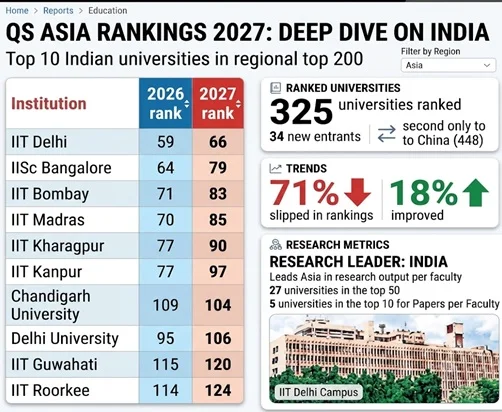
- IIT Delhi leads India: IIT Delhi is India's highest-ranked institution at 66th position, down from 59th last year.
- IISc Bengaluru: Its ranking has dropped from 64th to 79th.
- IIT Bombay: It has slipped from 71st to 83rd position.
- IIT Madras: Its position has declined from 70th to 85th.
- IIT Kharagpur: It has fallen from 77th to 90th.
- IIT Kanpur: It has dropped from 77th to 99th.
- Delhi University: It has moved from 95th to 106th position, falling outside the top 100.
India's Growing Presence in Asian Rankings
Despite the decline in the positions of leading institutions, India's overall representation in the QS Asia Rankings has increased significantly.
- India has 325 universities in the 2027 rankings, compared to 294 in 2026.
- India is the second most represented higher education system in Asia.
- The latest edition includes 34 new Indian universities.
- Since 2016, the number of ranked Indian institutions has increased from 24 to 325, representing growth of more than 1,250%.
- This growth is higher than that of several other major Asian higher education systems, including China, Indonesia, Japan and South Korea.
India's Strengths in Research and Doctoral Education
Although Indian universities have slipped in overall rankings, the country continues to perform strongly in research output and doctoral education.
1. Strong Research Output
- India leads Asia in research output relative to academic staff, measured through the QS Papers per Faculty indicator.
- A total of 27 Indian universities feature in Asia's top 50 for this indicator.
- Five Indian universities are among the top 10, while two are in the top five.
2. Strength in Doctoral Education
- Fifteen Indian universities share the first position in Asia for the proportion of academic staff holding PhD qualifications.
- This highlights India's growing capacity in advanced research and higher education.
Research Impact Remains a Major Challenge
Despite strong research output, India has not achieved comparable performance in research impact.
- Only three Indian universities feature in Asia's top 50 for Citations per Paper.
- This indicator measures how frequently published research is cited by other researchers.
- The gap suggests that higher research output has not yet translated into equally strong global research recognition and influence.
Indian Universities That Improved Their Rankings
- While most leading Indian institutions experienced a decline, some universities improved their positions.
- These include:
- Chandigarh University
- Lovely Professional University
- Jamia Millia Islamia
What Did QS Say?
- QS Senior Vice-President Ben Sowter highlighted India's growing research capacity but emphasised the need to improve research impact and international recognition.
- According to him, India has established a strong foundation in research, but it must now focus on translating research output into greater academic influence and international recognition.
Conclusion
The QS Asia University Rankings 2027 present a mixed picture of India's higher education system. The increasing number of Indian universities in the rankings reflects the expansion of higher education and research capacity. However, the decline of leading institutions highlights the need to improve research quality, citations, international collaboration and global academic reputation.
India must focus not only on increasing the number of ranked universities but also on improving their overall academic performance and international competitiveness.
Prelims Practice Question
1. With reference to the QS World University Rankings: Asia 2027, consider the following statements:
- QS Quacquarelli Symonds releases the QS World University Rankings.
- IIT Delhi is the highest-ranked Indian institution in the QS Asia Rankings 2027.
- India has the highest number of universities in Asia's top 50 for Citations per Paper.
Which of the statements given above is/are correct?
(a) 1 and 2 only
(b) 2 and 3 only
(c) 1 and 3 only
(d) 1, 2 and 3
Mains Practice Question
Q. Despite significant growth in research output and doctoral capacity, Indian universities continue to face challenges in global academic rankings. Discuss the major reasons behind this gap and suggest measures to improve the global competitiveness of India's higher education system.
|
FAQs
1. What is the QS World University Rankings: Asia?
It is an annual ranking of Asian universities released by QS Quacquarelli Symonds to evaluate their academic performance, research, internationalisation and other indicators.
2. Which is India's highest-ranked institution in the QS Asia Rankings 2027?
IIT Delhi is India's highest-ranked institution, securing the 66th position.
3. How many Indian universities are included in the QS Asia Rankings 2027?
A total of 325 Indian universities feature in the rankings, compared to 294 in the previous year.
4. What is the Papers per Faculty indicator?
It measures research output relative to the number of academic staff at a university.
5. What does Citations per Paper measure?
It measures the research impact of published academic papers based on how frequently other researchers cite them.
|