New
Hindi Medium: (Delhi) - GS Foundation (P+M) : 8th June 2026, 6:30 AM Hindi Medium: (Prayagraj) - GS Foundation (P+M) : 1st June 2026, 5:30 PM English Medium: (Prayagraj) - GS Foundation (P+M) : 7th June 2026, 8:00 AM Hindi Medium: (Delhi) - GS Foundation (P+M) : 8th June 2026, 6:30 AM Hindi Medium: (Prayagraj) - GS Foundation (P+M) : 1st June 2026, 5:30 PM English Medium: (Prayagraj) - GS Foundation (P+M) : 7th June 2026, 8:00 AM

Current Affairs for 08 May 2026

Governor’s Discretion vs Democratic Mandate: Tamil Nadu Controversy and Constitutional Debate

Why in News?

  • A fresh constitutional debate has emerged in India after the Governor of Tamil Nadu, Rajendra Arlekar, allegedly delayed inviting the leader of Tamilaga Vettri Kazhagam (TVK) to take oath as Chief Minister. 
  • The controversy has reignited questions over how wide the Governor’s discretionary powers should be in a hung assembly and how democratic mandate must be respected. 
  • The Governor reportedly sought clear proof of support from 118 MLAs in the 234-member Assembly before inviting TVK to form the government. 
  • Traditionally, however, the largest party or alliance is first invited to form the government and is later required to prove its majority on the floor of the House through a floor test. 
  • This has raised an important constitutional question: can a Governor impose additional conditions beyond established constitutional conventions in the name of political stability? 
Political Background

  • In the recently concluded Tamil Nadu Assembly elections, Tamilaga Vettri Kazhagam (TVK) emerged as the single largest party with 108 seats. With the support of Congress, its strength reportedly rises to 113, still short of the majority mark of 118. 
  • In India’s parliamentary democracy, a long-standing convention has been that when no party secures an absolute majority, the Governor invites the largest party or coalition to form the government and allows it to prove majority through a floor test in the Assembly. 
  • However, the Tamil Nadu Governor’s insistence on prior proof of majority has been criticized by opposition parties and constitutional experts as unnecessary interference in the democratic process. 
  • Critics argue that such actions weaken the role of elected representatives and place the office of the Governor at the centre of political controversy.

Constitutional Position on the Powers of the Governor

Provision under Article 164

According to Article 164 of the Indian Constitution :

  • The Chief Minister is appointed by the Governor. 
  • Other ministers are appointed by the Governor on the advice of the Chief Minister. 
  • The Council of Ministers is collectively responsible to the Legislative Assembly. 
  • Ministers hold office during the “pleasure” of the Governor. 

Constitutional Interpretation

  • Although the Constitution mentions the “pleasure of the Governor,” in a parliamentary democracy this does not imply personal or arbitrary discretion. 
  • The Governor is expected to act in accordance with constitutional conventions, democratic morality, and the will of the elected representatives. 
  • In practice, the Governor’s role is regarded as largely formal and constitutional in nature. 
  • Particularly in matters of government formation, the Governor is expected to allow the final test of majority support to take place on the floor of the Assembly. 

Traditional Process of Government Formation

A well-established constitutional convention has evolved in Indian states regarding government formation. Generally, the Governor :

  • Invites the largest party or coalition to form the government. 
  • Administers the oath of office to the Chief Minister. 
  • Appoints a Pro Tem Speaker. 
  • Directs that a floor test be conducted within a stipulated time in the Legislative Assembly. 

Importance of the Floor Test

In a parliamentary democracy, the floor of the House is considered the legitimate and final forum for testing majority support.

Whether a government enjoys an actual majority is determined :

  • Not by the Raj Bhavan, media reports, memoranda, or individual claims, but through open voting in the Legislative Assembly. 
  • Therefore, the Supreme Court has repeatedly held in several cases that a floor test is the most reliable constitutional mechanism for establishing democratic legitimacy.

Supreme Court’s Stand on Floor Test

Uttarakhand Crisis, 2016

  • During the 2016 Uttarakhand Constitutional Crisis, the Supreme Court clearly stated that a floor test is the “ultimate constitutional method” to determine majority in the Assembly. 
  • The Court directed the then Chief Minister Harish Rawat to prove his majority on the floor of the House and gave highest priority to the constitutional process. 

Karnataka Crisis, 2018

  • In the 2018 Karnataka Government Formation Crisis, the BJP emerged as the single largest party, while the Congress and JD(S) formed a post-poll alliance. 
  • The then Governor Vajubhai Vala invited B. S. Yediyurappa to form the government and granted 15 days to prove majority. 
  • The Congress-JD(S) alliance approached the Supreme Court. 
  • A Bench headed by the then Chief Justice Dipak Misra refused to stay the swearing-in ceremony but, considering the possibility of horse-trading, ordered a floor test within 36 hours. 
  • Eventually, the BJP failed to prove its majority, and the Congress-JD(S) alliance formed the government. 
  • The episode reinforced the principle that the final decision regarding majority must be determined on the floor of the House. 

Major Constitutional Debate: Governor’s Discretion vs Democratic Mandate

Arguments in Favour of the Governor

  • The Governor’s role is not merely ceremonial; it also includes ensuring constitutional stability in the state. 
  • If a government is formed without a clear majority, it may lead to : 
    • Political instability, 
    • Defections, 
    • Horse-trading, and 
    • Administrative crisis. 
  • In such situations, the Governor’s demand for proof of support before government formation may be viewed as a precautionary step to ensure a stable government. 

Arguments Against the Governor

  • Critics argue that the Governor cannot rise above constitutional conventions. 
  • In a democratic system, the will of elected representatives is supreme. 
  • If the single largest party is denied an opportunity to form the government, or if the swearing-in is unnecessarily delayed, it may weaken the democratic mandate. 
  • According to critics, the Governor should function as a neutral constitutional head rather than an active political decision-maker. 

Major Constitutional and Governance Issues

1. Ambiguity in Discretionary Powers

  • The Constitution does not clearly specify the order in which parties should be invited to form the government in a hung Assembly. 
  • This ambiguity often becomes the root cause of constitutional disputes. 

2. Allegations of Political Bias

  • In India, Governors have frequently been accused of acting in favour of the Union Government or a particular political party. 
  • Such allegations raise questions regarding the neutrality and dignity of the Governor’s office. 

3. Delay in Government Formation

Unnecessary delay in swearing-in and floor tests :

  • Increases political instability, 
  • Affects administrative decision-making, and 
  • Creates possibilities of horse-trading among legislators. 

4. Impact on Federal Structure

  • Disputes involving Governors often affect cooperative federalism and the autonomy of states. 
  • If Governors are perceived as political extensions of the Union Government, the federal balance may weaken. 

Recommendations of the Sarkaria and Punchhi Commissions

Sarkaria Commission (1983)

The Sarkaria Commission recommended the following order of preference for government formation in states :

  1. A pre-election alliance with a clear majority 
  2. The single largest party with support from others 
  3. A post-election coalition 
  4. A minority government with outside support 

The objective was to limit the discretionary powers of the Governor and ensure greater transparency and stability in the process of government formation.

Punchhi Commission (Constituted in 2007)

The Punchhi Commission recommended that :

  • Governors should be appointed through a neutral and impartial process, 
  • They should remain detached from active politics, and 
  • Clear limits should be defined for their discretionary powers. 

Way Forward

Development of Clear Constitutional Conventions

  • The procedure for inviting political parties to form the government should be standardized in written form to reduce ambiguity and prevent arbitrary decisions.

Time-bound Floor Test

  • Following the approach emphasized by the Supreme Court, a floor test may be made mandatory within 24–48 hours to reduce the possibility of political manipulation and horse-trading.

Political Neutrality of the Governor

  • Governors should function as impartial constitutional heads and guardians of the Constitution. Respecting the democratic mandate must remain their foremost responsibility.

Judicial Oversight

  • The judiciary should ensure that constitutional morality and democratic values are not overshadowed by political interests.

What is zinc phosphide? A simple carelessness can lead to a deadly poison

Why in the News?

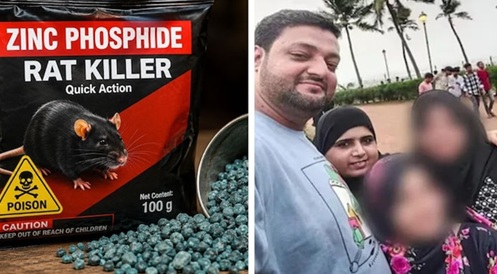
The mysterious deaths of four members of a family in Mumbai's Pydhonie area on the morning of April 26 shocked the entire nation. Initially, it was believed that eating watermelon might have caused food poisoning, but as the investigation progressed, the case turned out to be much more serious.

Key Points

  • The family had eaten biryani with relatives on the night of April 25, but no one else felt unwell. Later, around 1 a.m., only four family members ate watermelon and died within a few hours.
  • On May 7, a forensic report revealed that traces of a highly toxic chemical called zinc phosphide were found in the bodies of the deceased. This is the same chemical commonly used in rat poison.
  • The deceased have been identified as Abdullah Dokadia, his wife Nasreen, and their two daughters, Ayesha and Zainab. Police are now investigating whether the poison was accidentally mixed into the food, deliberately added, or caused contamination through the supply chain.

What is Zinc Phosphide?

  • Zinc phosphide (ZnP) is a chemical compound used in rat poisons in many countries, including India.
  • It is a dark brown or black powder. Under normal conditions, it remains relatively stable, but once it reaches the human stomach, it becomes extremely dangerous.
  • When zinc phosphide comes into contact with hydrochloric acid in the stomach, it undergoes a chemical reaction, producing phosphine gas.
  • This gas is colorless, invisible, and extremely toxic.

How does it affect the body once it enters the body ?

  • Phosphine gas directly attacks the body's cells.
  • Mitochondria within our cells produce energy.
  • Phosphine gas blocks cytochrome c oxidase, an important enzyme in mitochondria.
  • After this, the body's cells are unable to use oxygen, even if the person is breathing or receiving oxygen in the hospital.
  • This condition is called cellular anoxia, in which the body begins to suffocate from within. This is why the mortality rate for zinc phosphide poisoning is considered very high.

Why does the risk increase after eating ?

  • According to doctors, acid production increases when there is food in the stomach.
  • Foods like watermelon can further intensify the acidic reaction in the stomach, leading to the production of more phosphine gas.
  • Symptoms of poisoning can take several hours to appear on an empty stomach, but after eating, the effects can begin within minutes.

Key symptoms of zinc phosphide poisoning

  • Vomiting and nausea
  • Severe abdominal pain
  • Difficulty breathing
  • Dizziness and fainting
  • Drop in blood pressure
  • Heart failure
  • Garlic or rotten fish odor in the breath
  • According to experts, this odor is considered a key indicator of phosphine gas detection.

Is there an antidote ?

  • There is no definitive antidote for zinc phosphide poisoning in the world.
  • Doctors only try to save the patient's organs and slow the gas formation process.

What is the treatment ?

  • Cleansing the stomach with coconut oil
  • Reducing stomach acidity by giving sodium bicarbonate
  • Heart protection with magnesium sulphate
  • ICU and ventilator support
  • Experts warn that washing the stomach with water in such cases can be dangerous, as it can further accelerate the production of phosphine gas.

How different is it from other rat poisons ?

  • Most rat poisons sold in India are anticoagulants, which are slow-acting and can be treated with vitamin K1.
  • But zinc phosphide is different and far more lethal. It can cause vital organ failure within hours, leaving doctors with little time for treatment.

How do doctors identify it ?

  • Forensic experts identify it using several methods:
  • A characteristic odor in the breath
  • Bright spots on abdominal X-rays
  • Chemical examination of internal organs
  • Blood and tissue tests
  • In the Mumbai case, the true cause of death became clear after traces of zinc phosphide were found in the internal organs of the deceased.

A Serious Warning

  • This incident in Pydhoni is not just a criminal investigation, but also a major question about domestic safety.
  • Dangerous chemicals like zinc phosphide are often readily available at general stores and stored in homes without adequate precautions.
  • Experts believe that strict monitoring of the use, storage, and sale of such chemicals is essential, as even minor negligence can prove fatal.

Conclusion

This incident in Mumbai demonstrates that dangerous chemicals like zinc phosphide can be fatal even with minor negligence. Strict monitoring and raising public awareness regarding the safe use, storage, and sale of rat poisons is crucial, as there is no definitive antidote for this poison.

India-Vietnam relations take a major step forward, with bilateral partnership gaining new status.

Why in the news?

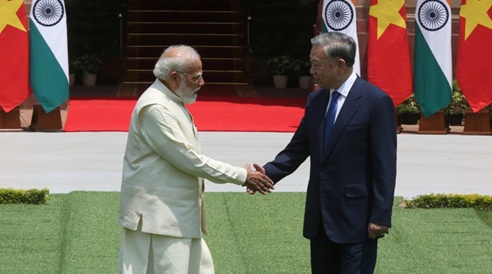
India and Vietnam have decided to further strengthen their bilateral relations, elevating them to the level of an "Enhanced Comprehensive Strategic Partnership." The two countries also agreed to increase trade to $25 billion by 2030 and enhance defense cooperation. This announcement was made following bilateral talks between Prime Minister Narendra Modi and Vietnamese President To Lam in New Delhi.

Relations gain new status

  • Prime Minister Modi stated that India and Vietnam will now elevate cooperation to new heights in areas such as culture, connectivity, capacity building, security, sustainable development, and supply chains.
  • India was among the first countries to establish a strategic partnership with Vietnam in 2007. This was India's first strategic partnership in the ASEAN region. Later, in 2016, the two countries elevated the relationship to a Comprehensive Strategic Partnership.
  • Now, the two countries have further strengthened this partnership by granting it the status of an 'Enhanced Comprehensive Strategic Partnership'.

$25 billion trade target by 2030

  • India and Vietnam have set a target of increasing bilateral trade to $25 billion by 2030.
  • Trade between the two countries has nearly doubled to $16 billion in the last decade.
  • Prime Minister Modi stated that Indian medicines will have easier access to Vietnam.
  • Exports of agricultural, fish, and animal products will receive a boost.
  • Exports of grapes and pomegranates from India will increase.
  • Availability of durian and pomelo fruits from Vietnam will increase in India.

11 Agreements Signed

  • A total of 11 Memorandums of Understanding (MoUs) were signed between the two countries. These agreements cover several key areas:
  • Rare Earth Minerals
  •  Digital Payments
  • Urban Management
  • Culture and Manuscripts
  • Science and Technology

Focus on Defense and Maritime Security

  • India and Vietnam described defense and maritime security cooperation as a key pillar of their partnership.
  • The two countries agreed to enhance joint military exercises, joint production of defense technology, naval cooperation, information sharing, and maritime security.
  • The joint statement also emphasized maintaining peace, stability, and freedom of navigation in the South China Sea. Both sides reiterated the need for peaceful resolution of disputes and adherence to international law, especially UNCLOS.

Vietnam Joins Indo-Pacific Oceans Initiative (IPOI)

  • During the meeting, Vietnam also decided to join India's Indo-Pacific Oceans Initiative (IPOI). This is being considered an important step towards increasing cooperation in the Indo-Pacific region.

Why are India-Vietnam relations important ?

  • According to experts, the growing strategic partnership between India and Vietnam can play a vital role in maintaining stability and balance in the Indo-Pacific region.
  • Growing cooperation in areas such as defense, trade, maritime security, and supply chains will give new strength to the relations between the two countries.

India-Vietnam Bilateral Relations: Historical Background

  • India and Vietnam's relations are based on historical trust, anti-colonial struggles, and long-standing political cooperation.
  • The two countries established formal diplomatic relations in 1972, although their ties had been strong even before this.
  • In 1954, Prime Minister Jawaharlal Nehru became the first foreign leader to visit Vietnam, immediately after the liberation of Hanoi.
  • During the Vietnam War, India consistently supported Vietnam's sovereignty and territorial integrity.
  • After Vietnam's reunification in 1975, India was among the first countries to recognize Vietnam.
  • Later, in 2007, the two countries elevated their relations to a Strategic Partnership, India's first strategic partnership in the ASEAN region.
  • In 2016, this cooperation was further strengthened and upgraded to a Comprehensive Strategic Partnership, giving new direction to relations in the political, economic, defense, and cultural spheres.

Conclusion

The elevation of India-Vietnam relations to an 'Enhanced Comprehensive Strategic Partnership' signals growing trust and strategic cooperation between the two countries. This partnership is likely to strengthen in the coming years, driven by increased cooperation in trade, defense, and the Indo-Pacific region.

First International Big Cat Alliance (IBCA) Summit, 2026

Why in News ?

  • India will host the first International Big Cat Alliance (IBCA) Summit in New Delhi on 1–2 June 2026. 
  • The announcement was made by Union Minister for Environment, Forest and Climate Change, Bhupender Yadav during the launch of the summit’s official website and logo. 
  • Heads of state, scientists, conservation experts, and policymakers from various countries will participate in the summit. 
  • The main objective of the summit is to strengthen the conservation of big cat species, promote transboundary cooperation, and enhance global ecosystem protection. 

What is the International Big Cat Alliance (IBCA) ?

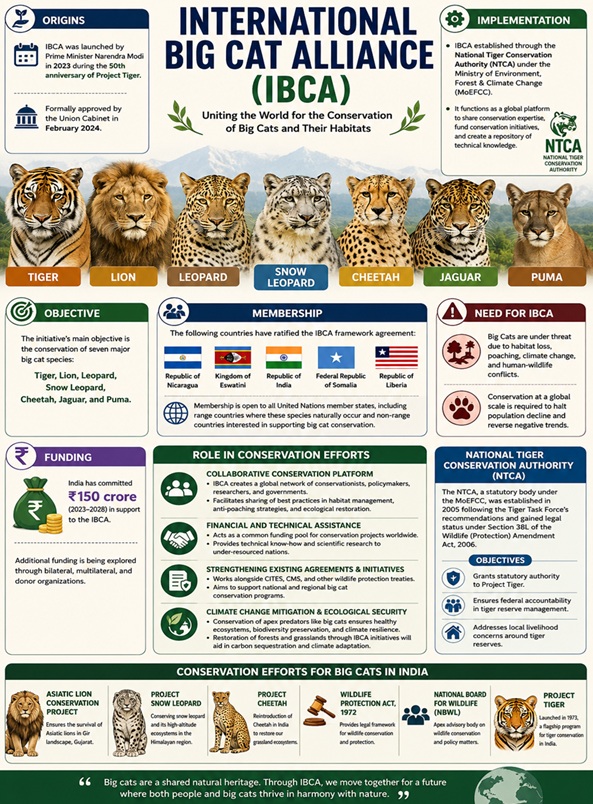
  • The International Big Cat Alliance (IBCA) is the world’s first intergovernmental and multi-agency global alliance dedicated to the conservation of big cat species. 
  • It brings together 95 big cat range countries, scientific organizations, conservation partners, and business groups on a common platform to address conservation challenges through cooperation, financial support, and knowledge sharing. 

Origins of IBCA

  • Launched in 2023 by Prime Minister Narendra Modi on the occasion of the 50th anniversary of Project Tiger. 
  • Received formal approval from the Union Cabinet in February 2024. 

Implementation

  • The initiative has been established through the National Tiger Conservation Authority. 
  • It functions under the Ministry of Environment, Forest and Climate Change. 
  • It acts as a global platform where: 
    • Conservation expertise is shared 
    • Financial support is provided for projects 
    • Technical knowledge repositories are developed 

Objectives of IBCA

  • To conserve seven major big cat species : 
    • Tiger 
    • Lion 
    • Leopard 
    • Snow Leopard 
    • Cheetah 
    • Jaguar 
    • Puma 
  • To prevent the decline in their populations and reverse negative conservation trends.

International Big Cat Alliance (IBCA) – Membership

  • Initial signatory countries: India, Nicaragua, Eswatini, Somalia, Liberia 
  • Membership is open to all United Nations member countries. 
  • It includes : 
    • Countries where big cat species are naturally found 
    • Countries willing to cooperate in wildlife conservation efforts 

Need for the International Big Cat Alliance (IBCA)

  • Habitat loss 
  • Poaching and illegal wildlife trade 
  • Climate change 
  • Human-wildlife conflict 

Due to these threats, the population of big cats is declining rapidly, making global conservation efforts essential.

Funding

  • India’s contribution: Approximately ₹150 crore (2023–2028) 
  • Additional sources of funding include : 
    • Bilateral assistance 
    • Multilateral assistance 
    • Donor agencies 

Key Functions of IBCA

1. Collaborative Platform

  • Creates a global network of conservationists, governments, and scientists 
  • Facilitates the exchange of best conservation practices 

2. Financial and Technical Assistance

  • Provides shared funding for global conservation projects 
  • Offers technical support to resource-deficient countries 

3. Policy and International Cooperation

  • Coordinates with international agreements such as CITES and CMS 
  • Promotes transboundary conservation initiatives 

4. Scientific Research

  • Encourages technology-driven and data-based conservation 
  • Focuses on ecological requirements of big cats 

5. Sustainable Livelihoods

  • Links conservation efforts with local employment opportunities and climate resilience 

Ecological Importance of Big Cats

  • Big cats are apex predators in the ecosystem 
  • They help maintain ecological balance 
  • They contribute to biodiversity conservation and climate stability 
  • Protection of forests and grasslands helps increase carbon absorption capacity 

Importance of IBCA for India

  • Strengthens India’s leadership in global wildlife diplomacy 
  • Showcases India’s successful conservation models such as : 
    • Project Tiger 
    • Project Cheetah 
  • Enhances international cooperation in wildlife conservation 
  • Promotes India’s role in global biodiversity governance

Project Tiger (1973)

  • Project Tiger is a centrally sponsored scheme launched by India on 1 April 1973 with the objective of protecting tigers from extinction. 
  • It is administered by the National Tiger Conservation Authority (NTCA). 
  • The scheme focuses on conserving tigers in their natural habitats, establishing protected tiger reserves, and increasing the tiger population. 

National Tiger Conservation Authority (NTCA)

  • The National Tiger Conservation Authority is a statutory body under the Ministry of Environment, Forest and Climate Change (MoEFCC), established to strengthen tiger conservation in India. 
  • It provides regulatory, technical, and financial support for the implementation of Project Tiger and the management and monitoring of tiger reserves across the country. 

Establishment

  • The NTCA was constituted in December 2005 and received statutory status following amendments to the Wildlife (Protection) Act, 1972, based on the recommendations of the Tiger Task Force. 

Objectives

  • To provide a statutory basis to Project Tiger 
  • To ensure accountability between the Central and State Governments 
  • To strengthen the effective conservation and management of tiger reserves 

Functions and Powers

1. Approval of Tiger Conservation Plans

  • Reviews and approves Tiger Conservation Plans prepared by State Governments 

2. Setting Standards

  • Frames guidelines for tourism and conservation activities in core and buffer areas of tiger reserves 

3. Management Evaluation

  • Conducts Management Effectiveness Evaluation (MEE) of tiger reserves 

4. Tiger Census and Monitoring

  • Conducts the All India Tiger Estimation 
  • Uses modern technologies such as camera traps for monitoring 
  • According to the 2022 estimation, India has more than 3,000 tigers 

5. Regulation of Land Use

  • Has the authority to restrict mining and unsustainable development projects within tiger reserves 

Key Initiatives

M-STrIPES

  • A software-based monitoring system for better patrolling and surveillance in tiger reserves 

Special Tiger Protection Force (STPF)

  • A dedicated force for anti-poaching operations 

Tiger Reintroduction Programme

  • Reintroduction of tigers in Sariska Tiger Reserve and Panna Tiger Reserve 

International Role

  • The National Tiger Conservation Authority also acts as the nodal agency for the International Big Cat Alliance (IBCA), an international initiative launched by India for the conservation of big cats. 
« »
  • SUN
  • MON
  • TUE
  • WED
  • THU
  • FRI
  • SAT
Have any Query?

Our support team will be happy to assist you!

OR