Why in News ?
- India will host the first International Big Cat Alliance (IBCA) Summit in New Delhi on 1–2 June 2026.
- The announcement was made by Union Minister for Environment, Forest and Climate Change, Bhupender Yadav during the launch of the summit’s official website and logo.
- Heads of state, scientists, conservation experts, and policymakers from various countries will participate in the summit.
- The main objective of the summit is to strengthen the conservation of big cat species, promote transboundary cooperation, and enhance global ecosystem protection.
_Summit.jpg)
What is the International Big Cat Alliance (IBCA) ?
- The International Big Cat Alliance (IBCA) is the world’s first intergovernmental and multi-agency global alliance dedicated to the conservation of big cat species.
- It brings together 95 big cat range countries, scientific organizations, conservation partners, and business groups on a common platform to address conservation challenges through cooperation, financial support, and knowledge sharing.
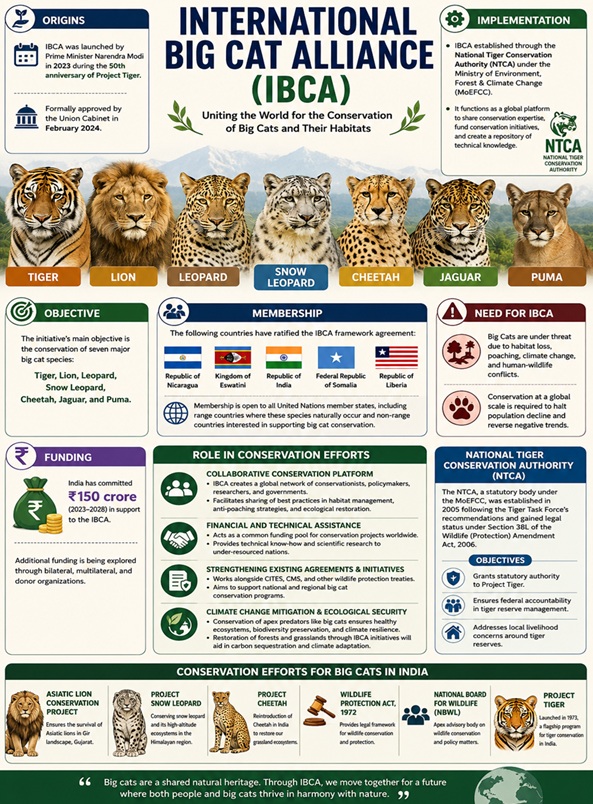
Origins of IBCA
- Launched in 2023 by Prime Minister Narendra Modi on the occasion of the 50th anniversary of Project Tiger.
- Received formal approval from the Union Cabinet in February 2024.
Implementation
- The initiative has been established through the National Tiger Conservation Authority.
- It functions under the Ministry of Environment, Forest and Climate Change.
- It acts as a global platform where:
- Conservation expertise is shared
- Financial support is provided for projects
- Technical knowledge repositories are developed
Objectives of IBCA
- To conserve seven major big cat species :
- Tiger
- Lion
- Leopard
- Snow Leopard
- Cheetah
- Jaguar
- Puma
- To prevent the decline in their populations and reverse negative conservation trends.
International Big Cat Alliance (IBCA) – Membership
- Initial signatory countries: India, Nicaragua, Eswatini, Somalia, Liberia
- Membership is open to all United Nations member countries.
- It includes :
- Countries where big cat species are naturally found
- Countries willing to cooperate in wildlife conservation efforts
Need for the International Big Cat Alliance (IBCA)
- Habitat loss
- Poaching and illegal wildlife trade
- Climate change
- Human-wildlife conflict
Due to these threats, the population of big cats is declining rapidly, making global conservation efforts essential.
Funding
- India’s contribution: Approximately ₹150 crore (2023–2028)
- Additional sources of funding include :
- Bilateral assistance
- Multilateral assistance
- Donor agencies
Key Functions of IBCA
1. Collaborative Platform
- Creates a global network of conservationists, governments, and scientists
- Facilitates the exchange of best conservation practices
2. Financial and Technical Assistance
- Provides shared funding for global conservation projects
- Offers technical support to resource-deficient countries
3. Policy and International Cooperation
- Coordinates with international agreements such as CITES and CMS
- Promotes transboundary conservation initiatives
4. Scientific Research
- Encourages technology-driven and data-based conservation
- Focuses on ecological requirements of big cats
5. Sustainable Livelihoods
- Links conservation efforts with local employment opportunities and climate resilience
Ecological Importance of Big Cats
- Big cats are apex predators in the ecosystem
- They help maintain ecological balance
- They contribute to biodiversity conservation and climate stability
- Protection of forests and grasslands helps increase carbon absorption capacity
Importance of IBCA for India
- Strengthens India’s leadership in global wildlife diplomacy
- Showcases India’s successful conservation models such as :
- Project Tiger
- Project Cheetah
- Enhances international cooperation in wildlife conservation
- Promotes India’s role in global biodiversity governance
Project Tiger (1973)
- Project Tiger is a centrally sponsored scheme launched by India on 1 April 1973 with the objective of protecting tigers from extinction.
- It is administered by the National Tiger Conservation Authority (NTCA).
- The scheme focuses on conserving tigers in their natural habitats, establishing protected tiger reserves, and increasing the tiger population.
|
National Tiger Conservation Authority (NTCA)
- The National Tiger Conservation Authority is a statutory body under the Ministry of Environment, Forest and Climate Change (MoEFCC), established to strengthen tiger conservation in India.
- It provides regulatory, technical, and financial support for the implementation of Project Tiger and the management and monitoring of tiger reserves across the country.
Establishment
- The NTCA was constituted in December 2005 and received statutory status following amendments to the Wildlife (Protection) Act, 1972, based on the recommendations of the Tiger Task Force.
Objectives
- To provide a statutory basis to Project Tiger
- To ensure accountability between the Central and State Governments
- To strengthen the effective conservation and management of tiger reserves
Functions and Powers
1. Approval of Tiger Conservation Plans
- Reviews and approves Tiger Conservation Plans prepared by State Governments
2. Setting Standards
- Frames guidelines for tourism and conservation activities in core and buffer areas of tiger reserves
3. Management Evaluation
- Conducts Management Effectiveness Evaluation (MEE) of tiger reserves
4. Tiger Census and Monitoring
- Conducts the All India Tiger Estimation
- Uses modern technologies such as camera traps for monitoring
- According to the 2022 estimation, India has more than 3,000 tigers
5. Regulation of Land Use
- Has the authority to restrict mining and unsustainable development projects within tiger reserves
Key Initiatives
M-STrIPES
- A software-based monitoring system for better patrolling and surveillance in tiger reserves
Special Tiger Protection Force (STPF)
- A dedicated force for anti-poaching operations
Tiger Reintroduction Programme
- Reintroduction of tigers in Sariska Tiger Reserve and Panna Tiger Reserve
International Role
- The National Tiger Conservation Authority also acts as the nodal agency for the International Big Cat Alliance (IBCA), an international initiative launched by India for the conservation of big cats.
|






 Contact Us
  New Batch : 9555124124/ 7428085757
  Tech Support : 9555124124/ 7428085757