India’s “3F” Concerns: Impact of West Asia Crisis on Fuel, Fertiliser and Foreign Exchange Reserves
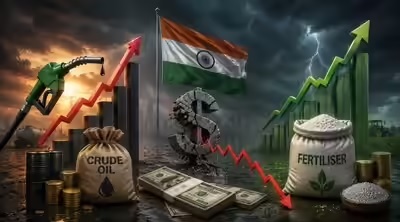
Recently, in the context of rising concerns over the Indian economy amid the West Asia crisis, the “3F” framework—Fuel, Fertilizer, and Foreign Exchange—has been highlighted.
High and volatile international crude oil prices, unprecedented increases in fertilizer prices, and rising gold prices are creating pressure on India’s external sector.
The Prime Minister had earlier called for adopting Covid-like consumption habits to conserve foreign exchange reserves.
This includes promoting work from home, encouraging virtual meetings, avoiding non-essential foreign travel, limiting gold purchases for one year, and prioritising local products. Since these activities involve imports and foreign exchange outflow, the objective was to reduce pressure on foreign exchange reserves.
Subsequently, the government took several measures to prevent rupee depreciation and conserve foreign exchange. These included increasing import duties on gold, silver, and platinum, restricting duty-free gold imports under export incentive schemes, and multiple hikes in petrol and diesel prices.
Due to foreign capital outflows and weak investment inflows, the Indian rupee has remained under pressure. After the West Asia conflict began, foreign portfolio investors (FPIs) withdrew about $24.4 billion from Indian equities and bonds. As a result, the rupee weakened by nearly 5% since late February and reached close to ₹97 per US dollar.
To prevent excessive depreciation of the rupee, the Reserve Bank of India (RBI) intervened in the foreign exchange market.
However, this increased pressure on foreign exchange reserves, and reports suggest a decline of nearly $40 billion compared to pre-war levels.
RBI’s gross forex sales in March stood at $29.6 billion, the highest in the last 13 months.
Economists have warned that rising import costs, rupee depreciation, and inflation due to energy shocks could lead India to face a Balance of Payments (BoP) deficit for the third consecutive year in 2026–27.
Although the RBI has projected GDP growth of 6.9% for 2026–27, several experts estimate it to be between 6% and 6.5%.
The Finance Minister rejected negative assessments of the economy, stating that such pessimistic views create unnecessary fear and weaken public confidence. She emphasized that India remains a strong economy and that confidence-building is essential.
Rising Fertilizer Import Bill Amid West Asia Crisis
Concerns related to 3F (Fuel, Fertiliser, Foreign Exchange) and rupee depreciation are expected to increase India’s fertiliser import expenditure. Experts believe that India’s fertiliser import bill in 2026–27 may surpass the record level of $33.4 billion recorded in 2022–23.
Status of India’s Fertilizer Sector
India is the world’s second-largest fertilizer consumer and third-largest producer. Total fertilizer production in the country increased from 385.39 lakh metric tonnes (LMT) in 2014–15 to 503.35 LMT in 2023–24.
Despite rising production, India’s fertilizer consumption remains high. In 2023–24, total fertilizer consumption was about 601 LMT, of which around 177 LMT was met through imports.
Fertilizer subsidy in India is also expected to exceed the FY26 budget estimate of ₹1.67 trillion, mainly due to higher consumption of urea and Di-Ammonium Phosphate (DAP).
Major Challenges in the Fertilizer Sector
India is heavily dependent on imports forfertilisers and raw materials due to limited domestic mineral resources. Key inputs such as LNG, rock phosphate, ammonia, and potash are imported in large quantities. This makes the sector vulnerable to global conflicts, price volatility, and foreign exchange pressures.
In FY26, the total import bill for fertilizers and related inputs reached approximately $27.2 billion.
Another challenge is the subsidy–productivity paradox. The Commission for Agricultural Costs and Prices (CACP) has warned that removal of fertilizer subsidies could reduce usage by farmers, thereby affecting agricultural productivity.
Additionally, delays in subsidy payments create working capital stress for private and cooperative fertilizer companies.
Way Forward: CACP Recommendations (Kharif 2026–27)
The Commission for Agricultural Costs and Prices (CACP), in its Kharif 2026–27 price policy report, recommended using digital platforms like AgriStack to promote balanced nutrient use and reduce the subsidy burden.
It also suggested revising India’s traditional Nitrogen: Phosphorus: Potassium (N:P:K) ratio of 4:2:1, as agro-climatic conditions, cropping patterns, and irrigation systems are changing.
Further, it emphasized promoting the use of micronutrients and secondary nutrients, and adopting soil organic carbon improvement strategies.
Conclusion
India’s “3F” challenge—Fuel,Fertiliser, and Foreign Exchange—reflects the increasing impact of global geopolitical events on the domestic economy.
Rising fuel costs, fertilizer import dependency, and pressure on foreign exchange reserves have emerged as major concerns.
For long-term economic stability, reducing import dependence, increasing domestic production, and efficient resource management are essential.






 Contact Us
  New Batch : 9555124124/ 7428085757
  Tech Support : 9555124124/ 7428085757