Why in news
India launched its first-ever Guide to Grasslands and Other Open Natural Ecosystems (ONEs) of India on 17 August 2026 during the 17th Session of the Conference of the Parties (COP17) to the United Nations Convention to Combat Desertification (UNCCD) in Ulaanbaatar, Mongolia.
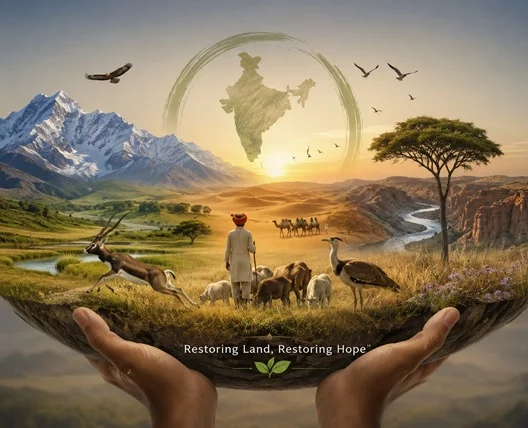
Key facts
|
Aspect
|
Details
|
|
Guide
|
First-ever Guide to Grasslands and Other Open Natural Ecosystems of India
|
|
Launch
|
17 August 2026
|
|
Venue
|
Ulaanbaatar, Mongolia
|
|
Event
|
UNCCD COP17
|
|
Theme
|
“Restoring Land, Restoring Hope”
|
|
Main focus
|
Grasslands and other naturally open ecosystems
|
|
Importance
|
Biodiversity + Climate + Livelihoods + Land Restoration
|
|
Major global framework
|
UNCCD
|
|
Key concept
|
Land Degradation Neutrality
|
|
Special 2026 connection
|
International Year of Rangelands and Pastoralists
|
What are Open Natural Ecosystems (ONEs)?
-
ONEs are landscapes that are naturally open or sparsely treed not degraded forests characterised by grasses, shrubs, and scattered trees, shaped over millennia by climate, soil, fire, and grazing rather than by deforestation.
Types of ONEs found in India
- Himalayan and Terai grasslands: high-altitude and foothill grass ecosystems supporting unique fauna
- Thar and Banni landscapes: arid and semi-arid grasslands/desert ecosystems of Rajasthan and Gujarat
- Deccan savannas: tropical grass-and-tree mosaics of peninsular India
- Rocky plateaus: lateritic and basaltic plateau grasslands (e.g., Western Ghats plateaus)
- Ravines: eroded riverine badlands (e.g., Chambal ravines)
- Scrublands: dry thorn-scrub ecosystems
- Coastal ecosystems: coastal grasslands and open scrub
- Desert landscapes: cold and hot desert open ecosystems
What is a Grassland?
- A grassland is an ecosystem in which grasses and herbaceous plants dominate vegetation while trees are absent, scattered or relatively sparse.
- Grassland structure depends upon rainfall, seasonality of rainfall, soil characteristics, temperature, fire, grazing and herbivory, topography, and water availability.
Major Grasslands and Open Ecosystems of India
- Thar Desert and Associated Grasslands
- Region: Mainly Rajasthan and parts of Gujarat
- Importance: Arid ecosystem, Desert biodiversity, Pastoralism, Habitat of the Great Indian Bustard, Important for understanding desertification and land degradation.
- Banni Grasslands
- Location: Kutch, Gujarat
- Importance: Pastoral livelihoods, Livestock grazing, Grassland biodiversity, Community-based resource use
- Major issues: Salinity, Invasive species, Changes in grazing patterns, Land-use change
- Terai Grasslands
- Location: Himalayan foothills
- Characteristics: Tall grasses, Floodplain environment, Seasonal wetlands, Grassland–forest mosaics
- They provide habitat for several large mammals and birds.
- Himalayan Grasslands
- These occur across high-altitude Himalayan landscapes.
- They are generally seasonal, high-altitude, climate-sensitive, important for pastoralism.
- Traditional communities may use these landscapes for seasonal livestock grazing.
- Deccan Savannas
- Region: Peninsular India
- These landscapes are characterised by grasses, scattered trees, seasonal rainfall, fire, and herbivory
- They demonstrate that not every naturally open landscape is a degraded forest.
- Shola Grasslands
- Region: High-elevation Western Ghats
- They form a characteristic Shola Forest–Grassland Mosaic
- Importance: Water regulation, Mountain hydrology, Endemic biodiversity, Climate regulation
- Ravines
- Ravines are deeply dissected landscapes generally associated with erosion. A major example is the Chambal Ravine landscape.
- They can support specialised vegetation, riverine ecosystems, wildlife, and unique geomorphological features
- Scrublands
- Scrublands are generally dominated by shrubs and herbs.
- They are common in dry regions, semi-arid regions, and water-stressed environments
Ecological and Socio-Economic Significance
- Biodiversity: Support distinct, often endemic flora and fauna adapted to open habitats e.g., the Great Indian Bustard, blackbuck, wolf, caracal, and numerous grassland-specialist birds and insects that cannot survive in dense forest.
- Carbon storage: Grasslands store substantial carbon below ground, in root systems and soil, making them significant and resilient (fire- and drought-tolerant) carbon sinks studies have estimated grassland soil carbon sequestration at roughly 146 tonnes per hectare per year, comparable to tropical forests.
- Water and soil processes: Regulate groundwater recharge, prevent soil erosion, and maintain watershed health, particularly in arid and semi-arid zones.
- Livelihoods: They sustain pastoral and agro-pastoral communities, livestock-rearing, and nomadic/transhumant tribes supporting an estimated 500 million livestock and about half of India's fodder production, along with the livelihoods of more than 20 nomadic pastoral communities.
- Climate resilience: Being naturally drought and fire-adapted, ONEs offer a lower-cost, higher-resilience alternative to inappropriate afforestation in dry and semi-arid regions.
Key Threats to India's ONEs
- Misclassification as “wastelands” nearly 70% of officially designated “wasteland” areas overlap with open natural ecosystems, exposing them to diversion for “development.”
- Inappropriate afforestation drives planting trees on natural grasslands disrupts native ecology instead of restoring it
- Land-use conversion intensive/expanding agriculture and infrastructure projects
- Renewable energy expansion large solar and wind installations sited on open lands without ecological assessment
- Overgrazing and loss of traditional pastoral rotation systems
- Absence of a distinct legal/policy category unlike forests, ONEs have historically lacked a dedicated conservation and land-use framework in India
Related Schemes, Concepts and Terms
- Land Degradation Neutrality (LDN): UNCCD/SDG target 15.3 to avoid, reduce and reverse land degradation
- Bonn Challenge: global effort to restore degraded/deforested land, to which India has committed 26 million hectares
- National Mission for a Green India (GIM): one of the eight missions under India's National Action Plan on Climate Change
- Banni Grasslands (Gujarat): Asia's largest tropical grassland, threatened by Prosopis juliflora invasion
- Great Indian Bustard: critically endangered grassland bird, flagship species for India's grassland conservation debate
- Desertification and Land Degradation Atlas of India: published by ISRO, maps land degradation status across states
- Rangelands: land used for grazing livestock/wildlife, largely overlapping with ONEs; focus of IYRP 2026
Relevant Indian Laws and Policies
|
Law/Policy
|
Relevance
|
|
Wildlife Protection Act, 1972
|
Wildlife and habitat protection
|
|
Environment Protection Act, 1986
|
Umbrella environmental legislation
|
|
Biological Diversity Act
|
Biodiversity conservation and sustainable use
|
|
National Biodiversity Action Plan
|
Biodiversity planning
|
|
Green India Mission
|
Ecosystem restoration
|
|
Land degradation programmes
|
Restoration and sustainable land management
|
|
National Livestock Mission
|
Livestock and fodder-related support
|
|
Rural employment programmes
|
Potential support for soil/water restoration
|
Significance for India
- First formal policy recognition that grasslands and open ecosystems are not “wastelands” but distinct, valuable ecosystems
- Provides a science-based framework to guide land-use planning, reducing indiscriminate afforestation or diversion of ONEs for infrastructure/renewable energy
- Strengthens India's international climate and biodiversity diplomacy by showcasing indigenous ecosystem knowledge at a global platform
- Supports livelihood security of pastoral and nomadic communities by recognising their traditional land-use systems
- Aligns with India's broader commitments under UNCCD (Land Degradation Neutrality), CBD (30x30 target) and UNFCCC (carbon sequestration)
Way Forward
- Formal legal/administrative recognition of ONEs as a distinct land-use category, separate from “wastelands” and forests
- Satellite-based national mapping and periodic monitoring of ONEs (building on ISRO/SAC's technical role)
- Integrating pastoral community rights and traditional grazing systems into conservation planning
- Careful ecological screening before siting afforestation or renewable energy projects on open lands
- Mainstreaming ONE conservation into India's Land Degradation Neutrality and Nationally Determined Contribution (NDC) targets
Prelims MCQ
Q. Consider the following statements regarding Open Natural Ecosystems (ONEs) in India:
- ONEs include grasslands, savannas, scrublands, ravines and deserts.
- Nearly 70% of India's officially classified ‘wastelands’ overlap with ONEs.
- ONEs sequester negligible carbon compared to forests.
Which of the statements given above is/are correct?
(a) 1 and 2 only
(b) 2 and 3 only
(c) 1 only
(d) 1, 2 and 3
Mains Practice Question
Q. "India's conservation policy needs to move beyond a forest-centric approach." Discuss with reference to Grasslands and Open Natural Ecosystems.
|
FAQs
What are Open Natural Ecosystems (ONEs)?
Naturally open landscapes dominated by grasses, herbs or shrubs with limited tree cover.
What is UNCCD COP17?
The 17th UNCCD Conference focuses on land restoration, desertification, drought and sustainable land management.
Why are grasslands important ?
They support biodiversity, carbon storage, soil conservation, pastoralism and climate resilience.
Do grasslands store carbon?
Yes, mainly through extensive roots and soil organic carbon stored underground.
Which SDG is most relevant?
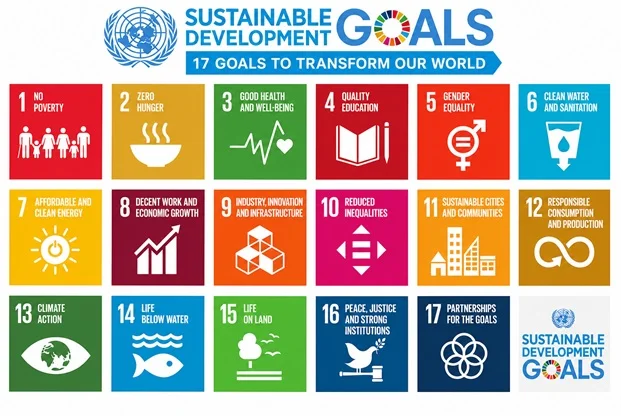
SDG 15 – Life on Land is most directly connected with grassland and biodiversity conservation.
|






 Contact Us
  New Batch : 9555124124/ 7428085757
  Tech Support : 9555124124/ 7428085757