
- UPSC Exam
- State PCS
- One Day Exam
- Current Affairs
- PT Quiz
- Downlaods
- About Coaching
- Blog
- Videos

| Prelims: NASA Moon Base | Artemis Programme | Artemis Accords | ISRO | Gaganyaan | Bharatiya Antariksh Station | Lunar South Pole | Human Spaceflight Mains: GS Paper II – India-US Relations | GS Paper III – Space Technology | Strategic Autonomy | Space Governance Keywords: NASA Moon Base, ISRO, Artemis Accords, Gaganyaan, Bharatiya Antariksh Station, Human Moon Mission, Lunar Exploration, India-US Space Cooperation |
India has reportedly received an invitation to participate in NASA’s Moon Base programme, which seeks to develop a sustained human and robotic presence on the Moon. The proposal is significant for ISRO because India is simultaneously pursuing Gaganyaan, Bharatiya Antariksh Station (BAS) and a human Moon-landing mission by 2040.
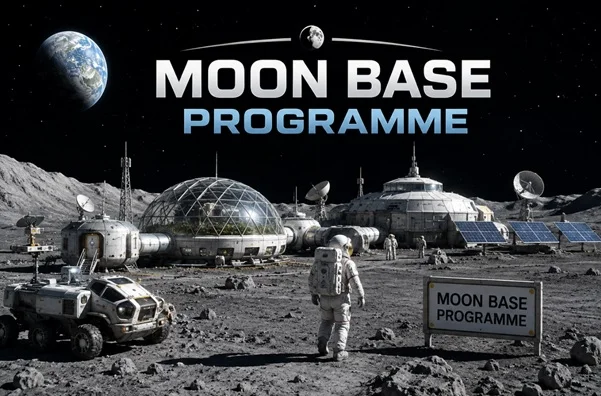
The programme aims to move beyond short-duration lunar missions towards creating infrastructure that can support astronauts and robots on the Moon for prolonged periods.
It could involve:
The Artemis Accords, launched in 2020, provide principles for peaceful and responsible space exploration.
They cover areas such as:
India became the 27th signatory to the Artemis Accords in June 2023.
However: Artemis Accords ≠ Artemis Programme
Signing the Accords does not automatically make India a participant in NASA's Artemis missions. Specific participation requires separate agreements.
The Artemis framework is sometimes viewed as a US-led effort to shape rules for future lunar exploration and resource utilisation, particularly because major space powers China and Russia remain outside it.
1. Faster Technology Development: ISRO needs several advanced technologies for future human and lunar missions. Participation would allow India to gain practical experience rather than independently developing every technology from scratch. This could significantly reduce development time and help India leapfrog technologically.
2. Support India's Human Spaceflight Roadmap: India has an ambitious sequence of missions:
Gaganyaan → Bharatiya Antariksh Station (2035) → Human Moon Landing (2040)
Experience from an international lunar programme could directly contribute to these missions. In particular, long-duration human spaceflight, docking, habitation and lunar-surface operations would be valuable for both BAS and India's eventual crewed Moon mission.
3. Economic Advantage: Maintaining an independent human-spaceflight programme, space station and lunar programme simultaneously would require enormous expenditure. International cooperation allows India to:
Share Cost + Share Infrastructure + Gain Experience + Avoid Technology Duplication
India can retain sovereign capabilities in critical areas while collaborating on infrastructure that does not need to be developed independently.
4. Boost to Indian Space Industry: Participation could provide opportunities for Indian companies in:
Robotics | Electronics | Advanced Materials | AI | Communications | Precision Manufacturing
It could also integrate India's private space sector into advanced global space supply chains.
5. Technology Spin-offs: Technologies developed for lunar exploration can have applications on Earth.
Areas such as robotics, AI, water recycling, advanced materials, energy storage, telecommunications and medical technology could benefit from such collaboration. Thus:
Space Cooperation → Technology Development → Industrial & Economic Benefits
Prelims MCQQ. With reference to the Artemis Accords, consider the following statements:
Which of the statements given above are correct? A. 1 and 2 only UPSC Mains QuestionQ. How can India's participation in NASA-led lunar exploration strengthen its human-spaceflight ambitions while preserving strategic autonomy? Discuss. |
1. What is NASA’s Moon Base Programme?It aims to establish a sustained human and robotic presence on the Moon for scientific research, exploration and future utilisation of lunar resources. 2. Why is NASA’s Moon Base Programme important for India?Participation could help ISRO gain experience in lunar habitats, life-support systems, robotics, docking and deep-space operations, accelerating India’s human-spaceflight programme. 3. What are the Artemis Accords?They are a set of principles for peaceful, transparent and responsible space exploration, including interoperability, scientific cooperation and space-resource utilisation. 4. How can Moon Base cooperation support India’s future space missions?The experience could complement Gaganyaan, Bharatiya Antariksh Station and India’s goal of sending astronauts to the Moon by 2040. 5. What is the main concern for India in joining such a programme?India must avoid excessive technological dependence and protect its strategic autonomy while benefiting from international cooperation—“Interoperability without Dependency.” |



Our support team will be happy to assist you!

 Contact Us
  New Batch : 9555124124/ 7428085757
  Tech Support : 9555124124/ 7428085757