Why in News?
India-based defence start-up D-Propulse recently announced the successful demonstration of a Rotating Detonation Engine (RDE) at a Defence Research and Development Organisation (DRDO) facility in Hyderabad.
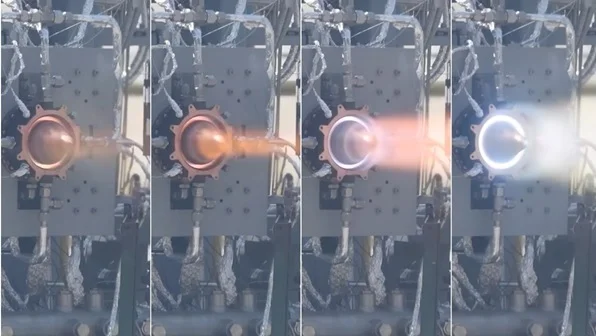
What is a Rotating Detonation Engine (RDE)?
- A Rotating Detonation Engine is an advanced propulsion system in which fuel-air combustion occurs through continuously travelling detonation waves inside an annular, or ring-shaped, combustion chamber.
- Unlike conventional engines, where fuel burns relatively slowly through a flame, an RDE uses extremely rapid combustion in which the reaction front travels at supersonic speed.
- These continuously rotating detonation waves create high pressure and temperature, which can then be converted into thrust.
In simple terms:
Conventional Engine → Fuel burns through a flame
RDE → Fuel-air mixture undergoes rapid supersonic detonation
Deflagration vs Detonation
Understanding the RDE requires understanding two different forms of combustion.
Deflagration: Most conventional engines, including many gas-turbine engines, depend on deflagration.
In deflagration:
- The flame travels at subsonic speed.
- Combustion is relatively steady.
- Pressure increase during combustion is limited.
- It is widely used because the process is easier to control.
Detonation: In detonation:
- Combustion travels at supersonic speed.
- A strong shock wave accompanies the chemical reaction.
- Fuel releases energy extremely rapidly.
- High pressure can potentially improve thermodynamic efficiency.
RDE technology attempts to continuously harness this detonation process for propulsion.
How Does an RDE Work?
- An RDE generally contains a ring-shaped combustion chamber.
- First, fuel and oxidiser are continuously injected into the chamber.
- The mixture is then ignited to create a detonation wave.
- Instead of disappearing immediately, the detonation wave travels continuously around the annular chamber.
- As it moves, fresh fuel-air mixture enters behind it and becomes available for the next combustion cycle.
- Thus, one or more detonation waves can continuously rotate around the chamber.
- The resulting high-pressure gases are expelled through the engine, producing thrust.
Basic Process
Fuel + Oxidiser Injection
↓
Ignition
↓
Supersonic Detonation Wave
↓
Wave Rotates Around Annular Chamber
↓
High-Pressure Gas Generation
↓
Thrust
Why Could RDEs Be More Efficient?
- The major attraction of RDE technology is its potential pressure-gain combustion.
- In conventional combustors, pressure losses can occur during the combustion process. Detonation-based combustion, however, can generate a significant pressure rise.
- Based on theoretical physics and experimental research, RDEs may potentially provide around 10%–25% improvement in thermodynamic efficiency compared with conventional combustion systems.
- Even a relatively small increase in propulsion efficiency can have major consequences in aerospace applications because fuel represents a significant portion of the weight and cost of aircraft and launch systems.
Significance for India
- India’s demonstration of RDE technology is important for the development of an indigenous ecosystem for advanced propulsion technologies.
- India has been strengthening domestic capabilities in missiles, fighter aircraft, UAVs, space launch vehicles and high-speed weapons. Propulsion remains one of the most difficult and strategically important technologies in aerospace development.
- The involvement of an Indian defence start-up also demonstrates the increasing role of the private sector and start-up ecosystem in developing advanced defence technologies alongside organisations such as DRDO.
- If India successfully develops operational RDE technology in the future, it could strengthen indigenous capabilities in advanced aerospace propulsion and reduce dependence on foreign technologies.
Way Forward
- India should focus on sustained R&D in high-temperature materials, computational fluid dynamics, advanced fuel injection, thermal management and combustion control.
- Greater collaboration among DRDO laboratories, IITs, universities, private companies and defence start-ups could accelerate the transition from experimental demonstrations to practical propulsion systems.
- At the same time, RDEs should be viewed as an emerging technology rather than an operational replacement for conventional engines.
Prelims MCQ
Q. With reference to Rotating Detonation Engine (RDE), consider the following statements:
- It uses supersonic detonation waves instead of conventional subsonic deflagration.
- Detonation waves continuously rotate inside an annular combustion chamber.
- RDE technology is already widely deployed in commercial aircraft engines.
Which of the statements given above are correct?
A. 1 and 2 only
B. 2 and 3 only
C. 1 and 3 only
D. 1, 2 and 3
Mains Practice Question
Q. What is a Rotating Detonation Engine (RDE)? Discuss its working principle, potential advantages and significance for India’s future aerospace and defence propulsion capabilities.
|
FAQs
1. What is a Rotating Detonation Engine (RDE)?
An RDE is an advanced propulsion system that uses continuously rotating supersonic detonation waves to generate thrust.
2. How is an RDE different from a conventional engine?
Conventional combustors primarily use subsonic deflagration, whereas RDEs use supersonic detonation for rapid energy release.
3. Why are RDEs considered more efficient?
Their pressure-gain combustion can potentially provide higher thermodynamic efficiency and better fuel utilisation than conventional combustors.
4. Why is RDE technology important for India?
It could strengthen India’s indigenous capabilities in advanced propulsion for missiles, high-speed aircraft, UAVs and space systems.
5. Are Rotating Detonation Engines currently operational?
RDEs are still largely in the research and development stage and are not yet widely deployed in operational commercial or military platforms.
|






 Contact Us
  New Batch : 9555124124/ 7428085757
  Tech Support : 9555124124/ 7428085757