Prelims: Environment & Ecology | Air Pollution | NCAP | PM10 | NAAQS | CPCB | Urban Governance
Mains: GS Paper III: Environmental Pollution and Degradation, Conservation, Urbanisation and Environmental Governance
Keywords: Swachh Vayu Sarvekshan, National Clean Air Programme, NCAP, PM10, NAAQS, CPCB, Non-Attainment Cities, Air Pollution, Road Dust, Electric Mobility, Urban Governance, Airshed Management, Waste Management, and Particulate Matter |
Why in News?
- Lucknow has secured the first position among million-plus cities in the Swachh Vayu Sarvekshan 2026.
- Indore secured the second position, while Jabalpur ranked third.
- The survey evaluates cities on their efforts to control major sources of air pollution such as road dust, waste, vehicles and industries.
- Despite topping the ranking, Lucknow's annual PM10 concentration remains above India's prescribed ambient air-quality standard.
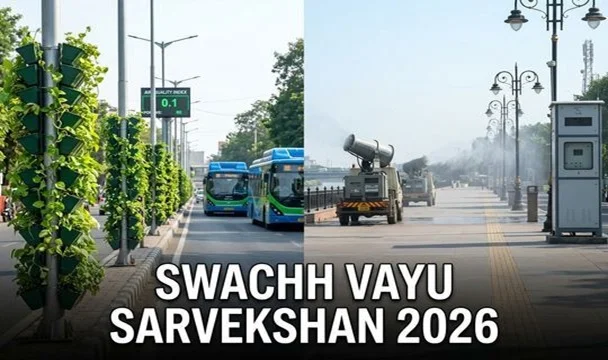
What is Swachh Vayu Sarvekshan?
- Swachh Vayu Sarvekshan (SVS) is a national assessment of cities covered under the National Clean Air Programme (NCAP).
- It encourages cities to identify pollution sources, implement targeted interventions and strengthen urban air-quality management.
Swachh Vayu Sarvekshan 2026 Rankings
|
Population Category
|
First
|
Second
|
Third
|
|
More than 10 lakh
|
Lucknow
|
Indore
|
Jabalpur
|
|
3–10 lakh
|
Rourkela
|
Firozabad & Guntur – Joint
|
Amravati
|
|
Below 3 lakh
|
Kalinga Nagar
|
Angul
|
Talcher
|
Awards were also introduced for municipal wards that demonstrated improvements in air-quality management.
Why Did Lucknow Rank First?
Lucknow adopted several measures aimed at controlling different sources of urban air pollution.
- Electric Waste Collection Vehicles: The city added electric vehicles to its waste collection fleet.
- This can help reduce: Diesel Consumption → Vehicular Emissions → Urban Air Pollution
- Mechanised Road Sweeping: Mechanised sweepers have been deployed to control road dust. Road and resuspended dust are important contributors to particulate pollution in many Indian cities.
- Legacy Waste Management: The city has also undertaken measures to manage legacy waste accumulated at old dumping sites. Scientific management of such waste can reduce dust, waste burning and local environmental pollution.
- Multi-Sector Pollution Control: Lucknow's performance reflects interventions across several sectors: Waste Management + Road Dust Control + Cleaner Vehicles + Urban Management This integrated approach helped the city secure the top position.
Why Did Jabalpur Perform Well?
Jabalpur's major interventions included:
- A waste-to-energy plant
- 100% waste collection
- Scientific waste disposal
- Mechanised street sweeping
- Promotion of electric vehicles
How Did the Ranking Change from the Previous Year?
- In the previous survey, Indore topped the million-plus population category, followed by Jabalpur. Agra and Surat jointly occupied the third position.
- Bottom Five Among Million-Plus Cities:
- The bottom five cities in the million-plus category included: Chennai, Jamshedpur, Kota, Kolkata, Madurai
- Among India's major metropolitan cities: Delhi - 30th, Mumbai -37th
- Their rankings highlight the complexity of managing air pollution in large and densely populated urban centres.
Key Parameters of Swachh Vayu Sarvekshan
- Cities are assessed on their performance across multiple pollution-control areas.
- Waste Management: Assessment includes scientific collection, processing and disposal of municipal solid waste.
- Road Dust Control: Cities are evaluated on measures such as mechanised road sweeping and dust-control practices.
- Construction and Demolition Dust: Measures to control dust generated from construction and demolition activities are assessed.
- Vehicular Pollution: Cities receive recognition for measures aimed at reducing transport-related emissions and promoting cleaner mobility.
- Industrial Pollution: Monitoring and control of emissions from industrial activities form another important component.
- PM10 Reduction: Actual improvement in PM10 concentrations is also considered.
- However, improvement in PM10 concentration carries only about 2.5% weightage in the overall assessment.
What are National Ambient Air Quality Standards?
- The National Ambient Air Quality Standards (NAAQS) prescribe permissible levels of major air pollutants in ambient air.
- For PM10, India's prescribed annual average standard is: 60 µg/m³
- Lucknow's reported annual concentration of around 137 µg/m³ therefore remains significantly above the prescribed standard despite substantial improvement from earlier levels.
What is the National Clean Air Programme?
- The National Clean Air Programme (NCAP) was launched by the Government of India in: January 2019
- It provides a national framework for tackling air pollution in targeted Indian cities.
- The programme seeks to improve air quality through city-specific action plans, monitoring, pollution-control measures and coordination between different levels of government.
How is NCAP Funded?
Air-quality improvement programmes receive financial support through multiple channels.
These include:
- Union Ministry of Environment, Forest and Climate Change
- 15th Finance Commission grants
- Convergence with funds from the Ministry of Housing and Urban Affairs
- Support through programmes of the Ministry of Heavy Industries
Significance of Swachh Vayu Sarvekshan
1. Promotes Competitive Federalism
Ranking cities encourages urban administrations to compete in adopting better pollution-control measures.
2. Strengthens Municipal Accountability
Urban local bodies become active stakeholders in air-quality management.
3. Encourages Source-Based Intervention
The survey promotes targeted action against road dust, waste burning, construction emissions, vehicles and industries.
4. Promotes Best-Practice Sharing
Successful interventions adopted by cities such as Lucknow, Indore and Jabalpur can be studied and replicated by other cities.
5. Links Environment with Urban Governance
Air quality is increasingly treated not merely as an environmental issue but also as a question of transport planning, waste management, infrastructure and municipal governance.
Prelims MCQs
Q. Consider the following statements regarding PM10:
- PM10 refers to particulate matter with an aerodynamic diameter of 10 micrometres or less.
- Road dust and construction activities can contribute to PM10 pollution.
- PM10 is exclusively produced by vehicular emissions.
Which of the statements given above are correct?
A. 1 only
B. 1 and 2 only
C. 2 and 3 only
D. 1, 2 and 3
Mains Question
“A high ranking in clean-air governance does not necessarily imply attainment of clean-air standards.” Discuss in the context of Swachh Vayu Sarvekshan 2026 and India's National Clean Air Programme.
|
FAQs
What is Swachh Vayu Sarvekshan?
Swachh Vayu Sarvekshan is a national assessment framework that evaluates cities covered under the National Clean Air Programme on their efforts and performance in reducing different sources of air pollution.
Which city topped Swachh Vayu Sarvekshan 2026?
Lucknow topped the million-plus population category, followed by Indore and Jabalpur.
When was the National Clean Air Programme launched?
The National Clean Air Programme was launched in January 2019.
What is India's annual standard for PM10?
The prescribed annual average standard for PM10 under India's National Ambient Air Quality Standards is 60 µg/m³.
What is the main objective of NCAP?
NCAP aims to improve air quality in targeted Indian cities through pollution monitoring, city-specific action plans, source-based interventions and coordinated governance.
|






 Contact Us
  New Batch : 9555124124/ 7428085757
  Tech Support : 9555124124/ 7428085757