Prelims: Defence Technology, Drones/UAVs, Cybersecurity, Electronic Warfare, GPS Spoofing & Jamming.
Mains GS-III: Science & Technology, Defence Indigenisation, Cybersecurity, Emerging Technologies.
Keyword: National Security, Technological Sovereignty, Atmanirbhar Bharat in Defence, Cyber Resilience. |
Why in News?
The Indian Army has established the AASHVAST facility in New Delhi to examine the electronic hardware, firmware and software used in military drones.
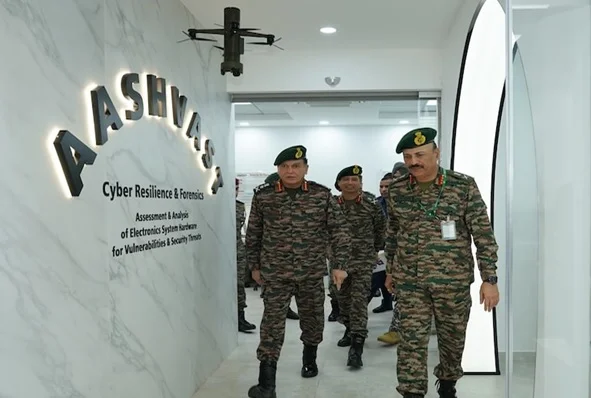
Important Points
- Army Chief General Dhiraj Seth inaugurated the facility on August 14, 2026. The facility is aimed at strengthening the security and reliability of critical defence electronics.
- AASHVAST stands for Assessment and Analysis of Electronic Systems Hardware for Vulnerabilities and Security Threats.
- The facility can help identify potentially embedded Chinese components and other security vulnerabilities.
- It checks for hidden passwords, encryption keys and remote-access mechanisms.
- It verifies whether drones can receive software updates only from authorised manufacturers.
- It also assesses risks related to GPS spoofing and jamming.
- AASHVAST is designed as an air-gapped and read-only facility, operating offline without modifying the equipment under examination.
- It also supports the growth of India’s domestic defence ecosystem.
What is AASHVAST?
- AASHVAST stands for Assessment and Analysis of Electronic Systems Hardware for Vulnerabilities and Security Threats.
- The AASHVAST suite was developed by QuickPay Tech for the Directorate General of Electronics and Mechanical Engineering (DG EME) as an analysis and validation system for assessing security vulnerabilities in defence electronics.
- The facility is designed to assess the security and integrity of electronic systems used in critical defence platforms.
- The system focuses on an important area that conventional physical inspections may overlook-the security of firmware and embedded software
Key Features
The AASHVAST facility has been designed as an air-gapped and read-only system.
This means:
- It operates offline.
- It does not write or modify data on the equipment being examined.
- Software can be extracted from a drone's flight controller or camera payload.
- Stored software images can also be analysed.
- Identified vulnerabilities are categorised according to their severity.
- Technical findings are converted into a simple security assessment.
The final findings are compiled into a single security record that can be used by both technicians and officers responsible for accepting the equipment.
What Does the AASHVAST Lab Check?
The facility examines both the hardware and software of military drones. Key checks include:
- Verifying whether the drone and its components are genuine.
- Detecting unauthorised hardware or software modifications.
- Identifying hidden passwords and encryption keys.
- Detecting possible remote-access mechanisms.
- Checking whether software updates can be received only from authorised manufacturers.
- Examining location-related controls and navigation functions.
- Assessing vulnerabilities related to GPS spoofing and jamming.
Why Is Drone Software Security Important?
A drone may appear physically secure during a conventional inspection, but vulnerabilities can remain hidden in its firmware, software and electronic systems.
A detailed software examination can reveal:
- Hidden credentials and access keys
- Unauthorised command pathways
- Remote-access features
- Modified flight restrictions
- Other software-based vulnerabilities
Such vulnerabilities could potentially allow unauthorised access or affect the drone's operation.
Why Is the AASHVAST Lab Important?
The facility is important because modern military drones rely heavily on software and electronic systems for navigation, communication and mission execution.
By examining these systems before deployment, the Army can:
- Improve the cybersecurity of military drones.
- Identify hidden security vulnerabilities.
- Detect unauthorised modifications.
- Reduce risks from compromised components.
- Strengthen the cyber resilience of critical defence platforms.
- Improve the reliability and operational readiness of unmanned systems.
- Support India's growing domestic defence ecosystem.
Challenges
- Rapid technological changes: Drone technology and software are developing quickly, making regular security testing necessary.
- Hidden vulnerabilities: Some security weaknesses may remain difficult to detect even after detailed testing.
- Dependence on foreign components: Identifying and replacing potentially risky foreign hardware and software can be challenging.
- Cyber threats: Hackers and adversaries can use malware, remote access or other methods to target drone systems.
- GPS spoofing and jamming: Disrupting a drone’s navigation can affect its operation during military missions.
- Software supply-chain risks: Unauthorised changes or compromised software updates can create security risks.
- Need for skilled personnel: Advanced testing requires trained experts in electronics, software and cybersecurity.
- Continuous monitoring: Drone security cannot be a one-time exercise; systems need regular testing and updates.
Conclusion
The AASHVAST Lab is an important step towards improving the security of India’s military drones. It will help the Indian Army detect hidden vulnerabilities, unauthorised changes and security risks in drone hardware and software. The facility will strengthen the security, reliability and operational readiness of military unmanned systems.
Prelims Practice Question
Q. With reference to the AASHVAST facility, consider the following statements:
- It has been established by the Indian Army in New Delhi.
- It is designed to examine the hardware, firmware and software of military drones.
- It can assess vulnerabilities related to GPS spoofing and jamming.
- It operates as an air-gapped and read-only facility.
Which of the statements given above are correct?
A. 1 and 2 only
B. 1, 2 and 3 only
C. 1, 2, 3 and 4
D. 2 and 4 only
Mains practice Question
Q. What is the significance of the AASHVAST facility for India’s defence cybersecurity and operational readiness? Discuss the major challenges in securing military drones from cyber and electronic threats.
|
FAQs
Q1. What is AASHVAST?
AASHVAST stands for Assessment and Analysis of Electronic Systems Hardware for Vulnerabilities and Security Threats.
Q2. Where has the AASHVAST facility been established?
It has been established by the Indian Army in New Delhi.
Q3. What is the main purpose of AASHVAST?
It examines military drones for hardware, firmware and software vulnerabilities, including unauthorised modifications and potential security risks.
Q4. Why is AASHVAST important?
It strengthens the cybersecurity, reliability and operational readiness of military unmanned systems.
Q5. What threats can affect military drones?
Major threats include GPS spoofing, jamming, malware, unauthorised remote access and compromised software or firmware.
|







 Contact Us
  New Batch : 9555124124/ 7428085757
  Tech Support : 9555124124/ 7428085757