Why in the news ?
- Recently, China and Pakistan agreed to accelerate the next phase of the China-Pakistan Economic Corridor (CPEC), namely CPEC 2.0. Both countries have specifically emphasized the development of the Gwadar port, industrial cooperation, agricultural modernization, and strengthening regional connectivity.
- This decision comes at a time when China is trying to re-energize key projects of its Belt and Road Initiative (BRI).
What is the China-Pakistan Economic Corridor (CPEC) ?
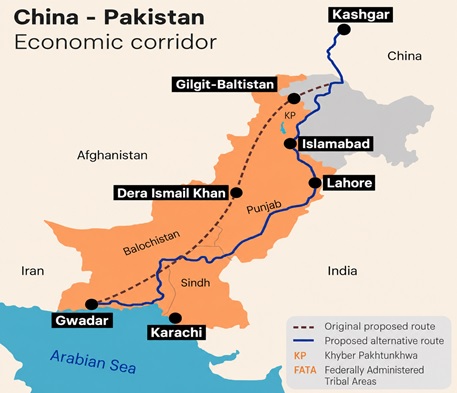
- The China-Pakistan Economic Corridor (CPEC) is a major flagship project of China's Belt and Road Initiative (BRI), announced in 2015.
- The project connects the Gwadar port in Pakistan's Balochistan province with Kashgar city in China's Xinjiang Uyghur Autonomous Region (XUAR).
- It involves extensive development of road, rail, energy, port, telecommunications, and industrial infrastructure.
Why is Gwadar Port important ?
- Located on the coast of the Arabian Sea, Gwadar Port is the centerpiece of CPEC. It was formally inaugurated in 2016.
- The port is located near major maritime trade routes between West Asia, Africa, and the Indian Ocean region.
- The port is important for China as an alternative route for energy supplies and trade, while Pakistan sees it as a key tool for economic development, attracting investment, and creating jobs.
Focus of CPEC 2.0
- The first phase of CPEC focused primarily on energy and transportation infrastructure. CPEC 2.0 prioritizes industrial development, special economic zones (SEZs), agricultural cooperation, information technology, mining, digital connectivity, and green growth.
- Its aim is to make Pakistan's economy more competitive and investment-friendly.
India's objections
- India has consistently opposed CPEC because the project passes through the Gilgit-Baltistan region of Pakistan-occupied Kashmir (PoK).
- India believes that this region is an integral part of its territory and that any third-country project in the region violates its sovereignty and territorial integrity.
- For this reason, India has not participated in China's Belt and Road Initiative.
Strategic and Geopolitical Importance
- CPEC is not seen solely as an economic project, but as an important pillar of the China-Pakistan strategic partnership.
- The project strengthens China's presence in the Indian Ocean region and influences the geopolitical situation in South Asia.
- Therefore, CPEC remains an important issue from the perspective of India-China relations, India-Pakistan relations, and regional security.
Conclusion
The decision to accelerate CPEC 2.0 reflects growing economic and strategic cooperation between China and Pakistan. While the project is a vehicle for development and connectivity for both countries, it remains a significant topic of discussion in international politics and diplomacy due to its implications for India's sovereignty and regional power balance.






 Contact Us
  New Batch : 9555124124/ 7428085757
  Tech Support : 9555124124/ 7428085757