- UPSC Exam
- State PCS
- One Day Exam
- Current Affairs
- PT Quiz
- Downlaods
- About Coaching
- Blog
- Videos

| Prelims : International Organisations + Culture + CA Mains : GS Paper 2 – International Relations, Cultural Diplomacy |
The Indian Council for Cultural Relations has recently signed an MoU with Doordarshan to expand the global reach of Indian cultural content.
This initiative aims to strengthen India’s cultural diplomacy by leveraging digital platforms and global media networks.

The Indian Council for Cultural Relations (ICCR) was established in 1950 by Maulana Abul Kalam Azad.
It is an autonomous organisation under the Ministry of External Affairs.
Its primary aim is to promote India’s cultural relations with other countries through cultural exchange and engagement.
This marks a shift towards digital cultural diplomacy and global outreach.
Q. The Indian Council for Cultural Relations (ICCR) functions under which ministry ?
(a) Ministry of Culture
(b) Ministry of External Affairs
(c) Ministry of Education
(d) Ministry of Information and Broadcasting
“Cultural diplomacy is an important pillar of India’s foreign policy.” Discuss with reference to the role of ICCR.
FAQsQ1. When was ICCR established ? 1950. Q2. Which ministry does ICCR function under ? Ministry of External Affairs. Q3. What is the main role of ICCR ? Promoting cultural exchange and India’s global cultural relations. Q4. What is the significance of the recent MoU ? It enhances global dissemination of Indian cultural content. Q5. Why is ICCR important for India ? It strengthens soft power and international cultural engagement. |
| Prelims : Polity (Union Territories, Constitutional Provisions) + CA Mains : GS Paper 2 – Governance, Federal Structure, Centre-State Relations |
The governance structure of Puducherry has come into focus due to ongoing debates over the powers of its elected government vis-à-vis the Lieutenant Governor.
Comparisons are being drawn with other Union Territories like Delhi and Jammu and Kashmir regarding administrative and legislative autonomy.
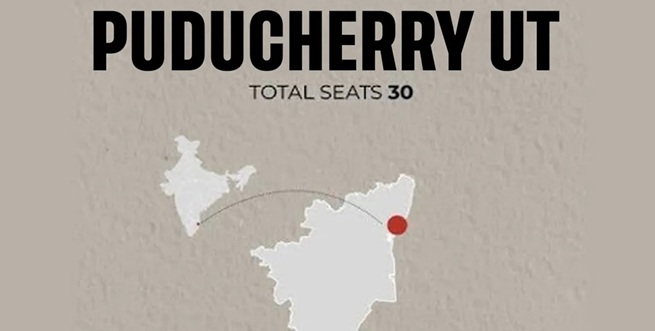
Union Territories (UTs) in India are governed directly by the Union Government, but some have been granted partial statehood features through legislatures.
Puducherry was formed from former French colonies and is governed under Article 239A, which provides for a legislature and Council of Ministers.
Delhi operates under Article 239AA, while Jammu and Kashmir was reorganised under the Jammu and Kashmir Reorganisation Act, 2019.
Frequent tussles between elected government and LG can affect policy implementation.
Limited autonomy raises concerns about the effectiveness of representative governance.
Differences among UTs highlight asymmetry in India’s quasi-federal structure.
Overlapping authority can delay decision-making and reduce governance efficiency.
Prelims
Q. Which of the following Union Territories has a legislature under Article 239A ?
(a) Delhi
(b) Puducherry
(c) Jammu and Kashmir
(d) Ladakh
Mains
“Union Territories with legislatures reflect the asymmetrical nature of Indian federalism.” Discuss with reference to Puducherry, Delhi, and Jammu & Kashmir.
FAQsQ1. Under which Article is Puducherry governed ? Article 239A. Q2. Why is Delhi different from other UTs ? It has special constitutional status under Article 239AA. Q3. Does Jammu & Kashmir have a legislature ? Yes, under the Reorganisation Act, 2019. Q4. What is unique about Puducherry ? It has geographically separated regions and nominated members. Q5. Why are UT governance issues important ? They affect federal balance and democratic functioning in India. |
| Prelims : Polity + Economy + CA Mains : GS Paper 2 – Governance, Local Self-Government; GS Paper 3 – Indian Economy, Inclusive Growth |
The Finance Commission of India (16th Finance Commission) has recommended a significant increase in financial transfers to rural local bodies for the period 2026–31.
This reflects a major push towards fiscal decentralisation aimed at strengthening grassroots governance and rural development.
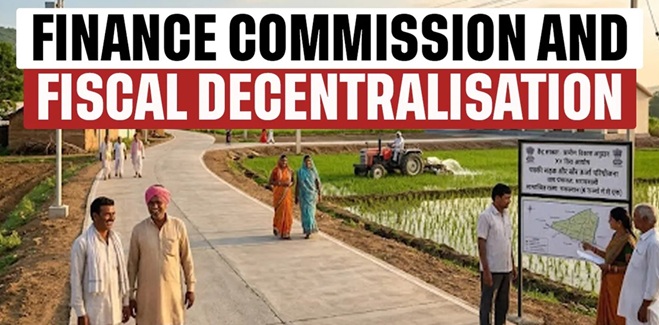
The Finance Commission of India is constituted under Article 280 to recommend the distribution of financial resources between the Centre and States.
The 73rd Constitutional Amendment Act institutionalised Panchayati Raj Institutions (PRIs) as the third tier of governance, requiring financial empowerment for effective functioning.
Fiscal decentralisation refers to the transfer of financial powers and resources from higher levels of government to local bodies.
The 16th Finance Commission has recommended about ₹4.35 lakh crore for rural local bodies during 2026–31.
This marks a substantial increase compared to previous commissions, reflecting growing emphasis on decentralised governance.
This incentivises better governance and efficient utilisation of funds.
This strengthens last-mile service delivery and rural development.
Grants are linked to :
This ensures transparency and fiscal discipline.
Initiatives like e-governance platforms improve :
Prelims
Q. The Finance Commission in India is constituted under which Article of the Constitution ?
(a) Article 270
(b) Article 280
(c) Article 243
(d) Article 356
Mains
“Fiscal decentralisation is essential for effective grassroots governance.” Discuss in the context of the role of the Finance Commission in empowering rural local bodies.
FAQsQ1. What is fiscal decentralisation ? Transfer of financial powers and resources to lower levels of government. Q2. What is the role of the Finance Commission ? It recommends distribution of tax revenues and grants between Centre and States. Q3. Why are rural local bodies important ? They enable grassroots governance and local development. Q4. What is the significance of the 16th Finance Commission ? It significantly increases funding to local bodies and promotes accountability. Q5. What challenges do Panchayats face ? Limited capacity, financial dependence, and governance issues. |
| Prelims : Geography + Environment + CA Mains : GS Paper 1 – Distribution of Natural Resources; GS Paper 3 – Mining, Environmental Conservation, Internal Security |
Recent developments in bauxite mining in Odisha have reignited conflicts between mining authorities, local communities, and environmental groups.
The issue has gained attention due to concerns over displacement of tribal populations, ecological degradation, and governance challenges in mineral-rich regions.

India is one of the major producers of bauxite, the primary ore used in aluminium production.
Odisha accounts for the largest share of India’s bauxite reserves, particularly in regions like the Eastern Ghats.
Many of these reserves lie in ecologically sensitive and tribal-dominated areas, leading to long-standing conflicts over land rights and resource utilisation.
Bauxite deposits are concentrated mainly in :
This regional concentration creates economic opportunities but also intensifies localised conflicts.
Many mining areas overlap with lands inhabited by tribal groups.
Issues include :
Resistance movements have emerged, particularly in regions like Niyamgiri Hills.
Bauxite mining in hilly and forested regions leads to :
The ecological sensitivity of the Eastern Ghats amplifies these impacts.
Conflicts highlight gaps in :
Resource-rich but underdeveloped regions often overlap with areas affected by Left Wing Extremism.
Grievances related to land and resource exploitation can fuel unrest and weaken state legitimacy.
Prelims
Q. Which of the following states has the largest bauxite reserves in India ?
(a) Maharashtra
(b) Odisha
(c) Rajasthan
(d) Punjab
Mains
“Discuss the challenges associated with bauxite mining in tribal regions of India. How can India balance resource extraction with environmental sustainability and social justice?”
FAQsQ1. What is bauxite used for ? It is primarily used in the production of aluminium. Q2. Why is Odisha significant for bauxite ? It holds the largest share of India’s bauxite reserves. Q3. What is the core issue in the Odisha mining conflict ? Conflict between mining development and tribal/environmental rights. Q4. How does mining affect the environment ? Through deforestation, biodiversity loss, and ecological imbalance. Q5. Why is this issue important for UPSC ? It links geography, environment, governance, and internal security. |
| Prelims : International Organisations + CA Mains : GS Paper 2 – International Relations, Global Governance |
The Commonwealth Parliamentary Association has been in news due to recent parliamentary engagements, including the India Region Zone VII Conference held in Goa.
Additionally, the CPA has launched new initiatives and strategic plans to strengthen parliamentary cooperation across Commonwealth nations.

The Commonwealth Parliamentary Association was established in 1911 (as the Empire Parliamentary Association) and renamed in 1948.
It is an organisation that promotes :
These aim to promote inclusivity and representation.
India actively participates through the CPA India Region, enhancing global legislative cooperation.
Indian parliamentarians benefit from :
India’s participation strengthens its position as a leader among developing countries in promoting democratic governance.
Prelims
Q. The headquarters of the Commonwealth Parliamentary Association is located in :
(a) New York
(b) Geneva
(c) London
(d) Ottawa
Mains
“Discuss the role of the Commonwealth Parliamentary Association in strengthening parliamentary democracy and global governance. Highlight its relevance for India.”
FAQsQ1. What is the Commonwealth Parliamentary Association ? An organisation that promotes cooperation among Commonwealth legislatures. Q2. Where is its headquarters located ? London, United Kingdom. Q3. How many members does it have ? Around 180 parliaments and legislatures. Q4. What is its main objective ? To strengthen democracy and parliamentary practices. Q5. Why is it important for India ? It enhances parliamentary diplomacy and global engagement. |

Our support team will be happy to assist you!

 Contact Us
  New Batch : 9555124124/ 7428085757
  Tech Support : 9555124124/ 7428085757