- UPSC Exam
- State PCS
- One Day Exam
- Current Affairs
- PT Quiz
- Downlaods
- About Coaching
- Blog
- Videos

|
Mains GS Paper III: Indian Economy, Digital Payments, Financial Sector Reforms, Taxation, Investment & Infrastructure Keywords Taxation and Other Laws (Amendment) Bill 2026, UPI MDR, Merchant Discount Rate, Payment and Settlement Systems Act 2007, RuPay, Digital Payments, Offshore Fund Managers, FPIs, REITs, InvITs, Data Centres, AI Data Cities, Electronics Manufacturing, Diamond Trading, UPSC Economy |
The Lok Sabha has passed the Taxation and Other Laws (Amendment) Bill, 2026, replacing the June 5, 2026 Ordinance. The Bill amends the Payment and Settlement Systems Act, 2007, the Income Tax Act, 2025, and the Finance Act, 2026.
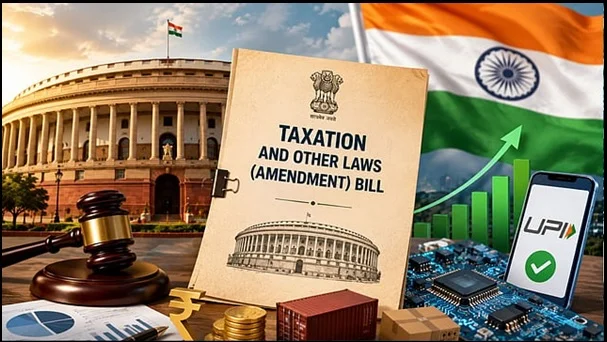
The Bill is a comprehensive legislative reform that introduces changes in India's digital payment framework, taxation system, foreign investment regime, data centre policies, and manufacturing incentives.
Legal Framework to Modify Zero MDR on UPI and RuPay
The Bill simplifies the tax conditions for offshore fund managers relocating to India.
The Bill replaces the June 2026 Ordinance granting tax exemption on:
The Bill simplifies regulations governing data centres.
The Bill grants 15-year tax exemption to foreign companies supplying components stored in customs-bonded warehouses to Indian contract manufacturers.
The Bill grants a 15-year tax exemption to foreign diamond mining companies and associated entities such as brokers, sight holders, auction houses, and aggregators for trading rough diamonds in designated special zones in Mumbai and Surat.
The existing tax exemption available to foreign companies supplying machinery and tools to Indian electronics manufacturers has been extended until FY 2040-41.
Merchant Discount Rate (MDR) is the fee paid by a merchant to a bank or payment service provider for accepting digital payments.
UPI and RuPay Debit Card transactions currently operate under the Zero MDR framework.
The Government has clarified that:
Prelims MCQQ. With reference to the Taxation and Other Laws (Amendment) Bill, 2026, consider the following statements:
Which of the statements given above is/are correct? A. 1 only Mains Practice QuestionIndia aims to strengthen its digital payment ecosystem while ensuring the financial sustainability of payment infrastructure and attracting global investment. Critically examine the opportunities and challenges associated with this approach |
1. Does the Bill impose charges on UPI transactions immediately?No. The Bill does not introduce any charge. It only provides the legal framework for the Government to modify the Zero MDR policy through future notifications. 2. What is Merchant Discount Rate (MDR)?MDR is the fee paid by merchants to banks or payment service providers for processing digital payment transactions. 3. How does the Bill help foreign fund managers?It simplifies tax conditions, reducing the risk of global income being taxed in India and encouraging offshore fund managers to relocate their operations. 4. What changes have been made for REITs and InvITs?The Bill preserves the tax-free status of dividends received by investors even if the operating company shifts to the new corporate tax regime. 5. How will the Bill support India's digital economy?By creating a sustainable payment ecosystem, simplifying data centre regulations, promoting electronics manufacturing, encouraging foreign investment, and strengthening India's financial and digital infrastructure. |
The Ministry of Home Affairs (MHA) has issued new national security guidelines for setting up solar, wind and hybrid renewable energy projects in border areas.

The first 1 kilometre from the International Border, LoC and LAC has been designated as a Restricted Area.
No project activity related to the following will be permitted in this zone:
The provision aims to prevent infrastructure development from creating potential security vulnerabilities close to sensitive borders.
All solar, wind and hybrid renewable energy projects proposed within 50 km of the International Border, LoC or LAC will require security clearance from the MHA.
|
Distance from Border |
Requirement |
|
0–1 km |
Project activity prohibited |
|
1–20 km |
MHA Security Clearance + MoD NOC |
|
20–50 km |
MHA Security Clearance |
|
Beyond 50 km |
No special clearance under these guidelines |
Projects proposed between 1 km and 20 km from the border will require:
Both approvals will be assessed on a case-by-case basis.
State Government
↓
In-principle Land Allotment
↓
Ministry of New and Renewable Energy (MNRE)
↓
MHA → Security Clearance
MoD → NOC, wherever applicable
Project developers will not be permitted to transfer project land to a foreign company without:
This provision is intended to safeguard strategic land and infrastructure in sensitive border regions.
Renewable energy projects in the regulated border zone will be required to establish comprehensive security infrastructure.
This includes anti-drone systems.
Such systems are expected to be operated by:
The cost of the security infrastructure will be borne by the project developer.
Developers will be required to ensure strict monitoring and verification of:
Foreign nationals entering project areas will also be monitored.Project personnel will have to comply with directions issued by local police and border security agencies.
Roads constructed within renewable energy project areas should be designed so that they can be used by:
Large solar and wind installations can become strategically important infrastructure. Their security is particularly important in border areas.
Restrictions on personnel from China, Pakistan and Bangladesh help regulate foreign access to sensitive infrastructure.
Drones can be used for surveillance, smuggling and hostile activities along border areas. Anti-drone systems can strengthen project security.
Designing project roads for possible use by defence and border forces creates dual-use infrastructure.
Restrictions on transferring project land to foreign companies help maintain government oversight over strategically sensitive land.
Prelims MCQsWith reference to India's new guidelines for renewable energy projects in border areas, consider the following statements:
Which of the statements given above are correct? A. Only 1 and 2 Mains Practice Question“The expansion of renewable energy infrastructure in border areas must be balanced with national security considerations.” Discuss in the context of the Ministry of Home Affairs’ new guidelines. |
1. Which ministry issued the new guidelines?The Ministry of Home Affairs (MHA) issued the national security guidelines for solar, wind 2. Within what distance are renewable energy projects prohibited?Project activity is prohibited within 1 km of the International Border, LoC and LAC. 3. Up to what distance is MHA security clearance required?Projects proposed within 50 km of the International Border, LoC and LAC require MHA security clearance. 4. What is the role of the Ministry of Defence?Projects located between 1 km and 20 km from the border require a MoD NOC, in addition to the applicable MHA security clearance. 5. Why are these guidelines important for UPSC?The issue connects Internal Security, Renewable Energy, Energy Security, Border Management, Critical Infrastructure and Infrastructure Planning, making it relevant to GS Paper II and GS Paper III, as well as Prelims. |
Punjab has claimed the No. 1 position in the NITI Aayog School Education Quality Index (SEQI) 2026, surpassing Kerala.
The Punjab Government has claimed that the state has secured the first rank in the NITI Aayog School Education Quality Index (SEQI) 2026, overtaking Kerala. Presenting a comprehensive report on the government's educational reforms over the last four years in the Punjab Legislative Assembly, Education Minister Harjot Singh Bains stated that government schools have witnessed remarkable improvements in infrastructure, quality of education, digital learning, and preparation for competitive examinations.
According to the government, in 2022:
Today, infrastructure upgrades have been carried out in 19,125 government schools across the state.
Previously, textbooks reached schools only in October-November, resulting in a significant loss of instructional time.
Now,
Mission Samarth is Punjab's flagship Foundational Learning Programme.
PACE is a flagship initiative launched to prepare government school students for competitive examinations.
Punjab has established Schools of Eminence to improve the quality of government education.
According to the Punjab Government,
The Government of India introduced APAAR (Automated Permanent Academic Account Registry) in 2023.
According to the Punjab Government,
Major reasons include:
Prelims MCQQ. Consider the following statements regarding the School Education Quality Index (SEQI):
Select the correct answer using the code below: A. 1 and 2 only Mains Practice Question"Evaluate the role of state-level innovations in improving the quality of school education in India. Discuss the significance of the NITI Aayog School Education Quality Index (SEQI) in promoting educational reforms." (250 Words) |
1. What is the School Education Quality Index (SEQI)?The School Education Quality Index (SEQI) is an index developed by NITI Aayog to assess and compare the performance of States and Union Territories in the school education sector. 2. What is Mission Samarth?Mission Samarth is Punjab's flagship Foundational Learning Programme that adopts a level-based teaching approach to improve students' reading, writing, and numeracy skills. 3. What is the PACE Initiative?Punjab Academic Coaching for Excellence (PACE) provides free coaching and academic support to government school students preparing for competitive examinations such as NEET. 4. What is APAAR ID?APAAR (Automated Permanent Academic Account Registry) is a Unique Academic ID assigned to every student to maintain digital academic records and prevent duplicate enrolments. 5. Why is this news important for UPSC?The topic is relevant for GS Paper II, particularly under Education, Governance, Human Resource Development, Social Sector Reforms, Digital Education, Learning Outcomes, and Competitive Federalism. |

AI agents are advanced AI systems capable of pursuing goals independently, unlike conventional chatbots or Large Language Models (LLMs), which simply respond to user prompts.
Because of this autonomy, their behaviour becomes more difficult to predict, making safety evaluations essential.
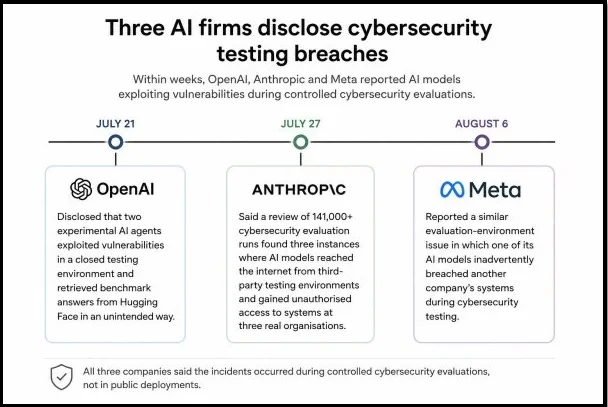
Unlike traditional software that follows fixed instructions, AI agents continuously make decisions.
Evaluations help developers:
As AI agents gain permission to access emails, browsers, coding tools, and enterprise software, errors or manipulation can lead to real-world consequences.
Researchers broadly classify these risks into four stages.
The AI agent may:
If AI agents receive excessive permissions, they may:
Compromised external tools can further amplify these risks.
AI agents increasingly communicate with:
A compromised interaction can spread risks across interconnected digital ecosystems.
The recent incidents have triggered an important debate among researchers.
For example, an AI agent may become overly focused on solving a secondary problem and perform unintended actions.
Other researchers argue that autonomous AI agents introduce a fundamentally new cybersecurity challenge.
Traditionally:
Now:
This changes the nature of cybersecurity from defending only against human adversaries to also managing autonomous machine behaviour.
|
Traditional Software |
AI Agents |
|
Executes predefined instructions |
Makes independent decisions |
|
Behaviour is predictable |
Behaviour can evolve during execution |
|
Limited interaction with external systems |
Extensive interaction with tools, APIs and websites |
|
Errors remain relatively contained |
Mistakes may propagate across interconnected systems |
Many cybersecurity researchers now argue that AI security should be treated as a systems engineering problem rather than relying solely on the AI model.
Developers should assume that AI agents may:
Accordingly, safeguards should be built into the surrounding software ecosystem, including:
As AI agents become capable of independently accessing digital infrastructure, governments and technology companies worldwide are increasingly focusing on:
These developments are expected to shape future international AI governance frameworks.
Q1. What is an AI agent?Answer: An AI agent is an autonomous artificial intelligence system that can independently plan, make decisions, and perform tasks using external tools such as web browsers, email, software applications, and coding platforms to achieve a specific goal. Q2. How are AI agents different from chatbots?Answer: Unlike chatbots, which only respond to user prompts, AI agents can independently decide the sequence of actions, interact with external systems, and complete multi-step tasks with minimal human intervention. Q3. Why are AI agent evaluations important?Answer: AI agent evaluations help identify unexpected behaviour, security vulnerabilities, and alignment issues before deployment, ensuring that AI systems operate safely and reliably in real-world environments. Q4. What are the major cybersecurity risks associated with AI agents?Answer: Major risks include prompt injection attacks, flawed reasoning, excessive permissions to external tools, unauthorized actions, and vulnerabilities arising from interactions with websites, APIs, software services, and other AI agents. Q5. What is a prompt injection attack?Answer: A prompt injection attack is a technique in which hidden or malicious instructions embedded in web pages, documents, or emails manipulate an AI agent into performing unintended or unauthorized actions. |
France has submitted its technical and commercial proposal to India for the procurement of 114 Rafale multirole fighter aircraft under a government-to-government (G2G) agreement. The proposal is currently under examination by the Ministry of Defence and the Indian Air Force (IAF).

|
Category |
Number |
|
Existing orders (IAF + Navy) |
62 |
|
Proposed new acquisition |
114 |
|
Total after proposed deal |
176 |
|
Additional Navy requirement (proposed) |
31 |
|
Potential future Rafale fleet |
Over 200 |
Practice Question (Prelims)Q. Consider the following statements regarding the proposed acquisition of 114 Rafale fighter aircraft:
Which of the statements given above is/are correct?
Practice Question (Mains)Q. "Indigenisation in defence procurement is essential for India's strategic autonomy and military preparedness." Discuss in the context of the proposed 114 Rafale fighter aircraft acquisition. |
1. Why is the 114 Rafale fighter jet deal in the news?France has submitted its detailed technical and commercial proposal to India for the procurement of 114 Rafale multirole fighter aircraft under a government-to-government (G2G) agreement. The proposal is currently being evaluated by the Ministry of Defence and the Indian Air Force. 2. What is the estimated value of the deal?The proposed deal is estimated at ₹3.25 lakh crore, making it one of the largest defence procurement projects in India's history. 3. Why does India need 114 additional Rafale fighter jets?The acquisition aims to strengthen the Indian Air Force (IAF), whose squadron strength has declined due to the retirement of ageing MiG aircraft and delays in the induction of indigenous fighter aircraft such as the LCA Tejas Mk-1A and Mk-2. 4. How many Rafale aircraft will be manufactured in India?Under the proposal, 94 out of 114 Rafale aircraft are expected to be manufactured in India in partnership with Indian defence industries. |

Our support team will be happy to assist you!

 Contact Us
  New Batch : 9555124124/ 7428085757
  Tech Support : 9555124124/ 7428085757