|
Mains
GS Paper III: Indian Economy, Digital Payments, Financial Sector Reforms, Taxation, Investment & Infrastructure
Keywords
Taxation and Other Laws (Amendment) Bill 2026, UPI MDR, Merchant Discount Rate, Payment and Settlement Systems Act 2007, RuPay, Digital Payments, Offshore Fund Managers, FPIs, REITs, InvITs, Data Centres, AI Data Cities, Electronics Manufacturing, Diamond Trading, UPSC Economy
|
Why in News?
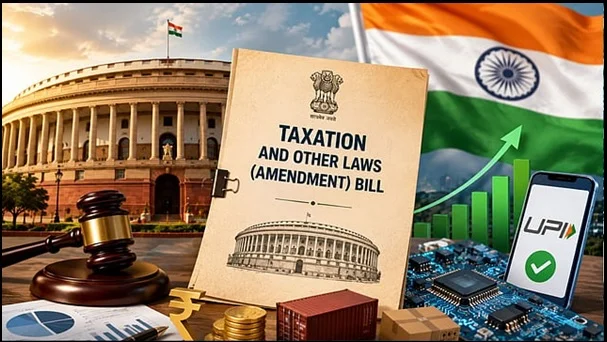
The Lok Sabha has passed the Taxation and Other Laws (Amendment) Bill, 2026, replacing the June 5, 2026 Ordinance. The Bill amends the Payment and Settlement Systems Act, 2007, the Income Tax Act, 2025, and the Finance Act, 2026.
Important Points
- The Bill creates the legal framework for the Central Government to modify the Zero Merchant Discount Rate (Zero MDR) regime for UPI and RuPay transactions through future notifications.
- The Bill does not impose any MDR or transaction fee immediately; it only enables the Government to decide which notified electronic payment modes or transactions may remain free or attract charges in the future.
What is the Taxation and Other Laws (Amendment) Bill, 2026?
The Bill is a comprehensive legislative reform that introduces changes in India's digital payment framework, taxation system, foreign investment regime, data centre policies, and manufacturing incentives.
Major Provisions of the Bill
Legal Framework to Modify Zero MDR on UPI and RuPay
Current Framework
- UPI and RuPay Debit Card transactions currently operate under the Zero Merchant Discount Rate (Zero MDR) policy.
- Banks and Payment Service Providers (PSPs) cannot charge merchants for these notified payment modes.
What the Bill Changes
- Amends the Payment and Settlement Systems Act, 2007.
- Empowers the Central Government to notify which electronic payment modes or transactions will remain free and which may attract charges in the future.
- The Bill does not impose MDR immediately; it only provides the legal authority to modify the Zero MDR regime through future notifications.
Possible Impact
- Selected UPI transactions could attract merchant charges in the future.
- Banks and payment service providers may receive a sustainable revenue model.
- Greater investment in digital payment infrastructure.
Easier Relocation for Offshore Fund Managers
The Bill simplifies the tax conditions for offshore fund managers relocating to India.
Objective
- Position India as a global fund management hub.
- Encourage international asset managers to shift operations to India.
- Generate high-value employment and financial services activity.
Benefits
- Reduces the risk of global income being taxed in India.
- Provides flexibility to establish fund management operations anywhere in India, including but not limited to the International Financial Services Centre (IFSC).
Relief for Foreign Portfolio Investors (FPIs)
The Bill replaces the June 2026 Ordinance granting tax exemption on:
- Interest income; and
- Capital gains earned by FPIs from investments in Government Securities.
Significance
- Encourages foreign investment in India's government bond market.
- Improves capital inflows and market stability.
Relief for REIT and InvIT Investors
- Existing Issue: Investors could lose dividend tax exemption if the operating company opted for the new corporate tax regime.
- New Provision: Dividend income received through REITs and InvITs will continue to remain tax-free for investors even if the operating company adopts the new tax regime.
Impact
- Protects retail investors.
- Encourages investment in real estate and infrastructure.
- Enhances the attractiveness of REITs and InvITs.
Simpler Rules for Data Centres
The Bill simplifies regulations governing data centres.
Key Changes
- Removes multiple government approval requirements.
- Allows leased data centres instead of only directly owned facilities.
- Continues tax incentives for eligible foreign cloud companies.
Expected Benefits
- Development of AI-ready data centre infrastructure.
- Increased foreign investment.
- Supports India's ambition to become a global cloud and AI hub.
Boost to Electronics Manufacturing
The Bill grants 15-year tax exemption to foreign companies supplying components stored in customs-bonded warehouses to Indian contract manufacturers.
Products Covered
- Mobile phones
- Laptops
- Tablets
- Personal computers
- Servers
- Electronic components
Expected Outcome
- Strengthens India's electronics manufacturing ecosystem.
- Enhances domestic supply chains.
- Supports the Make in India initiative.
Promotion of India's Diamond Trading Ecosystem
The Bill grants a 15-year tax exemption to foreign diamond mining companies and associated entities such as brokers, sight holders, auction houses, and aggregators for trading rough diamonds in designated special zones in Mumbai and Surat.
Objective
- Transform India into a global rough diamond trading hub.
- Expand diamond trading beyond display activities to actual commercial transactions.
Extended Tax Incentives for Contract Manufacturing
The existing tax exemption available to foreign companies supplying machinery and tools to Indian electronics manufacturers has been extended until FY 2040-41.
What is Merchant Discount Rate (MDR)?
Merchant Discount Rate (MDR) is the fee paid by a merchant to a bank or payment service provider for accepting digital payments.
Who Pays MDR?
- Generally, merchants bear the cost.
- In some cases, the cost may indirectly be passed on to consumers.
Where is MDR Applicable?
- Debit Cards
- Credit Cards
- Digital Wallets
- Other electronic payment systems
UPI and RuPay Debit Card transactions currently operate under the Zero MDR framework.
Importance of Zero MDR
- Encouraged rapid adoption of digital payments.
- Supported small merchants and MSMEs.
- Promoted financial inclusion.
- Helped India become the world's largest real-time digital payment ecosystem.
Potential Challenges
- Possibility of merchant charges on selected UPI transactions.
- Increased cost for small businesses.
- Potential slowdown in digital payment adoption.
- Risk of indirect costs being passed on to consumers.
Government's Position
The Government has clarified that:
- The Bill does not introduce MDR.
- It only creates the legal framework for future policy changes.
- The objective is to ensure the long-term financial sustainability of banks, payment service providers, and digital payment infrastructure while retaining the flexibility to determine which payment modes remain free.
UPSC Prelims Facts
- Payment and Settlement Systems Act: 2007
- Current Zero MDR applies to: UPI and RuPay Debit Cards
- Bill Passed by Lok Sabha: 6 August 2026
- Replaces Ordinance issued on: 5 June 2026
- MDR: Merchant Discount Rate
- FPI: Foreign Portfolio Investor
- IFSC: International Financial Services Centre
- REIT: Real Estate Investment Trust
- InvIT: Infrastructure Investment Trust
Prelims MCQ
Q. With reference to the Taxation and Other Laws (Amendment) Bill, 2026, consider the following statements:
- The Bill immediately imposes Merchant Discount Rate (MDR) on all UPI transactions.
- The Bill empowers the Central Government to determine through notification which electronic payment modes may continue under the Zero MDR regime.
- The Bill simplifies tax conditions for offshore fund managers relocating to India.
Which of the statements given above is/are correct?
A. 1 only
B. 2 only
C. 2 and 3 only
D. 1, 2 and 3
Mains Practice Question
India aims to strengthen its digital payment ecosystem while ensuring the financial sustainability of payment infrastructure and attracting global investment. Critically examine the opportunities and challenges associated with this approach
|
FAQs
1. Does the Bill impose charges on UPI transactions immediately?
No. The Bill does not introduce any charge. It only provides the legal framework for the Government to modify the Zero MDR policy through future notifications.
2. What is Merchant Discount Rate (MDR)?
MDR is the fee paid by merchants to banks or payment service providers for processing digital payment transactions.
3. How does the Bill help foreign fund managers?
It simplifies tax conditions, reducing the risk of global income being taxed in India and encouraging offshore fund managers to relocate their operations.
4. What changes have been made for REITs and InvITs?
The Bill preserves the tax-free status of dividends received by investors even if the operating company shifts to the new corporate tax regime.
5. How will the Bill support India's digital economy?
By creating a sustainable payment ecosystem, simplifying data centre regulations, promoting electronics manufacturing, encouraging foreign investment, and strengthening India's financial and digital infrastructure.
|






 Contact Us
  New Batch : 9555124124/ 7428085757
  Tech Support : 9555124124/ 7428085757