Prelims: Exercise INDRA, INS Sahyadri, Shivalik-class Frigates, Vladivostok, MAHASAGAR Vision, Indian Navy.
Mains: GS Paper II – India–Russia Relations and Bilateral Cooperation; GS Paper III – Maritime Security, Defence Technology and Operational Preparedness.
Keywords: INDRA 2026, INS Sahyadri, India–Russia Naval Exercise, Vladivostok, Maritime Cooperation, MAHASAGAR Vision, Naval Interoperability, Defence Diplomacy. |
Why in News?
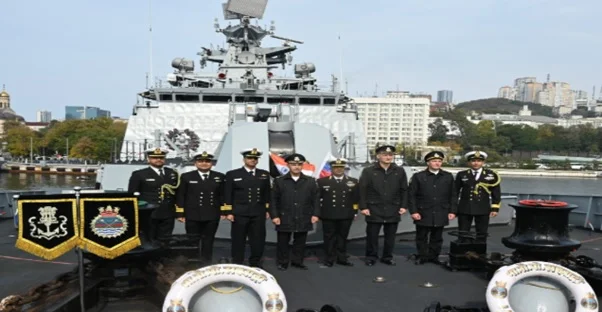
- INS Sahyadri arrived at Vladivostok, Russia to participate in Exercise INDRA 2026, scheduled from October 13 to 18, 2026.
- The bilateral exercise involves the Indian Navy and the Russian Federation Navy and aims to strengthen maritime cooperation and operational coordination.
Evolution of India–Russia Defence Cooperation through INDRA
- India and Russia share a longstanding defence relationship, supported by military exercises, professional exchanges and institutional cooperation.
- The INDRA framework is an important part of this engagement. It has included cooperation across military services: the first tri-service INDRA exercise was held at Vladivostok in October 2017. The present announcement concerns the naval exercise involving INS Sahyadri.
About Exercise INDRA 2026
|
Aspect
|
Details
|
|
Participating countries
|
India and Russia
|
|
Participating forces
|
Indian Navy and Russian Federation Navy
|
|
Indian warship
|
INS Sahyadri
|
|
Host port
|
Vladivostok, Russia
|
|
Scheduled dates
|
October 13–18, 2026
|
|
Structure
|
Harbour engagements followed by coordinated activities at sea
|
|
Primary objective
|
Strengthen operational coordination and interoperability
|
The programme also includes social and cultural exchanges between naval personnel.
About INS Sahyadri
- INS Sahyadri is an indigenously built Shivalik-class guided-missile stealth frigate.
- Its deployment illustrates the role of Indian-built warships in international naval cooperation.
- The ship has participated in other overseas exercises, including the Japan–India Maritime Exercise in October 2025.
Harbour and Sea Phases
- Harbour phase: This phase will involve professional engagements that provide opportunities for interaction and preparation before coordinated operations.
- Sea phase: Harbour engagements will be followed by operational activities at sea, intended to improve coordination and mutual understanding.
The official announcement does not provide a detailed list of individual combat drills or participating Russian vessels.
Understanding Interoperability
Interoperability refers to the ability of different armed forces to operate effectively together. In naval operations, it involves:
- Establishing effective communication.
- Understanding each other’s procedures.
- Coordinating ship movements and activities.
- Developing familiarity with different operational practices.
INDRA 2026 identifies improved interoperability as one of its central objectives.
Alignment with the MAHASAGAR Vision
- The deployment aligns with India’s MAHASAGAR vision - Mutual and Holistic Advancement for Security and Growth Across Regions.
- It also seeks to sustain the momentum of bilateral engagement following the 23rd India–Russia Annual Summit, held on December 4-5, 2025.
Significance
- Strengthening Defence Diplomacy: Naval engagements create opportunities to maintain professional contact and reinforce defence relationships through practical cooperation.
- Improving Operational Understanding: Working together enables personnel to understand different naval practices. Such familiarity can make future coordination more effective.
- Building Professional Relationships: Social and cultural activities complement operational training by encouraging interaction between personnel and strengthening camaraderie. These exchanges form part of the announced programme.
- Connecting Diplomacy with Operational Engagement: The exercise demonstrates how bilateral diplomatic engagement can be supported by practical exchanges between the armed forces.
Relevance for India
The following are strategic implications of the deployment:
- Operational experience: Overseas engagements expose naval crews to different operating environments and procedures.
- Indigenous capability: The participation of an Indian-built frigate demonstrates domestic warship-building capability.
- Maritime outreach: Naval visits and exercises support sustained engagement with partner countries.
- Strategic autonomy: Cooperation with Russia can be understood within India’s broader approach of maintaining diverse defence partnerships and independent decision-making.
Challenges
These are broader considerations for naval cooperation, rather than problems officially reported during INDRA 2026.
- Differences in Equipment and Procedures: Different communication systems, platforms and operating practices can make coordination demanding.
- Sustaining Training Benefits: The value of an exercise depends on whether lessons are documented, assessed and incorporated into subsequent training.
- Managing Geopolitical Complexity: India must pursue bilateral defence cooperation while navigating wider international tensions and protecting its own strategic interests.
- Deployment and Logistics: Overseas operations require careful planning for maintenance, supplies, personnel readiness and operational safety.
Way Forward
- Strengthen professional exchanges: Maintain regular interaction between naval personnel.
- Assess exercise outcomes: Identify operational lessons and areas requiring further coordination.
- Improve communication procedures: Develop greater familiarity with practices needed for safe joint operations.
- Support indigenous capabilities: Use operational experience to inform training and capability development.
- Maintain an interest-based approach: Align maritime partnerships with India’s security priorities and strategic autonomy.
Conclusion
Exercise INDRA 2026 provides an opportunity to strengthen India–Russia maritime cooperation through professional exchanges and coordinated naval activities.Its practical value will depend on the operational lessons gained and the ability to translate them into sustained cooperation.
Prelims MCQ
INS Sahyadri, participating in Exercise INDRA 2026, belongs to which class of Indian naval warships?
(a) Kolkata class
(b) Shivalik class
(c) Kalvari class
(d) Vikrant class
Mains Practice Question
“Bilateral naval exercises strengthen operational preparedness while serving as instruments of defence diplomacy.” Discuss with reference to India–Russia maritime cooperation.
|
FAQs
1. What is Exercise INDRA 2026?
The announced naval edition is a bilateral exercise involving the Indian Navy and the Russian Federation Navy.
2. When and where is INDRA 2026 scheduled?
It is scheduled for October 13–18, 2026, with Vladivostok, Russia, serving as the host port, followed by coordinated activities at sea.
3. What is INS Sahyadri?
INS Sahyadri is an indigenously built Shivalik-class guided-missile stealth frigate of the Indian Navy.
4. What are the main objectives of the exercise?
The exercise aims to improve mutual understanding, operational coordination and interoperability between the participating navies.
5. What does MAHASAGAR stand for?
MAHASAGAR stands for Mutual and Holistic Advancement for Security and Growth Across Regions. INS Sahyadri’s deployment aligns with this vision of maritime engagement.
|






 Contact Us
  New Batch : 9555124124/ 7428085757
  Tech Support : 9555124124/ 7428085757