Why in news?
Karnataka celebrates Karnataka Rajyotsava on 1 November every year, commemorating the formation of the reorganised Mysore State in 1956 through the unification of Kannada-speaking regions.
Key Facts
|
Particular
|
Details
|
|
Formation Day
|
1 November 1956
|
|
Original name
|
Mysore State
|
|
Renamed as Karnataka
|
1 November 1973
|
|
Formation Act
|
States Reorganisation Act, 1956
|
|
Capital
|
Bengaluru
|
|
First Chief Minister of reorganised Mysore State
|
S. Nijalingappa
|
|
First Governor
|
Jayachamarajendra Wadiyar
|
|
Official Language
|
Kannada
|
|
High Court
|
Karnataka High Court
|
|
Classical Language
|
Kannada
|
|
Famous heritage site
|
Hampi
|
|
Major technology hub
|
Bengaluru
|
|
State formation celebration
|
Karnataka Rajyotsava
|
|
Major folk theatre
|
Yakshagana
|
Historical Background
- Karnataka before independence
- Before independence, Kannada-speaking populations were distributed across several administrative and political territories.
- These included the princely State of Mysore, the Bombay Presidency, the Hyderabad State under the Nizam, the Madras Presidency and Coorg, a separate administrative unit.
- This administrative division created difficulties in bringing Kannada-speaking people under a common political and administrative framework.
- Ekikarana Movement
- The movement for the unification of Kannada-speaking regions became known as the Ekikarana Movement.
- The term Ekikarana refers to unification. The movement aimed to unite Kannada-speaking populations living under different administrative systems into a single state.
- Its major objectives included protecting and promoting the Kannada language, unifying Kannada-speaking territories, strengthening regional cultural identity and improving administrative coordination.
Formation of Mysore State: 1 November 1956
- On 1 November 1956, the reorganised Mysore State was formed by integrating the princely State of Mysore with Kannada-speaking territories from neighbouring administrative units.
- The major territorial additions included:
- Kannada-speaking regions of the former Bombay State.
- Kannada-speaking regions of Hyderabad State.
- Kannada-speaking regions of Madras State, including the transfer of Bellary district arrangements.
- The former Coorg State.
- The enlarged Mysore State represented a major step towards Kannada linguistic and cultural unification.
Renaming of Mysore State as Karnataka
|
Date
|
Historical event
|
|
1 November 1956
|
Formation of the reorganised Mysore State
|
|
1 November 1973
|
Renaming of Mysore State as Karnataka
|
Karnataka Rajyotsava Awards
- The Karnataka Rajyotsava Awards are among the state's prestigious civilian honours.
- They recognise individuals who have made significant contributions in areas such as Literature, Education, Arts and culture, Science and technology, Social service, Agriculture, Sports and Public service.
Geographical Significance of Karnataka
|
Feature
|
Details
|
|
Location
|
Southwestern India
|
|
Capital
|
Bengaluru
|
|
Coastal region
|
Karavali
|
|
Mountain range
|
Western Ghats
|
|
Major plateau
|
Deccan Plateau
|
|
Major rivers
|
Krishna, Kaveri, Tungabhadra and Sharavathi
|
|
Famous waterfall
|
Jog Falls
|
|
Important hill region
|
Kodagu and Chikkamagaluru
|
Western Ghats
- The Western Ghats extend through the western part of Karnataka.
- They are internationally recognised for their biodiversity and ecological importance.
- The region contains tropical forests, endemic plant and animal species, rivers and important wildlife habitats.
Major rivers
- Karnataka is an important state in the river systems of southern India.
- Important rivers include Krishna, Kaveri, Tungabhadra, Sharavathi, Malaprabha and Ghataprabha.
- These rivers support irrigation, agriculture, drinking-water supply and hydropower generation.
Historical and Architectural Heritage
- Hampi: Hampi was the capital of the Vijayanagara Empire. It is famous for its temples, royal complexes, market streets and architectural remains. The Group of Monuments at Hampi is a UNESCO World Heritage Site.
- Pattadakal: Pattadakal is famous for its early Chalukyan temple architecture. Its monuments demonstrate a combination of northern Nagara and southern Dravida architectural styles. The Group of Monuments at Pattadakal is a UNESCO World Heritage Site.
- Hoysala Temples: The Hoysala temples of Belur, Halebidu and Somanathapura are famous for intricate stone carvings and architectural excellence. The Sacred Ensembles of the Hoysalas were inscribed on the UNESCO World Heritage List in 2023.
- Mysore Palace: Mysore Palace is one of India's most famous royal palaces. It represents the architectural and cultural legacy of the Wadiyar dynasty. The palace is particularly popular during the Mysuru Dasara celebrations.
Cultural Heritage of Karnataka
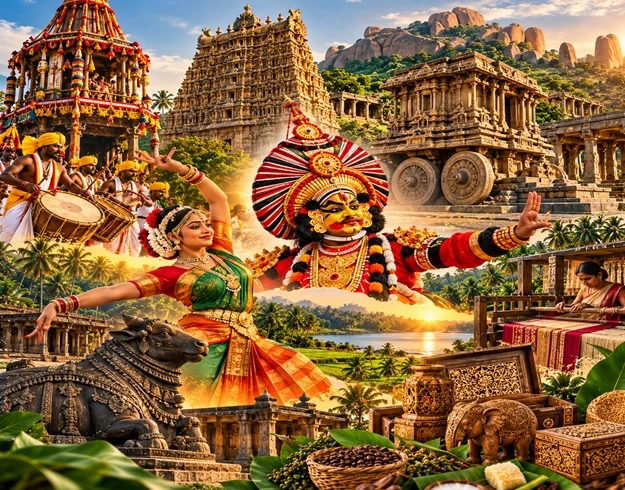
- Yakshagana: Yakshagana is a traditional dance-drama and theatre form popular in coastal Karnataka. It combines music, dance, elaborate costumes, dialogue and mythological storytelling.
- Dollu Kunitha: Dollu Kunitha is a traditional percussion-based folk dance associated with Karnataka. It involves energetic movements accompanied by large drums.
- Carnatic Music: Karnataka has made significant contributions to the development of Carnatic classical music. The region is historically associated with several important composers and musical traditions.
- Mysuru Dasara: Mysuru Dasara is one of Karnataka's most famous cultural festivals. It is celebrated with royal processions, traditional performances, cultural events and the illumination of Mysore Palace.
Kannada Language and Literature
- Kannada is the principal official language of Karnataka.
- It has a long literary tradition and is one of India's classical languages.
- The Government of India recognised Kannada as a Classical Language in 2008.
Important Kannada literary personalities
|
Personality
|
Contribution
|
|
Pampa
|
Early Kannada literature and epic poetry
|
|
Ranna
|
Important Kannada poet
|
|
Basavanna
|
Vachana literature and social reform
|
|
Kuvempu
|
Renowned Kannada poet and writer
|
|
D. R. Bendre
|
Celebrated Kannada poet
|
|
U. R. Ananthamurthy
|
Modern Kannada literature
|
Karnataka: India's Technology and Innovation Hub
- Modern Karnataka has become one of India's most important technology and innovation centres.
- Bengaluru is popularly known as India's Silicon Valley.
- The city has developed into a major centre for information technology, start-ups, biotechnology, aerospace and research.
Major sectors
- Information Technology: Bengaluru is home to several domestic and international technology companies.
- Start-up ecosystem: Karnataka has a strong entrepreneurial ecosystem supported by technology institutions, investors and incubators.
- Biotechnology: The state has emerged as an important biotechnology and life-sciences hub.
- Aerospace and defence: Bengaluru is an important centre for India's aerospace and defence research and manufacturing ecosystem.
- Education and research: Institutions such as the Indian Institute of Science and Indian Institute of Management Bangalore contribute to research and higher education.
Economic Significance of Karnataka
- Agriculture: Major agricultural products include Coffee, Ragi, Rice, Sugarcane, Arecanut, Cotton and Spices. Karnataka is particularly famous for its coffee plantations in Kodagu, Chikkamagaluru and Hassan.
- Mining and mineral resources: The state possesses significant deposits of iron ore, manganese, gold and other minerals. The Kolar Gold Fields have historically been associated with India's gold-mining industry.
- Tourism: Karnataka has significant potential for heritage, wildlife, religious, coastal and eco-tourism. Major destinations include Hampi, Mysuru, Badami, Pattadakal, Gokarna, Coorg, Chikkamagaluru and Jog Falls.
Environmental Challenges and Sustainable Development
- Water-sharing disputes involving interstate river systems.
- Groundwater depletion.
- Urban congestion in Bengaluru.
- Forest degradation.
- Human-wildlife conflict.
- Coastal erosion.
- Pressure on Western Ghats ecosystems.
Prelims MCQs
Q. Karnataka was initially known as which of the following after its formation on 1 November 1956?
(a) Mysore State
(b) Coorg State
(c) Hyderabad State
(d) Kannada State
Mains Practice Question
Q. Explain the role of the Kannada linguistic movement in the formation of Karnataka.
|
FAQs
When is Karnataka Rajyotsava celebrated?
1 November.
When was the reorganised Mysore State formed?
1 November 1956.
When was Mysore State renamed Karnataka?
1 November 1973.
Who was the first Chief Minister of the reorganised Mysore State?
S. Nijalingappa.
What was the Ekikarana Movement?
It was a movement for the unification of Kannada-speaking territories.
|