Why in news?
Kerala celebrates Kerala Piravi on 1 November every year, marking the formation of the modern state of Kerala in 1956.
Key Facts
|
Particular
|
Details
|
|
Formation Day
|
1 November 1956
|
|
Celebration
|
Kerala Piravi
|
|
Formation Act
|
States Reorganisation Act, 1956
|
|
Earlier integrated state
|
Travancore-Cochin
|
|
Capital
|
Thiruvananthapuram
|
|
First Chief Minister
|
E. M. S. Namboodiripad
|
|
First Governor
|
Burgula Ramakrishna Rao
|
|
Official Language
|
Malayalam
|
|
High Court
|
Kerala High Court
|
|
Major river
|
Periyar
|
|
Largest lake
|
Vembanad
|
|
Classical dance forms
|
Kathakali and Mohiniyattam
|
|
Major festival
|
Onam
|
Historical Background
- Kerala before independence
- Before independence, Malayalam-speaking regions were divided among different administrative territories.The three principal regions were Travancore, Cochin and Malabar.
- Travancore and Cochin were princely states, while Malabar was administered as part of the Madras Presidency under British rule.
- This administrative division meant that Malayalam-speaking people were governed through different political and administrative systems.
- The demand for a unified Malayalam-speaking state gradually gained momentum.
- Formation of Travancore-Cochin in 1949
- Following India's independence, an important step towards regional integration took place on 1 July 1949.
- The princely states of Travancore and Cochin were integrated to form the Travancore-Cochin State.
- This integration laid the foundation for the later formation of Kerala.
- Aikya Kerala Movement
- The demand for the unification of Malayalam-speaking regions became known as the Aikya Kerala Movement.
- The movement aimed to bring Malayalam-speaking territories under one administrative unit.
- Its major objectives included:
- Promoting Malayalam linguistic identity.
- Unifying historically connected regions.
- Improving administrative coordination.
- Strengthening regional political representation.
- Preserving the cultural and literary traditions of Malayalam-speaking people.
Formation of Kerala
- The States Reorganisation Act, 1956, provided the legal framework for the formation of Kerala.
- On 1 November 1956, the modern state of Kerala came into existence through the integration of:
- Travancore-Cochin, excluding the present Kanyakumari district and Shencottah Taluk, which were transferred to Madras State.
- Malabar district of the erstwhile Madras State.
- Kasaragod Taluk of South Kanara district.
- Burgula Ramakrishna Rao became the first Governor of Kerala, and E. M. S. Namboodiripad became its first Chief Minister.
Geographical Significance of Kerala
- Kerala is situated between the Arabian Sea in the west and the Western Ghats in the east.
- Its geographical diversity includes coastal plains, backwaters, midland regions and mountainous landscapes.
|
Feature
|
Details
|
|
Location
|
Southwestern India
|
|
Capital
|
Thiruvananthapuram
|
|
Coastline
|
Arabian Sea
|
|
Mountain range
|
Western Ghats
|
|
Major rivers
|
Periyar, Bharathapuzha and Pamba
|
|
Important lake
|
Vembanad Lake
|
|
Important hill station
|
Munnar
|
|
Neighbouring states
|
Karnataka and Tamil Nadu
|
Western Ghats and biodiversity
- The Western Ghats are among the world's important biodiversity hotspots.
- Kerala's portion of the Western Ghats contains tropical evergreen forests, endemic species and several protected areas.
- Important protected areas include:
- Periyar Tiger Reserve.
- Eravikulam National Park.
- Silent Valley National Park.
- Wayanad Wildlife Sanctuary.
- Parambikulam Tiger Reserve.
Backwater ecosystem
- Kerala's backwaters form an interconnected network of lakes, lagoons, rivers and canals.
- Vembanad Lake is the largest lake in Kerala and an important part of its backwater ecosystem.
- These water bodies support fisheries, agriculture, tourism and inland transportation.
Cultural Heritage of Kerala
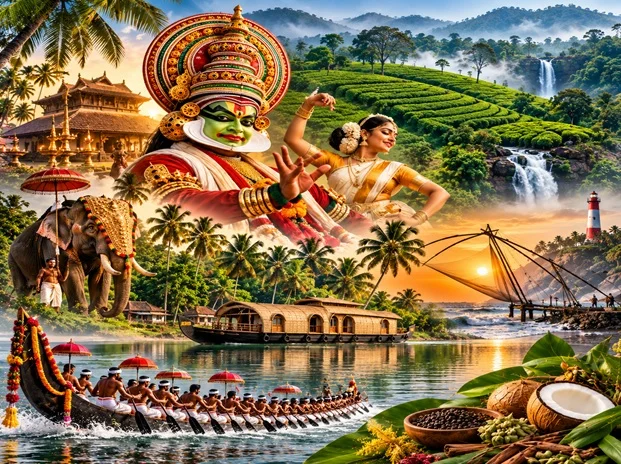
- Kathakali: Kathakali is a classical dance-drama form characterised by elaborate costumes, facial expressions, hand gestures and dramatic storytelling. It traditionally draws inspiration from Indian epics and mythological narratives.
- Mohiniyattam: Mohiniyattam is a classical dance form associated with Kerala. It is known for graceful movements, expressive gestures and elegant costumes.
- Theyyam: Theyyam is a traditional ritual performance mainly associated with northern Kerala. It combines dance, music, elaborate costumes and religious traditions.
- Kalaripayattu: Kalaripayattu is an ancient martial art traditionally associated with Kerala. It involves physical training, flexibility, weapon techniques and disciplined movements.
Onam: Kerala's most important festival
- It is traditionally associated with the legendary King Mahabali.
- Important features include Pookalam (floral decorations), Onam Sadya (traditional feast), Vallam Kali (boat races), Pulikali (tiger dance), traditional cultural performances.
Kerala's Social Reform Movements
|
Social reformer
|
Contribution
|
|
Sree Narayana Guru
|
Promoted social equality and challenged caste discrimination
|
|
Ayyankali
|
Worked for the rights and education of oppressed communities
|
|
Chattampi Swamikal
|
Contributed to social and religious reform
|
|
Vakkom Moulavi
|
Promoted education and social reform among Muslims
|
|
Sahodaran Ayyappan
|
Advocated social equality and anti-caste reform
|
Vaikom Satyagraha
- The Vaikom Satyagraha of 1924-1925 was an important movement against caste-based restrictions on access to public roads surrounding the Vaikom Mahadeva Temple.
- It became a significant milestone in India's struggle against untouchability and social discrimination.
- The movement also attracted support from national leaders, including Mahatma Gandhi.
Kerala's Development Model
- Kerala is frequently discussed in development economics and public administration because of its achievements in human development.
- The Kerala Development Model highlights the importance of social investment and public welfare.
Major characteristics
- Education: Kerala has historically achieved high literacy and educational attainment.
- Healthcare: The state has developed an extensive public healthcare network.
- Life expectancy: Kerala has consistently performed strongly on life expectancy indicators.
- Gender and social development: Social reform movements and public welfare initiatives have contributed to improvements in social indicators.
- Decentralised governance: Kerala has placed considerable emphasis on local self-government and participatory planning.
People's Plan Campaign
- Kerala launched the People's Plan Campaign in 1996.
- It aimed to strengthen decentralised planning by transferring substantial planning responsibilities and resources to local self-government institutions.
- The campaign is an important example of participatory governance in India.
Economic Significance of Kerala
|
Sector
|
Significance
|
|
Tourism
|
Backwaters, beaches, hill stations and cultural tourism
|
|
Agriculture
|
Rubber, coconut, spices and tea
|
|
Fisheries
|
Marine fisheries and seafood exports
|
|
Services
|
Education, healthcare and financial services
|
|
Remittances
|
Important source of household income
|
|
Traditional industries
|
Coir, handloom and cashew processing
|
Spice trade and maritime history
- Kerala has historically been an important centre of the international spice trade.
- Its coastline attracted traders from West Asia, Europe and other regions.
- Black pepper, cardamom, cinnamon and other spices played a major role in its commercial history.
Environmental Challenges
- Floods and extreme rainfall events.
- Landslides in the Western Ghats.
- Coastal erosion.
- Wetland degradation.
- Human-wildlife conflict.
- Pressure from unplanned urbanisation and tourism.
Prelims MCQs
Q. Which movement was associated with the unification of Malayalam-speaking regions?
A. Punjabi Suba Movement
B. Aikya Kerala Movement
C. Telangana Movement
D. Ekikarana Movement
Mains Practice Question
Q. Kerala's formation in 1956 was closely associated with the linguistic reorganisation of Indian states. Discuss.
|
FAQs
When is Kerala Piravi celebrated?
1 November.
In which year was Kerala formed?
1956.
Which regions were integrated to form Kerala?
Travancore-Cochin, Malabar and Kasaragod Taluk of South Kanara.
Who was the first Chief Minister of Kerala?
E. M. S. Namboodiripad.
What was the Aikya Kerala Movement?
It was a movement for the unification of Malayalam-speaking regions into a single state.
|