New
Hindi Medium: (Delhi) - GS Foundation (P+M) : 14th Oct. 2026, 06:00 PM Hindi Medium: (Prayagraj) - GS Foundation (P+M) : 23rd Oct. 2026, 11:00 AM English Medium: (Delhi) - GS Foundation (P+M) : 12th Oct. 2026, 5:30PM English Medium: (Prayagraj) - GS Foundation (P+M) : 19th Aug 2026, 11:00 AM Hindi Medium: (Delhi) - GS Foundation (P+M) : 14th Oct. 2026, 06:00 PM Hindi Medium: (Prayagraj) - GS Foundation (P+M) : 23rd Oct. 2026, 11:00 AM English Medium: (Delhi) - GS Foundation (P+M) : 12th Oct. 2026, 5:30PM English Medium: (Prayagraj) - GS Foundation (P+M) : 19th Aug 2026, 11:00 AM

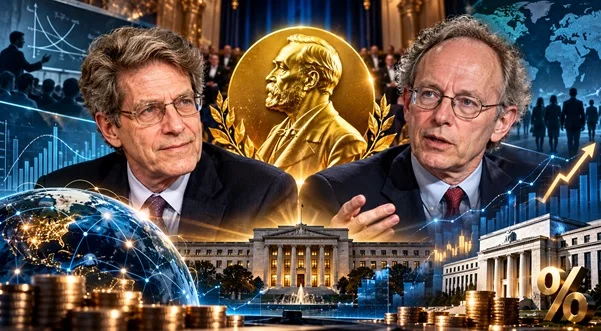
Nobel Prize in Economics Sciences: Robert E. Hall and Michael Woodford, Key facts, Awarding organisation, Selection Process, Previous winners, Indian Laureate, Significance and Challenges

Prelims: Nobel Prize in Economic Sciences, Sveriges Riksbank, Royal Swedish Academy of Sciences, Alfred Nobel, Amartya Sen, Abhijit Banerjee, Behavioural Economics and Development Economics.
Mains: GS Paper III: Indian Economy, Economic Growth and Development, Poverty and Inequality, Innovation, Public Policy, Financial Stability and Inclusive Growth.

Why in news?

  • The 2026 Sveriges Riksbank Prize in Economic Sciences in Memory of Alfred Nobel is scheduled to be announced on 12 October 2026.
  • The award is goven to Robert E. Hall (Stanford University) and Michael Woodford (Columbia University).

Key Facts

Particular

Details

Official name

Sveriges Riksbank Prize in Economic Sciences in Memory of Alfred Nobel

Common name

Nobel Prize in Economics

Announcement date

12 October 2026

Awarding institution

Royal Swedish Academy of Sciences

Country

Sweden

Established

1968

Established by

Sveriges Riksbank, Sweden's central bank

First awarded

1969

First recipients

Ragnar Frisch and Jan Tinbergen

2026 prize money

12 million Swedish kronor (SEK)

Award ceremony

10 December 2026

Ceremony location

Stockholm, Sweden

2026 laureate

Robert E. Hall and Michael Woodford

Who Is Robert E. Hall?

  • American economist associated with Stanford University.
  • Known for research in macroeconomics, consumption, unemployment and business cycles.
  • His research examines how households and labour markets respond to changing economic conditions.
  • He has also studied prolonged economic downturns and the difficulties of restoring employment. 

Major Contributions of Robert E. Hall

  • Consumption and the Permanent Income Hypothesis
    • Hall's research helped explain why household spending depends not only on current income but also on expectations about future income.
    • Under particular assumptions, changes in consumption should be difficult to predict using information already available to households.
    • This is associated with his influential 1978 research on the random walk hypothesis of consumption. 
    • Example: If a person expects a salary increase next year, they may adjust their spending decisions today. An unexpected job loss, however, can produce a much larger change in spending.
  • Unemployment and Labour Market Dynamics
    • Hall has studied how workers find jobs, how firms recruit employees and why unemployment can remain high during economic downturns.
    • His work includes research on unemployment when nominal interest rates approach their effective lower bound.
  • Business Cycles and Economic Recessions: His research also examines why economies experience persistent slowdowns and why recovery may be difficult even after financial conditions improve.

Who Is Michael Woodford?

  • American economist associated with Columbia University.
  • Known for influential contributions to modern monetary economics.
  • His work examines how central-bank policies influence inflation, output and expectations.
  • His research has helped develop the theoretical foundations of modern New Keynesian monetary policy. 

  Major Contributions of Michael Woodford

  • New Keynesian Macroeconomics: New Keynesian models explain how decisions by households and firms interact with price and wage rigidities. Prices and wages do not always adjust immediately when economic conditions change. Therefore, monetary policy can influence real economic activity, particularly in the short run.
  • Forward Guidance: Forward guidance refers to communication by a central bank about the expected future direction of monetary policy. For example, a central bank may signal that interest rates are likely to remain low for some time, subject to economic conditions. Such communication can influence borrowing, investment and spending decisions even before the central bank changes its policy rate. Woodford's research explores the importance and limitations of these expectation-based policy effects.
  • Interest and Prices: Woodford's influential book Interest and Prices: Foundations of a Theory of Monetary Policy (2003) provides a systematic framework for analysing monetary policy in modern economies. It connects interest-rate decisions, inflation expectations and economic stabilisation.

What Is Forward Guidance?

  • Forward guidance is a monetary-policy communication strategy through which a central bank provides information about its likely future policy stance.
  • Suppose inflation is under control but economic growth is weak. A central bank may indicate that interest rates could remain relatively low until economic conditions improve.
  • Businesses and households may respond to this information when making investment, borrowing and spending decisions.
  • However, forward guidance is not a guarantee. Its effectiveness depends on credibility, public understanding, economic conditions and whether the guidance is conditional or unconditional.

Relevance for India's Monetary Policy

  • Inflation Targeting: India's monetary policy framework uses the Consumer Price Index (CPI) as its inflation measure. The RBI's Monetary Policy Committee makes policy-rate decisions within the applicable inflation-targeting framework.
  • Monetary Policy Transmission: Changes in the repo rate can influence banks' lending rates, deposit rates, borrowing costs and economic activity. However, the transmission of monetary policy is neither immediate nor uniform.
  • Expectations and Communication: The RBI's policy statements, inflation forecasts and explanations can influence how businesses and households assess future economic conditions.
  • Employment and Economic Growth: Understanding household consumption, investment decisions and labour-market behaviour can help policymakers analyse economic slowdowns.

What is the Nobel Prize in Economic Sciences?

  • The Nobel Prize in Economic Sciences is an international award recognising research that improves our understanding of how economies function.
  • Economics studies how individuals, businesses and governments make decisions about limited resources.
  • The prize recognises contributions that improve economic knowledge, research methods or policy understanding.

Why is the Economics Prize different from other Nobel Prizes?

  • Alfred Nobel's will of 1895 established prizes in five fields: Physics, Chemistry, Physiology or Medicine, Literature and Peace. Economics was not among the original five categories.
  • In 1968, Sveriges Riksbank established the Economics Prize to commemorate its 300th anniversary.
  • The first prize was awarded in 1969.
  • Although commonly called the Nobel Prize in Economics, its official name remains the Sveriges Riksbank Prize in Economic Sciences in Memory of Alfred Nobel.
  • It follows Nobel-related award traditions and is presented during the annual Nobel ceremonies. 

Who awards the Nobel Prize in Economics?

  • The Royal Swedish Academy of Sciences selects the laureates. It is also responsible for awarding the Nobel Prizes in Physics and Chemistry.
  • The Academy evaluates economic research through a specialised committee and expert assessments.
  • The Economics Prize is not awarded by the Swedish Academy, which selects the Nobel Literature laureate.

How is the winner selected?

  • Invitation to qualified nominators
  • Submission of nominations
  • Review by Economic Sciences Prize Committee
  • Expert evaluation of research
  • Royal Swedish Academy's final decision

Previous Nobel Prize in Economics Winners

Year

Laureates

Major Contribution

2026

Robert E. Hall and Michael Woodford

For microeconomic foundations of macroeconomic stabilisation

2025

Joel Mokyr, Philippe Aghion and Peter Howitt

Innovation-driven economic growth

2024

Daron Acemoglu, Simon Johnson and James A. Robinson

Institutions and economic prosperity

2023

Claudia Goldin

Women's labour market outcomes

2022

Ben Bernanke, Douglas Diamond and Philip Dybvig

Banks and financial crises

2021

David Card, Joshua Angrist and Guido Imbens

Labour economics and causal analysis

India's Connection with the Nobel Prize in Economics

  • Amartya Sen (1998)
    • Awarded for contributions to welfare economics.
    • His work explored poverty, inequality, famine and social choice.
    • His capability approach emphasises people's real opportunities and freedoms rather than income alone.
  • Abhijit Banerjee (2019)
    • Shared the prize with Esther Duflo and Michael Kremer.
    • Recognised for their experimental approach to alleviating global poverty.
    • Their research helped popularise randomised controlled trials in development economics.

Significance 

  • Economic Policy: Research can inform government decisions on taxation, inflation, employment and public spending.
  • Poverty Reduction: Economic studies improve understanding of deprivation and the effectiveness of welfare interventions.
  • Financial Stability: Research on banking and financial crises helps strengthen regulatory frameworks.
  • Economic Development: Studies of institutions, technology and productivity explain long-term growth.
  • Evidence-Based Governance: Economic research encourages policymakers to evaluate programmes using reliable evidence.

Challenges 

  • Limited representation: Recognition has historically been concentrated among economists working in Western institutions
  • Gender disparity: Women remain underrepresented among Economics Prize laureates
  • Competing economic theories: Economists may disagree about the causes of economic problems and suitable policies.
  • Policy applicability: Findings from one country or period may not apply directly elsewhere
  • Research limitations: Economic models and experiments rely on assumptions and may not capture every social factor

Prelims MCQ

Q. Consider the following statements regarding the Nobel Prize in Economic Sciences:

  1. It was established by Sweden's central bank in 1968.
  2. It is awarded by the Royal Swedish Academy of Sciences.
  3. Amartya Sen received the prize in 1998 for contributions to welfare economics.

Which of the statements given above are correct?

(a) 1 and 2 only

(b) 2 and 3 only

(c) 1 and 3 only 

(d) 1, 2 and 3

Mains Practice Question

Q. Discuss the role of economic research in promoting inclusive growth and evidence-based policymaking.

FAQs

When is the 2026 Economics Prize announced? 

12 October 2026

Who awards the Economics Prize? 

The Royal Swedish Academy of Sciences

Who won the Economics Nobel Prize 2026?

Robert E. Hall and Michael Woodford

When was it first awarded? 

1969

Who was the first Indian Economics laureate? 

Amartya Sen, in 1998

Have any Query?

Our support team will be happy to assist you!

OR