Prelims: Securities and Exchange Board of India (SEBI), Credit Risk-o-Meter, Corporate Bonds, Credit Rating Agencies, Debt Securities, Investor Protection, Financial Market Regulation.
Mains: GS Paper III Indian Economy, Capital Markets, Financial Sector Reforms, Corporate Bond Market, Transparency and Investor Protection.
Keywords: SEBI Credit Risk-o-Meter, Bond Credit Risk, Colour-Coded Risk Classification, Credit Ratings, AAA Bonds, Default Risk, Debt Securities, Corporate Bond Market, Investor Awareness, Financial Transparency. |
Why in News?
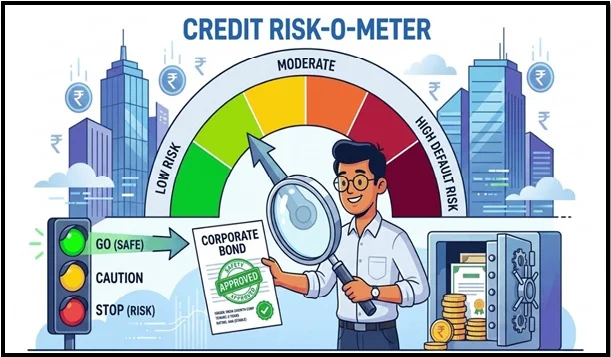
- The Securities and Exchange Board of India (SEBI) has introduced a colour-coded Credit Risk-o-Meter (CRM) to help investors assess the credit risk associated with bonds and other specified debt securities.
- The new framework classifies credit risk into six categories, using different colours ranging from green to red, based on the credit rating assigned to a debt instrument.
What is SEBI's Credit Risk-o-Meter?
- The Credit Risk-o-Meter is a visual risk assessment tool that presents the credit risk of specified debt securities through six colour-coded categories.
- Its purpose is to make credit rating information more accessible, particularly to retail investors who may not be familiar with technical financial terminology.
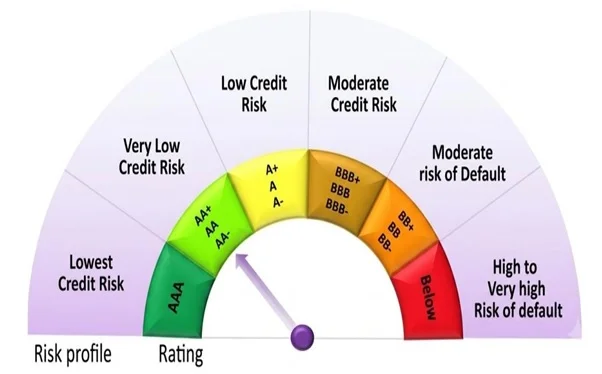
Colour classification prescribed in SEBI's circular dated October 7, 2026. The gauge is an illustrative visualisation, not a rating of a specific bond.
Key Provisions of the New Framework
1. Mandatory Disclosure Requirements
- Issuers and Online Bond Platform Providers (OBPPs) must prominently display the Credit Risk-o-Meter in offer documents, abridged prospectuses, private placement memoranda and advertisements.
- The meter must also appear on web and mobile bond platforms, allowing investors to identify credit risk before investing.
- The disclosure must specify the name of the Credit Rating Agency (CRA) and the actual rating assigned to the instrument.
2. Multiple Credit Ratings
- When a debt security receives ratings from multiple credit rating agencies, the meter must reflect the lowest assigned rating.
- Issuers may display the other ratings alongside the meter.
- This provision aims to prevent investors from relying exclusively on the most favourable credit rating.
3. Special Disclosure for Unsecured Bonds
- For unsecured debt instruments, the term Unsecured must appear below the meter in bold red text.
- Additional Tier-1 (AT1) bonds must carry a separate warning about the possibility of losing the entire invested capital.
- These disclosures are intended to improve investor awareness of the specific risks associated with such instruments.
4. Issuer Not Cooperating (INC)
- When a Credit Rating Agency classifies an issuer as Issuer Not Cooperating, the meter must indicate this status through a separate INC zone.
- Such a classification signals that the rating agency has faced difficulties obtaining adequate information from the issuer.
- This disclosure helps investors identify potential information gaps while assessing creditworthiness.
5. Updating Credit Ratings
- Online Bond Platform Providers must update the Credit Risk-o-Meter within 24 hours of receiving rating-change alerts from depositories such as NSDL and CDSL.
- The meter must be prominently positioned on bond listing and detail pages, ahead of investment action buttons.
- These requirements are designed to reduce the risk of investors making decisions using outdated credit ratings.
Which Debt Instruments Are Covered?
The framework applies to listed and proposed-to-be-listed debt instruments, including:
- Non-Convertible Securities (NCS): Debt instruments that cannot be converted into equity shares.
- Commercial Papers (CPs): Short-term unsecured instruments issued to raise funds.
- Securitised Debt Instruments (SDIs): Securities backed by pools of underlying financial assets.
- Security Receipts (SRs): Instruments representing interests in acquired financial assets.
- Market-Linked Debentures (MLDs): Debt instruments whose returns are linked to specified market indicators.
Significance of SEBI's Credit Risk-o-Meter
- Improved Investor Protection: The colour-coded mechanism simplifies complex financial information and helps investors identify potential default risks before investing.
- Greater Market Transparency: Standardised risk disclosures enable investors to compare the credit risk of different debt instruments more effectively.
- Financial Literacy: The system makes credit ratings easier to understand, particularly for first-time retail investors.
- Strengthening the Corporate Bond Market: Improved risk communication may enhance investor confidence and encourage more informed participation in India's debt market.
- Regulatory Accountability: Mandatory disclosures and timely rating updates strengthen the responsibilities of issuers, rating agencies and online bond platforms.
Challenges and Limitations
- Limited Risk Coverage: The Credit Risk-o-Meter measures credit risk but does not capture market risk, interest rate risk or liquidity risk.
- Dependence on Credit Ratings: Its effectiveness depends on the accuracy, independence and timeliness of ratings issued by CRAs.
- Risk of Oversimplification: Investors may interpret green-rated securities as completely safe, even though all investments involve some degree of risk.
- Compliance Requirements: Issuers and online platforms must maintain systems to display and update risk classifications accurately.
Way Forward
- SEBI should strengthen supervision of credit rating agencies to improve the reliability of risk assessments.
- Investor awareness programmes should explain the differences between credit, market and liquidity risks.
- Online bond platforms should integrate clear disclosures and investor education tools alongside the Credit Risk-o-Meter.
- Periodic evaluation of the framework can help identify implementation gaps and improve risk communication.
Prelims MCQs
Q. The Credit Risk-o-Meter introduced by SEBI primarily aims to:
A. Determine interest rates on corporate bonds
B. Assess and visually disclose credit risk associated with debt securities
C. Guarantee repayment of all bond investments
D. Regulate foreign exchange transactions
Mains Question
Q. Discuss the significance of SEBI's Credit Risk-o-Meter in enhancing transparency and investor protection in India's corporate bond market. Examine its limitations in assessing the overall risks associated with debt securities.
|
Frequently Asked Questions (FAQs)
1. What is SEBI's Credit Risk-o-Meter?
It is a six-level, colour-coded disclosure tool introduced by SEBI to help investors understand the credit risk associated with specified debt securities.
2. Which colour represents the highest credit risk?
Red represents high to very high risk of default, covering instruments rated in the B, C and D categories.
3. Does the Credit Risk-o-Meter guarantee investment safety?
No. It provides information about credit risk but does not guarantee repayment or protection against market and liquidity risks.
4. What happens when a bond has multiple credit ratings?
The Credit Risk-o-Meter must reflect the lowest rating assigned by the credit rating agencies, although other ratings may also be disclosed.
5. What is the significance of the Credit Risk-o-Meter for retail investors?
It makes complex credit rating information easier to interpret, improves risk awareness and supports more informed investment decisions.
|






 Contact Us
  New Batch : 9555124124/ 7428085757
  Tech Support : 9555124124/ 7428085757