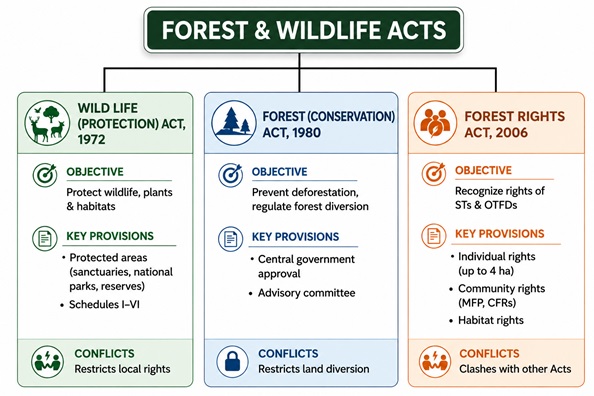
New
Hindi Medium: (Delhi) - GS Foundation (P+M) : 8th June 2026, 6:30 AM Hindi Medium: (Prayagraj) - GS Foundation (P+M) : 1st June 2026, 5:30 PM English Medium: (Prayagraj) - GS Foundation (P+M) : 7th June 2026, 8:00 AM Hindi Medium: (Delhi) - GS Foundation (P+M) : 8th June 2026, 6:30 AM Hindi Medium: (Prayagraj) - GS Foundation (P+M) : 1st June 2026, 5:30 PM English Medium: (Prayagraj) - GS Foundation (P+M) : 7th June 2026, 8:00 AM

Current Affairs for 11 May 2026

The Wild Life (Protection) Act, 1972

Overview

  • The Wild Life (Protection) Act, 1972 is India’s principal legislation for the protection of wildlife and biodiversity. It provides a legal framework for the conservation of wild animals, birds, plants, and their habitats.

Objectives of the Act

  • Protect wild animals, birds, and plants
  • Conserve biodiversity and ecological balance
  • Establish Protected Areas (PAs)
  • Regulate hunting, poaching, and wildlife trade
  • Prevent illegal wildlife trafficking

Key Features of WLPA

Protected Areas (PAs)

  • The Act provides for different categories of protected areas :
    • Sanctuary
      • Area declared for wildlife protection
      • Certain regulated human activities may be permitted
    • National Park
      • Strictly protected ecosystem
      • Human activities are highly restricted
    • Conservation Reserve
      • Declared mainly on government land
      • Protects landscapes, wildlife corridors, and habitats
    • Community Reserve
      • Declared on community/private land
      • Encourages community participation in conservation

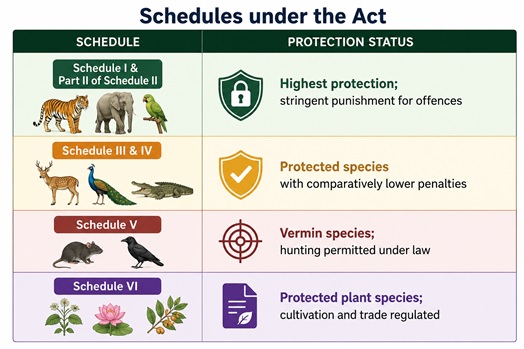
Schedules under the Act

Institutional Framework

National Board for Wildlife (NBWL)

  • Apex advisory body for wildlife conservation
  • Chaired by the Prime Minister

State Board for Wildlife (SBWL)

  • State-level wildlife advisory authority
  • Chaired by the Chief Minister

Wildlife Crime Control Bureau (WCCB)

  • Combats poaching and illegal wildlife trade
  • Coordinates wildlife crime enforcement across India

National Tiger Conservation Authority (NTCA)

  • Supervises tiger conservation programmes
  • Manages and strengthens tiger reserves

Chief Wildlife Warden (CWLW)

  • The Chief Wildlife Warden is the chief implementing authority of the Wild Life (Protection) Act, 1972 at the state level.

Major Powers and Functions

  • Issues permits for entry into protected areas, research and scientific studies, photography, filming, and tourism-related activities. 
  • Can permit hunting only when an animal is dangerous to human life or diseased/incapacitated beyond recovery. 
  • Manages sanctuaries and protected areas, regulates livestock grazing, and ensures livestock immunisation to prevent disease transmission to wildlife. 
  • Issues licences for the cultivation, trade, and transport of Schedule VI protected plant species. 
  • Supervises wildlife law enforcement, conducts search, seizure, and confiscation operations, and regulates possession and use of firearms near protected areas.

Wild Life (Protection) Amendment Act, 2022

Key Provisions

Rationalisation of Schedules

  • Number of schedules reduced from 6 to 4 for simplification and better management

Alignment with CITES

  • Incorporated provisions of Convention on International Trade in Endangered Species of Wild Fauna and Flora
  • Strengthened regulation of international wildlife trade

Protection of Elephants

  • Elephants continue to receive Schedule I protection
  • Limited exemptions allowed for :
    • Religious purposes
    • Traditional use

Regulation of Invasive Alien Species

  • Central government empowered to regulate invasive alien species harmful to ecosystems and native biodiversity

Enhanced Penalties

  • Stricter punishment for wildlife crimes
  • Minimum fine increased to ₹25,000 and above

Forest (Conservation) Act, 1980 (FCA)

Purpose of the Act

  • The Forest (Conservation) Act, 1980 was enacted to curb rapid deforestation and ensure that forest land is not diverted indiscriminately for non-forest activities.

Objectives

  • Prevent large-scale deforestation
  • Regulate diversion of forest land for non-forest purposes
  • Maintain ecological balance and forest cover
  • Ensure centralized scrutiny of forest diversion projects

Key Features

Mandatory Central Government Approval

  • Prior approval of the Central Government is required for:
    • De-reservation of reserved forests
    • Diversion of forest land for non-forest purposes such as :
      • Mining
      • Dams
      • Industries
      • Infrastructure projects
  • Assignment or lease of forest land to private entities, corporations, or agencies

Advisory Committee

  • Constituted by the Central Government
  • Assists in examining proposals related to forest land diversion and clearances

Importance of the Act

  • Acts as a safeguard against indiscriminate diversion of forests by states
  • Strengthens environmental governance and forest conservation
  • Forms the basis of India’s forest clearance mechanism

Forest Rights Act, 2006 (FRA)

Full Name

  • Scheduled Tribes and Other Traditional Forest Dwellers (Recognition of Forest Rights) Act, 2006

Background

  • The Act was enacted to address the historical injustice faced by forest-dwelling communities whose traditional rights over forests were not formally recognized during colonial and post-colonial forest administration.

Objectives

  • Recognize and vest forest rights in forest-dwelling communities
  • Correct historical injustice faced by :
    • Scheduled Tribes (STs)
    • Other Traditional Forest Dwellers (OTFDs)
  • Empower local communities in forest governance and conservation

Major Rights under FRA

Individual Forest Rights (IFR)

  • Right to cultivate forest land for livelihood purposes
  • Maximum limit: 4 hectares

Community Forest Rights (CFR)

  • Rights over common forest resources, including:
  • Grazing grounds
  • Fishing resources
  • Water bodies
  • Collection and use of Minor Forest Produce (MFP)
  • Access to Community Forest Resources (CFRs)

Habitat Rights

  • Special rights granted to:
  • Particularly Vulnerable Tribal Groups (PVTGs)
  • Protects traditional habitats, culture, and livelihoods

Forest Protection & Management Rights

  • Local communities are empowered to:
  • Protect forests
  • Regenerate degraded forest areas
  • Conserve biodiversity
  • Manage community forest resources sustainably

Role of Gram Sabha

  • The Gram Sabha is the central authority under FRA and is responsible for:
  • Receiving claims
  • Verifying claims
  • Approving or rejecting claims
  • Protecting community forest resources

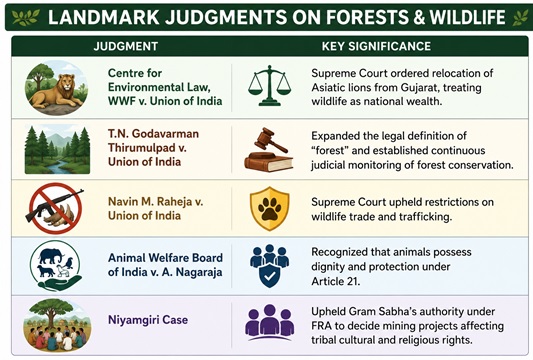
Landmark Judgments on Forests & Wildlife

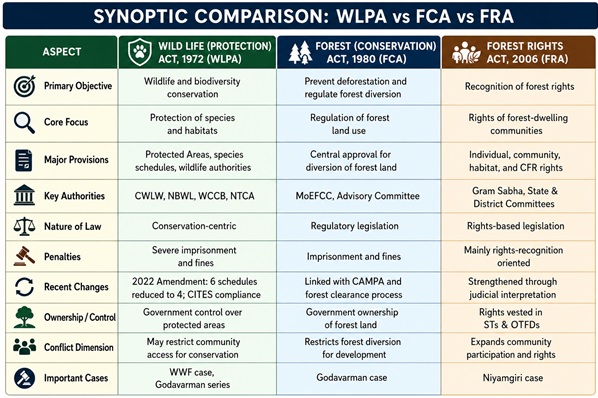
Synoptic Comparison: WLPA vs FCA vs FRA

Air Pollution in India: Causes, Effects, AQI and Solutions Explained

How Air Quality is Measured ?

  • The National Air Quality Index (AQI) monitors air quality in urban centers in real time to enhance public awareness and drive mitigation efforts.
  • AQI simpl ifies complex air quality data into a single numerical index, categorized using color codes.
  • It measures eight pollutants: PM10, PM2.5, NO2, SO2, CO, O3, NH3, and Pb. The highest sub-index determines the overall AQI score.

Impact of Pollution

  • Economic Cost : Pollution-related health care expenses and productivity losses account for 8.5% of India's GDP (World Bank).
  • Health Cost : Air pollution caused 1.1 million premature deaths in India in 2017 (Lancet Commission).
  • Environmental Cost : Increased GHG emissions, rising sea levels (1.8 mm per year), acid rain, ozone layer depletion, and eutrophication.
  • Political Impact : Public dissatisfaction is rising, leading to movements like the Urban Chipko Movement against tree-cutting for infrastructure projects.

Air Pollution in Northern India

  • India ranks 178 out of 180 in air quality (Environmental Performance Index 2018).
  • Annual PM2.5 levels (90 μg/m3) are more than twice India's standard (40 μg/m3) and nine times the WHO limit (10 μg/m3).
  • India accounts for 26% of global premature deaths due to air pollution.
  • Major NOx hotspots: Delhi-NCR, Sonbhadra (UP), Singrauli (MP), Talcher-Angul (Odisha).
  • In November 2019, Delhi declared a public health emergency as AQI exceeded 500 in multiple locations.
  • Pollution levels in Delhi are 40% to 80% higher in winter than in other seasons.

Key Sources of Air Pollution in Delhi

  1. Vehicular Pollution : Vehicles contribute 28% of PM2.5 emissions; total vehicles in Delhi increased from 4.24 million (2004) to 10.8 million (2018).
  2. Stubble Burning : A primary cause of winter pollution due to burning of crop residue in neighboring states.
  3. Industrial Pollution : Contributes 30% of PM2.5 levels, including 14% from small industries.
    • India is the second-largest coal burner after China.
    • Sulfur dioxide (SO2) from power plants is transported to Delhi by northwesterly winds.
  4. Construction Dust : A significant contributor to particulate matter levels.
  5. Geographical & Meteorological Factors : Lack of winds, late monsoon withdrawal, and dust storms worsen pollution.

Stubble Burning – Causes and Policy Responses

  • Mechanized harvesting leaves stubble behind, preventing wheat sowing. Burning is a fast, cheap solution.
  • Punjab Preservation of Subsoil Water Act (2009) delayed paddy transplantation, coinciding burning with winter.
  • Policy responses :
    • Bans on crop residue burning (NGT & Environmental Protection Acts).
    • National Policy for Management of Crop Residue (NPMCR) 2014.
    • Central Sector Scheme (2018-2020) subsidizing machinery for crop residue management.
    • State-imposed fines & incentives (Punjab & Haryana offer ₹2,500 per acre bonus to stop burning).
    • Alternative uses of stubble: Cattle feed, compost, biomass energy, ethanol production.

Steps Taken to Curb Air Pollution

  1. Graded Response Action Plan (GRAP)
    • Implements tiered restrictions based on AQI severity. E.g., bans diesel generators, increases parking fees.
  2. National Clean Air Programme (NCAP)
    • Targets 20-30% reduction in PM levels by 2024 (base year: 2017).
    • Expands PM2.5 monitoring infrastructure and manual stations from 684 to 1,000.
  3. Vehicular Emission Control
    • Green Budget (2018) : 26 programs for pollution reduction.
    • Shift to CNG for commercial vehicles.
    • Bharat Stage-VI (BS-VI) norms: Delhi became the first Indian city to run on BS-VI fuels (2018).
  4. Industrial & Power Plant Regulations
    • Environmental norms for PM10, SO2, NOx reduction.
    • Pradhan Mantri Ujjwala Yojana (PMUY): Promotes clean cooking fuels (LPG, biogas, solar).
    • Ban on pet coke & furnace oil in Haryana, Rajasthan, and UP.
  5. Emerging Solutions
    • Smog Towers : Purifies air in 10 km radius, removes PM2.5 and PM10 pollutants.
    • Hydrogen Fuel Cells: Zero-emission alternative to fossil fuels, though still under testing.

Challenges in Pollution Control

  • Lack of coordination : Pollution control is divided among 16 agencies across central, state, and municipal levels.
  • Regional Problem : Delhi’s pollution spreads across neighboring states, requiring a regional action plan.
  • Inconsistent Source Identification : Pollution studies give varying contributions from different sources.
  • Insufficient Infrastructure : Delhi Pollution Control Committee (DPCC) has been understaffed since 1990.

Way Forward – Policy Suggestions

  1. NITI Aayog’s ‘Breathe India’ Report
    • Electrification of public transport (taxis, 3-wheelers).
    • Feebate System : Higher taxes on polluting vehicles, incentives for clean vehicles.
    • Scrappage policy : Encourage replacement of old vehicles.
    • Optimize power sector : Shift to renewables, upgrade old thermal plants, use cleaner coal.
    • Improve industrial audits : Shift from self-audits to third-party verification.
    • Implement emissions trading : Market-based approach using the polluter-pays principle.
  2. Regional Approach to Pollution Control
    • Air pollution is a regional issue, requiring an airshed-based approach beyond city/state boundaries.
    • China’s Example : Beijing adopted unified planning, monitoring, and alerting across multiple regions.
  3. Public Engagement & Monitoring
    • Behavioral change campaigns : Promote eco-friendly transport & waste management.
    • Improved monitoring systems : Use satellite data (Sentinel 5-P) to track pollution patterns.
    • India faces severe air pollution challenges, especially in North India.
    • Government measures have shown partial success, but long-term solutions require regional cooperation.
    • A multi-pronged approach involving policy, technology, economic incentives, and public participation is needed to tackle air pollution effectively.

Climate and Clean Air Coalition (CCAC) launched an AQMX in the backdrop of International Day of Clean Air for Blue Skies (7 September).

  • Led by UN Environment Programme (UNEP), this year’s theme focuses on ‘Invest in Clean Air Now’.

About Air Quality Management Exchange Platform (AQMx)

  • It is a one-stop-shop that provides the latest air quality management guidance and tools proposed to meet WHO Air Quality Guidelines interim targets.
  • It is a component of CCAC Clean Air Flagship and contributes to implementation of UNEA-6 Resolution to increase regional cooperation and action on improving air quality globally.

Need of Air Quality Management Exchange Platform (AQMx)

  • Menace of air pollution : Causes more than 8 million premature deaths annually, particularly affecting poor and vulnerable.
  • Capacity gaps : AQMx helps to address air quality management capacity gaps with curated guidance on air quality monitoring, health impact assessments etc.
  • Knowledge sharing : Allow regional and sub-regional communities to exchange knowledge about air quality management best practices.

The Climate and Clean Air Coalition (CCAC) 

  • Founded in 2012, and convened within UNEP, CCAC is a voluntary partnership of more than 160 governments, intergovernmental organizations, and NGOs. India joined CCAC in 2019.
  • It works to reduce powerful but short-lived climate pollutants– methane, black carbon, hydrofluorocarbons (HFCs), and tropospheric ozone – that drive both climate change and air pollution.
  • Aerobiology is the study of the movement and impact of airborne biological particles, or bioaerosols, on human, animal, and plant health. Bioaerosols include:
    • Bacteria, fungal spores, pollen grains, viruses, etc.
  • Bioaerosols reflect changes in biodiversity, plant flowering patterns, and distribution, all sensitive to climate shifts.
    • Hence, new technologies are needed to improve understanding of Bioaerosols which would further enhance forecasting and climate change impact assessments.
  • New observational techniques: Such as high-resolution image analysis, holography, multi-band scatterometry, fluorescence spectrometry and nanotechnology for DNA sequencing.

WHO Air Quality Guidelines (AQG)

  • They are a set of evidence-based recommendations of limit values for specific air pollutants.
  • They recommend levels and interim targets for common air pollutants: PM, O3, NO2, SO2, and CO.
  • For instance, 24-hour mean of PM2.5 should not exceed 15 µg/m³ and annual mean of PM2.5 should not exceed 5 µg/m³.

India’s first ‘teal carbon’ study undertaken at Keoladeo National Park (KNP).

  • The study depicted the potential of teal carbon as a tool to mitigate climate change, if the anthropogenic pollution in the wetlands can be controlled.
  • Study also reveals elevated methane emissions can be reduced by use of a specialized type of biochar, which is a form of charcoal.

Teal Carbon

  • Teal carbon refers to carbon stored in non-tidal freshwater wetlands, encompassing carbon sequestered in vegetation, microbial biomass, and dissolved and particulate organic matter.
  • Teal carbon, being a color-based terminology (refer infographics), reflects the classification of the organic carbon based on its functions and location rather than its physical properties.
  • In contrast, black and brown carbon are produced by incomplete combustion of organic matter and contribute to global warming.
  • Significance: It contributes to an increase in the ground water level, flood mitigation and heat island reduction, supporting a sustainable urban adaptation.

Keoladeo National Park (Bharatpur, Rajasthan)

  • Declared a national park in 1982 and a UNESCO World Heritage Site in 1985.
  • Home to over 370 species of birds and animals like pythons, Siberian cranes etc.
  • Placed on the Montreux Record (Ramsar Convention) in 1990 due to "water shortage and an unbalanced grazing regime”.

International Environmental Agreements: Key Conventions & Protocols

United Nations Framework Convention on Climate Change (UNFCCC)

  • The United Nations Framework Convention on Climate Change was adopted in 1992 during the Earth Summit. 
  • The main objective of the convention is to stabilize greenhouse gas (GHG) concentrations in the atmosphere at a level that prevents dangerous human interference with the climate system.
  • It serves as the foundation of international climate governance and paved the way for major climate agreements such as the Kyoto Protocol and the Paris Agreement.

Kyoto Protocol

  • The Kyoto Protocol was adopted in 1997 in Kyoto, Japan, and came into force in 2005 after Russia ratified it. 
  • It was the first legally binding agreement under the UNFCCC that required developed countries, known as Annex I nations, to reduce greenhouse gas emissions.
  • Under the protocol, developed countries committed to reducing emissions by an average of 5.2% below 1990 levels during the first commitment period from 2008 to 2012. 
  • Developing countries such as India and China were not given legally binding targets, although they were encouraged to adopt voluntary climate actions.
  • The protocol introduced three important mechanisms to help countries meet their targets. 
  • These included Emissions Trading, through which countries could trade emission allowances; the Clean Development Mechanism (CDM), which allowed developed countries to invest in emission-reduction projects in developing nations; and Joint Implementation (JI), which enabled developed countries to undertake emission-reduction projects in other developed countries.
  • Despite its significance, the protocol faced several criticisms. The United States never ratified it, arguing that it was unfair because major developing economies were not subject to binding targets. Some countries also failed to meet their commitments, and the agreement lacked strong enforcement mechanisms.
  • The Doha Amendment extended the Kyoto Protocol from 2012 to 2020, but it had limited impact because several major emitters did not participate. Eventually, the protocol was largely replaced by the more inclusive Paris Agreement adopted in 2015.

Paris Agreement

  • The Paris Agreement was adopted in 2015 during COP-21 under the UNFCCC framework. 
  • Its primary objective is to limit the increase in global average temperature to well below 2°C above pre-industrial levels while pursuing efforts to restrict the rise to 1.5°C.
  • The agreement also focuses on strengthening climate adaptation measures and increasing financial and technological support for developing countries. 
  • Unlike the Kyoto Protocol, the Paris Agreement follows a more flexible and inclusive approach in which all countries submit their own climate action plans known as Nationally Determined Contributions (NDCs).

Convention on Biological Diversity (CBD)

  • The Convention on Biological Diversity was adopted in 1992 during the Earth Summit. 
  • The convention aims to conserve biological diversity, ensure the sustainable use of biodiversity resources, and promote the fair and equitable sharing of benefits arising from the use of genetic resources.
  • An important related agreement is the Nagoya Protocol, which deals with access to genetic resources and benefit-sharing mechanisms among countries and communities.

Ramsar Convention on Wetlands

  • The Ramsar Convention on Wetlands was adopted in 1971 in Ramsar. 
  • The convention seeks to promote the conservation and sustainable use of wetlands across the world.
  • For India, Ramsar Sites are extremely important because they support biodiversity, maintain ecological balance, provide water security, and help regulate local climate conditions.

Montreal Protocol

  • The Montreal Protocol was adopted in 1987 to phase out ozone-depleting substances such as chlorofluorocarbons (CFCs). 
  • The treaty is regarded as one of the most successful international environmental agreements because of its effective global cooperation and measurable success in ozone layer recovery.

Stockholm Convention on Persistent Organic Pollutants (POPs)

  • The Stockholm Convention on Persistent Organic Pollutants was adopted in 2001. 
  • Its main objective is to eliminate or restrict the production and use of hazardous Persistent Organic Pollutants (POPs), which are harmful to both human health and the environment.

Bonn Convention / Convention on Migratory Species (CMS)

  • The Convention on Migratory Species was adopted in 1979 and came into force in 1983. The convention aims to conserve migratory species throughout their migratory routes and habitats.
  • It addresses threats such as habitat destruction, poaching, illegal wildlife trade, and climate change, which adversely affect migratory animals.

United Nations Convention to Combat Desertification (UNCCD)

  • The United Nations Convention to Combat Desertification was adopted in 1994. 
  • Its objective is to combat desertification and reduce the impact of drought through coordinated national and international efforts.
  • The convention is particularly relevant for India because large parts of the country face challenges related to land degradation, desertification, and water scarcity.

Basel Convention

  • The Basel Convention on the Control of Transboundary Movements of Hazardous Wastes and Their Disposal was adopted in 1989. 
  • Its primary objective is to reduce the movement of hazardous waste between nations, especially from developed to developing countries, and to ensure environmentally sound management of hazardous waste.

India’s Wildlife & Forest Laws

Wild Life (Protection) Act, 1972 (WLPA)

  • The Wild Life (Protection) Act, 1972 is India’s principal legislation for wildlife conservation.
  • It was enacted to protect wild animals, birds, plants, and their habitats, while also regulating hunting and wildlife trade.
  • The Act classifies species into different schedules that provide varying levels of protection. Schedule I and Part II of Schedule II provide the highest degree of protection, while Schedules III and IV include species with comparatively lesser protection. Schedule V contains vermin species that may be hunted under certain conditions, and Schedule VI covers protected plant species.
  • The Act prohibits hunting of highly protected animals and establishes protected areas such as National Parks, Wildlife Sanctuaries, Conservation Reserves, and Community Reserves. It also bans trade in endangered species and wildlife products such as ivory and tiger skins.
  • Several institutions have been established under the Act, including the National Board for Wildlife (NBWL), the Wildlife Crime Control Bureau (WCCB), and the National Tiger Conservation Authority (NTCA).

Wildlife Protection (Amendment) Act, 2022

  • The Wildlife Protection (Amendment) Act, 2022 introduced major reforms to strengthen wildlife conservation in India. 
  • One significant change was the reduction of schedules from six to four for better clarity and administration.
  • The amendment incorporated provisions of Convention on International Trade in Endangered Species of Wild Fauna and Flora to improve regulation of international wildlife trade. 
  • It also introduced legal provisions related to invasive alien species and enhanced penalties for wildlife crimes.
  • The amendment further strengthened the protection of Ramsar wetlands and introduced stricter mechanisms for wildlife trade regulation. 
  • However, some conservationists criticized the law for possible dilution of protection for certain species and concerns regarding the transfer of captive elephants.

Forest Rights Act (FRA), 2006

  • The Forest Rights Act, 2006, officially known as the Scheduled Tribes and Other Traditional Forest Dwellers (Recognition of Forest Rights) Act, 2006, was enacted to address the historical injustice faced by forest-dwelling communities.
  • The Act recognizes both individual and community rights over forest land and resources. Individual Forest Rights allow eligible families to cultivate forest land up to four hectares for livelihood purposes.
  • Community Forest Rights provide access to grazing land, fishing areas, bamboo, tendu leaves, honey, and other minor forest produce. The Act also grants habitat rights to Particularly Vulnerable Tribal Groups (PVTGs).
  • A major feature of the Act is the empowerment of the Gram Sabha, which plays a central role in receiving, verifying, and approving claims related to forest rights. Communities are also given rights to protect and conserve forests sustainably.
  • Despite its importance, the implementation of the FRA has faced several challenges, including bureaucratic delays, conflicts with conservation projects, and lack of awareness among beneficiaries.

Forest (Conservation) Act, 1980 (FCA)

  • The Forest (Conservation) Act, 1980 was enacted to prevent rapid deforestation and regulate the diversion of forest land for non-forest purposes.
  • The Act mandates prior approval from the Central Government before forest land can be diverted for activities such as mining, industries, infrastructure projects, or dams. It also introduced the concept of compensatory afforestation, under which equivalent land must be afforested if forest land is diverted.
  • The Forest Advisory Committee (FAC) was established to examine proposals related to forest diversion and advise the government.

Forest (Conservation) Amendment Act, 2023

  • The Forest (Conservation) Amendment Act, 2023 introduced several changes aimed at balancing development needs with forest conservation.
  • The amendment exempted certain strategic projects located near international borders, the Line of Control (LoC), and the Line of Actual Control (LAC) from requiring central approval under specific conditions.
  • It also allowed limited use of forest land for defense infrastructure, paramilitary camps, eco-tourism, zoos, and safaris. Another important change was the redefinition of forest land, restricting the Act mainly to lands officially recorded as forests after October 25, 1980.
  • These provisions attracted criticism from environmental groups, which argued that they could weaken forest conservation and adversely affect indigenous communities.
  • The Supreme Court referred to the landmark T.N. Godavarman Thirumulpad v. Union of India judgment while examining issues related to the interpretation of forests.

Landmark Environmental & Wildlife Judgments

  • The Supreme Court of India has played a major role in strengthening environmental governance and wildlife protection through landmark judgments.
  • In T.N. Godavarman Thirumulpad v. Union of India, the Court expanded the definition of forests and established continuous judicial monitoring of forest conservation across India.
  • In Centre for Environmental Law, WWF v. Union of India, the Court ordered the relocation of Asiatic lions outside Gujarat, emphasizing that wildlife is part of the nation’s natural heritage.
  • The judgment in Animal Welfare Board of India v. A. Nagaraja recognized that animals possess dignity and are entitled to protection under Article 21 of the Constitution.
  • Similarly, the Niyamgiri Case upheld the powers of the Gram Sabha under the FRA to decide mining projects affecting tribal cultural and religious rights.
  • In Navin M. Raheja v. Union of India, the Supreme Court upheld restrictions on wildlife trade and trafficking to strengthen wildlife conservation in India.

Preparedness to Tackle Marine Disasters

Context

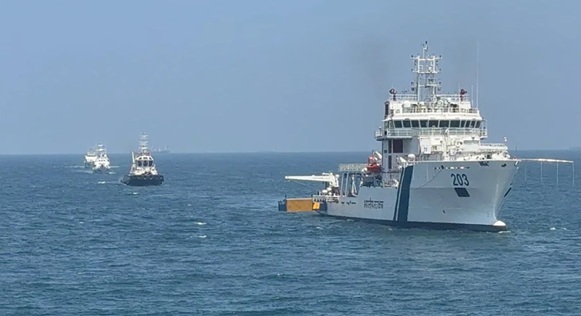
Considering the growing environmental threats looming over Kerala’s coastal ecosystem, the state government has taken a decisive step. Following two major ship accidents in 2025 — MSC Elsa 3 and MV Wan Hai 503 — Kerala is now on the verge of implementing a dedicated Oil Spill Contingency Plan (OSCP) to safeguard its maritime boundaries. Recently, the Kerala State Pollution Control Board (KSPCB) informed the National Green Tribunal (NGT) that the draft of this protective framework has been prepared.
Background of the Crisis: Why Was This Plan Necessary ?

Two separate maritime accidents in May and June 2025 exposed the vulnerability of Kerala’s 590-km-long coastline.

  • MSC Elsa 3 Incident :
    The vessel sank carrying 640 containers, including hazardous chemicals and calcium carbide. 
  • Environmental Damage :
    These incidents led to the spread of large quantities of plastic pellets (nurdles) along the southern coast, threatening marine biodiversity and local livelihoods. 
  • Judicial Intervention :
    The suo motu cognisance taken by the Principal Bench of the NGT compelled the administration to formulate a comprehensive remedial strategy. 

Need for a State-Specific Policy

Kerala’s coastline lies extremely close to international oil transportation routes. Statistically :

  • 9 out of Kerala’s 14 districts fall directly within oil-spill risk zones. 
  • The proposed plan will cover up to 12 nautical miles (24 km) from the coastline and extend 40 km inland through rivers. 
  • Massive oil tankers frequently visiting ports increase the possibility of maritime accidents. 
  • Although the idea of such a plan was proposed in 2016, technical and financial constraints delayed its finalisation until now. 

About the Oil Spill Contingency Plan (OSCP)

The OSCP is not merely a document; it is a technical blueprint for rapid response during marine emergencies.

Key features include :

  • Preparation of an Environmental Sensitivity Index (ESI) for the entire coastline to identify areas requiring priority protection. 
  • Measures for wildlife rescue, ship-level pollution control, and tactical booming to contain oil spills. 
  • Inclusion of emergency contact lists of machinery suppliers, equipment providers, and technical experts for immediate deployment during crises. 

Effective Shoreline Response

The plan clearly defines the chain of command for coastal clean-up operations.

  • Before initiating any clean-up activity, authorities will assess : 
    • the nature of the spilled oil, and 
    • on-site environmental conditions. 
  • The entire response mechanism will follow the national guidelines under NOS-DCP 2024

Next Phase of the Plan

  • The plan is currently in the draft stage and incorporates complex scientific aspects such as : 
    • hydrodynamic modelling, and 
    • marine sensitivity analysis. 
  • In the next stage, it will be reviewed by an expert committee and subsequently forwarded to the Indian Coast Guard for approval. 

Once approved, Kerala will possess a strong institutional shield to protect its marine resources and coastal ecosystem from future maritime disasters.

Structural challenges and solutions in India's healthcare system

Why in News?

Recently, India approved 43 new medical colleges along with 20,649 additional MBBS and postgraduate (PG) seats for the academic year 2025–26. However, despite the rapid expansion in medical education infrastructure, rural Community Health Centres (CHCs) continue to suffer from severe shortages of specialists and weak public healthcare delivery.

Structural Problems in India’s Public Healthcare System

1. Acute Shortage of Specialists

One of the biggest weaknesses in India’s healthcare system is the shortage of specialist doctors in rural areas.

  • According to The Health Dynamics of India 2022–23 Report, rural CHCs face nearly 79.9% specialist vacancies
  • Only 4,413 specialists are available against the required 21,964 specialists in 5,491 CHCs across the country. 
  • Since 2014, around 72,627 PG seats have been added across 731 medical colleges, yet the shortage in CHCs has remained almost unchanged. 

This clearly shows that increasing medical seats alone has not improved specialist availability in public healthcare institutions.

2. Weak Health Governance Framework

The expansion of medical education has largely occurred through private institutions.

  • Out of the 43 newly approved medical colleges for 2025–26 : 
    • 27 are private colleges, 
    • 8 belong to State governments, 
    • 8 are under the Employees’ State Insurance (ESI) sector. 

Private medical colleges often charge high fees and are not obligated to deploy their graduates in government health facilities. As a result, public healthcare institutions continue to face shortages despite increasing numbers of medical graduates.

There is also no strong national policy linking medical education with public healthcare workforce requirements.

3. Reluctance of Doctors to Serve in Rural Areas

Many newly trained specialists avoid postings in remote and underserved regions due to poor working and living conditions.

Major reasons include :

  • Lack of modern medical equipment, 
  • Poor hospital infrastructure, 
  • Absence of staff quarters, 
  • Inadequate schools for children, 
  • Limited peer support and professional growth opportunities. 

Consequently, patients from rural and tribal areas are forced to travel long distances to district hospitals or medical colleges for specialized treatment.

4. Dysfunctional Community Health Centres (CHCs)

A CHC is designed to serve as a First Referral Unit for a population of around 1.6–2 lakh people.

Each CHC is expected to have :

  • 30 beds, 
  • Five specialists : 
    • Physician, Surgeon, Obstetrician, Paediatrician,Anaesthetist. 

However, due to severe staff shortages, most CHCs function like Primary Health Centres (PHCs) rather than fully equipped referral hospitals.

At present:-India has 5,491 CHCs, But only enough specialists to fully operationalize around 882 CHCs. 

This means that effectively only one CHC per district can function properly.

5. Flawed Budgetary Priorities

India’s health budget remains heavily focused on capital expenditure such as :

  • Building hospitals, 
  • Constructing medical colleges, 
  • Expanding infrastructure. 

However, insufficient attention is given to :

  • Medicines, 
  • Diagnostics, 
  • Emergency care, 
  • Ambulance services, 
  • Salaries for healthcare staff, 
  • Maintenance of facilities. 

Without adequate operational funding, infrastructure alone cannot improve healthcare outcomes.

Measures Required to Improve Public Healthcare Delivery

1. Align PG Medical Education with Public Health Needs

Postgraduate medical education should be directly linked to vacancies in CHCs and district hospitals.

Suggested Reforms :

  • Government-sponsored PG seats should be tied to specialist vacancies. 
  • Candidates should sign service bonds to work in government hospitals after training. 
  • Priority should be given to doctors willing to serve in difficult and remote areas for 10 years. 

This will ensure that public investment in medical education benefits the healthcare system directly.

2. Promote Rural Specialist Deployment

The government should create attractive conditions for rural postings.

Incentives may include :

  • Higher salaries and hardship allowances, 
  • Quality housing, 
  • Better schools for children, 
  • Career advancement opportunities, 
  • Preference in future promotions and higher education. 

States like Chhattisgarh have already implemented such models through the Rural Medical Corps Scheme.

3. Adopt the “All or None” Deployment Strategy

Instead of posting individual specialists separately, the government should deploy complete specialist teams in CHCs.

Under this model :

  • A CHC should either receive all five required specialists or none at all. 

This approach :-

  • Improves teamwork, 
  • Reduces workload pressure, 
  • Enhances patient care, 
  • Increases public confidence in government hospitals. 

4. Improve Functional Infrastructure

Healthcare improvement should focus not only on buildings but also on functional readiness.

Priority areas include :

  • Staff quarters, 
  • Operation theatres, 
  • Labour rooms, 
  • Intensive Care Units (ICUs), 
  • 24×7 emergency services. 

Well-equipped facilities encourage doctors to remain in rural service.

Government Initiatives to Strengthen the Health System

1. Human Resource Development

Examples :

  • Expansion of All India Institute of Medical Sciences institutions, 
  • New medical colleges, 
  • Nursing institutions. 

2. Digital Health Reforms

Example :-Ayushman Bharat Digital Mission for digital health IDs and electronic health records. 

3. Affordable Healthcare Initiatives

Example :-Pradhan Mantri Jan Arogya Yojana to reduce out-of-pocket healthcare expenditure. 

4. Public Health and Preventive Care

Example :-National Health Mission to strengthen rural and urban healthcare systems. 

5. Governance and Regulatory Reforms

Example :-National Medical Commission reforms aimed at improving transparency and quality in medical education. 

Conclusion

India’s healthcare challenge is not merely the shortage of medical colleges or doctors, but the structural mismatch between medical education and public healthcare needs. 

Despite producing thousands of specialists every year, rural healthcare institutions continue to suffer from severe vacancies.

A sustainable solution requires :

  • Better governance, 
  • Functional infrastructure, 
  • Strong rural incentives, 
  • Service-linked medical education, 
  • Efficient deployment of specialists. 

Only by aligning medical education with public service obligations can India strengthen its healthcare system and ensure equitable healthcare access for poor and marginalized populations.

« »
  • SUN
  • MON
  • TUE
  • WED
  • THU
  • FRI
  • SAT
Have any Query?

Our support team will be happy to assist you!

OR