Context
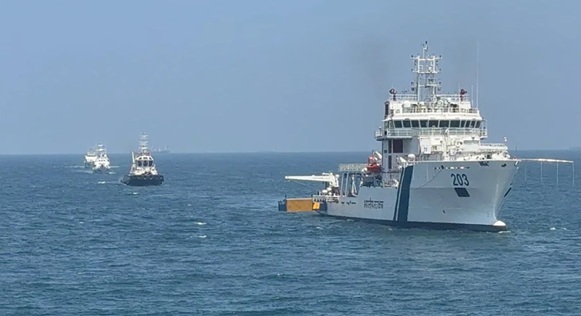
Considering the growing environmental threats looming over Kerala’s coastal ecosystem, the state government has taken a decisive step. Following two major ship accidents in 2025 — MSC Elsa 3 and MV Wan Hai 503 — Kerala is now on the verge of implementing a dedicated Oil Spill Contingency Plan (OSCP) to safeguard its maritime boundaries. Recently, the Kerala State Pollution Control Board (KSPCB) informed the National Green Tribunal (NGT) that the draft of this protective framework has been prepared.
Background of the Crisis: Why Was This Plan Necessary ?
Two separate maritime accidents in May and June 2025 exposed the vulnerability of Kerala’s 590-km-long coastline.
- MSC Elsa 3 Incident :
The vessel sank carrying 640 containers, including hazardous chemicals and calcium carbide.
- Environmental Damage :
These incidents led to the spread of large quantities of plastic pellets (nurdles) along the southern coast, threatening marine biodiversity and local livelihoods.
- Judicial Intervention :
The suo motu cognisance taken by the Principal Bench of the NGT compelled the administration to formulate a comprehensive remedial strategy.
Need for a State-Specific Policy
Kerala’s coastline lies extremely close to international oil transportation routes. Statistically :
- 9 out of Kerala’s 14 districts fall directly within oil-spill risk zones.
- The proposed plan will cover up to 12 nautical miles (24 km) from the coastline and extend 40 km inland through rivers.
- Massive oil tankers frequently visiting ports increase the possibility of maritime accidents.
- Although the idea of such a plan was proposed in 2016, technical and financial constraints delayed its finalisation until now.
About the Oil Spill Contingency Plan (OSCP)
The OSCP is not merely a document; it is a technical blueprint for rapid response during marine emergencies.
Key features include :
- Preparation of an Environmental Sensitivity Index (ESI) for the entire coastline to identify areas requiring priority protection.
- Measures for wildlife rescue, ship-level pollution control, and tactical booming to contain oil spills.
- Inclusion of emergency contact lists of machinery suppliers, equipment providers, and technical experts for immediate deployment during crises.
Effective Shoreline Response
The plan clearly defines the chain of command for coastal clean-up operations.
- Before initiating any clean-up activity, authorities will assess :
- the nature of the spilled oil, and
- on-site environmental conditions.
- The entire response mechanism will follow the national guidelines under NOS-DCP 2024.
Next Phase of the Plan
- The plan is currently in the draft stage and incorporates complex scientific aspects such as :
- hydrodynamic modelling, and
- marine sensitivity analysis.
- In the next stage, it will be reviewed by an expert committee and subsequently forwarded to the Indian Coast Guard for approval.
Once approved, Kerala will possess a strong institutional shield to protect its marine resources and coastal ecosystem from future maritime disasters.





 Contact Us
  New Batch : 9555124124/ 7428085757
  Tech Support : 9555124124/ 7428085757